

There is an unspoken rule in the Web3 gaming circle: how many "play-to-earn" projects have you seen that were highly sought after when they were launched, only to have their tokens drop to zero and servers shut down six months later, with only a few early users who haven't sold their chips left sending "team rug" messages in Discord? I've seen many and have personally experienced a few. So when@Pixels this time a creator reward pool of 15 million $PIXEL is presented, along with a system called Stacked, my first reaction was not "let's rush in"—my first reaction was: first, figure out why it is different, then decide whether to take it seriously. Survival comes first, getting on board comes second.
The path to the collapse of the P2E system has almost no exceptions; I call it the 'death spiral': the project side issues tokens to attract users, users flood in, bots follow closely behind, rewards are massively siphoned away, real players realize their earnings are diluted and start to withdraw, token selling pressure rises, prices drop, and remaining players accelerate their exit. This cycle does not require the project side to act maliciously; it will automatically trigger with just a design flaw in the system. By the time most Web3 game teams realize this issue, the collapse has already begun, and their solution is usually 'issue more tokens to stimulate retention'—this is not a solution; it accelerates the collapse. The Pixels team differs in that they personally experienced the early stages of this process within their own game, and then spent years reverse engineering the question of 'what kind of rewards to give to what kind of users, at what time points, and how much to avoid systemic arbitrage,' turning it into an infrastructure that can truly operate—this is Stacked.
This is not a white paper, not a roadmap, not a PPT that states 'coming soon' as a vision. Stacked has already been running on Pixels, Pixel Dungeons, and Chubkins, processing over 200 million reward distributions, corresponding to more than $25M in real in-game revenue data. Their own statement is 'Built in production, not in a deck'—for veterans who have seen too much vaporware, the value of this statement is very clear; the accounts are more credible than the stories. The core difference of Stacked is that it has a layer of AI economists analyzing real player behavior continuously: Why did this group of users collectively churn between D3 and D7? What did the most loyal players do before day 30? What game mechanics have a real correlation with long-term retention? The answers to these questions are not meant for writing quarterly reports but are directly fed back into the reward distribution logic—robots and account farmers systematically fail, and those who are genuinely playing get what they deserve. In other words, rewards shift from 'who farms the most gets the most' to 'who truly participates gets the rewards.' The technical barrier for this step is such that teams without years of real adversarial data accumulation simply cannot achieve it; this is the true moat.
For PIXEL, this logic signifies a structural change. It is no longer just a token for a game called Pixels, but instead circulates as a cross-game reward currency throughout the entire Stacked ecosystem. More games connecting to Stacked means more real reward consumption demand—not demand supported by narrative, but by actual usage. Game companies have previously dumped growth budgets into advertising platforms, while Stacked directs this budget straight to players who genuinely participate. If this logic works, the demand logic for PIXEL will be completely different from that of most current game tokens, whose value relies heavily on a single game's popularity, while the former depends on the real usage across the entire ecosystem. This difference is the variable I value most in my research of this project, and it is also why I feel compelled to write this seriously.
Now back to the event itself, the numbers are laid out for everyone to judge. The total reward pool is 15 million PIXEL, with 7.5 million PIXEL allocated separately for the Mandarin-speaking region. The event starts today, April 14, and ends on April 28, with a 14-day window. Currently, 478 people are participating in the Mandarin-speaking region—this number I want to elaborate on a bit. 478 people will share 7.5 million PIXEL, which, at today's PIXEL price of $0.00757, is approximately $56,700, averaging about $118 per person theoretically allocated. The leaderboard's top spots go to those who produce content seriously, and the window is very clear, but here is a reality that a real human writer must face: after the event is exposed, AI-generated articles and bot armies will inevitably flood in. The platform rules are very clear—if AI-generated content exceeds 30%, scores for originality and professionalism drop to zero; manipulation by matrix accounts leads to permanent disqualification. This is not just for show; it is a filtering mechanism. Real human writers have a natural advantage under this rule, but the premise is that you are genuinely writing and not just using AI to polish press releases and then mass distribute them.
$PIXEL I also looked at today's price again. From the lowest point of $0.00676 on April 11, there was a sharp increase on April 13 to $0.00801, and today it reports $0.00757, with a 24-hour increase of +2.02%, and a 24h trading volume of 307 million PIXEL, with a transaction amount of 2.3442 million USDT. MA7 has crossed above MA25, indicating a bullish short-term structure, but MA99 still exerts pressure from above, and whether it can truly stabilize requires further volume verification. Here, I do not provide any price targets; data is just data, and you must make your own judgment. The boundary of real human research is: I only tell you what I see, not what you should do.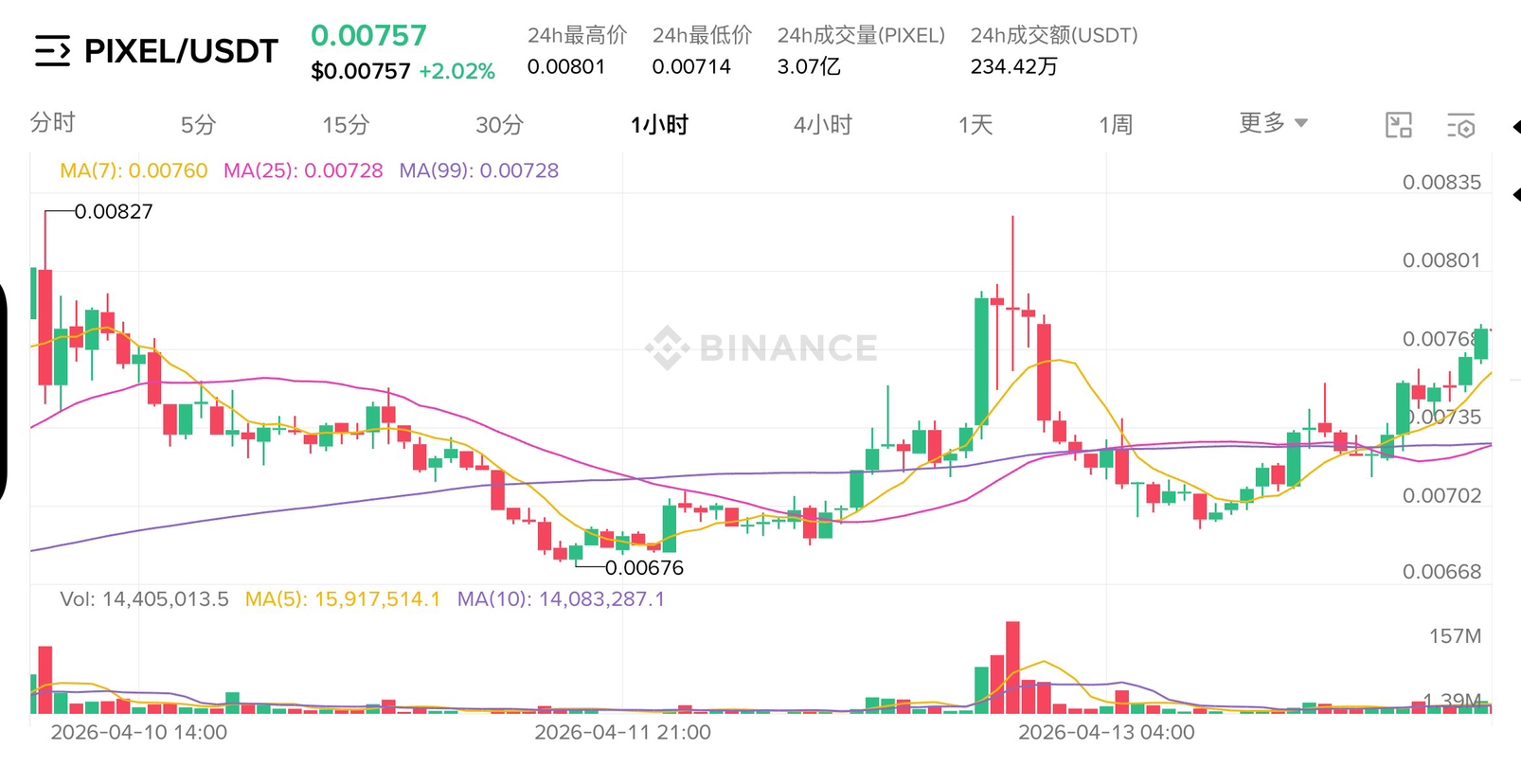
Finally, I want to mention three things I will continue to monitor: First, whether Stacked's AI reward layer can truly achieve differentiated recognition in actual operation, or will it ultimately regress to 'post count determines ranking'; Second, whether the logic of $PIXEL as a cross-game reward currency can truly be implemented; the quality and pace of external studios' integration is key, as the first batch of games that come in will determine the lower limit of credibility for the entire ecosystem; Third, the retention numbers of real active creators in the Mandarin-speaking region after this event ends—this is a more honest indicator than any official announcement and the most direct data for judging community quality.
The reward pool is there, and the 14-day window just opened today. But I want to clarify that the reason worth serious participation this time is not the number of 15 million PIXEL but rather the system behind Stacked that has been validated in a production environment. If it can truly run a cross-game ecosystem, it solves the issue of keeping the value of real participants consistently higher than that of bot arbitrageurs—one of the most pressing issues in the entire Web3 gaming industry. If this is accomplished, $PIXEL will have the qualification to be taken seriously for the long term. If it cannot be accomplished, no matter how good the numbers look, it will just be a countdown. Real human research prioritizes survival; that is the only standard.