
The Web3 gaming landscape is undergoing rapid change. We're moving past the initial excitement of "Play-to-Earn" toward a more sustainable and enjoyable ecosystem. The team at Pixels leads this transformation. After successfully growing their flagship game into a profitable, massive multiplayer online hit, they are now sharing the key technology behind its success.
This new chapter introduces "Stacked." For $PIXEL token holders and gamers in the expanding partner ecosystem, stacked marks a significant shift in how rewards are generated, shared, and valued. It's not just a minor update; it provides a solid infrastructure designed to address the main challenges facing decentralized gaming economies.
The Challenge of Play-to-Earn Sustainability
Before diving into Stacked, we need to understand the problem it seeks to resolve. The first wave of Play-to-Earn (P2E) games often depended on inflationary token systems. Early players earned large amounts of new tokens, which caused enormous selling pressure. Without a steady influx of new users or real value within the game, the worth of these tokens often dropped, making the games unsustainable.
Additionally, many reward systems were basic. Players earned rewards for repetitive tasks rather than for real skill or creativity. Studios had difficulty distinguishing between dedicated community members and opportunists who aimed to extract value before moving on to another project. The @Pixels team, having successfully navigated these issues and made their game profitable, recognized the need for an improved system that aligns the long-term interests of players, developers, and token holders.
What is Stacked? The Dual-Faced Ecosystem
Stacked is a complex platform with two related parts, serving as the universal reward layer for many games. Think of it as the administrative center and rewards engine supporting a network of interconnected games. Each "floor" represents a different game, but stacked ensures everything runs smoothly and rewards are consistently provided.
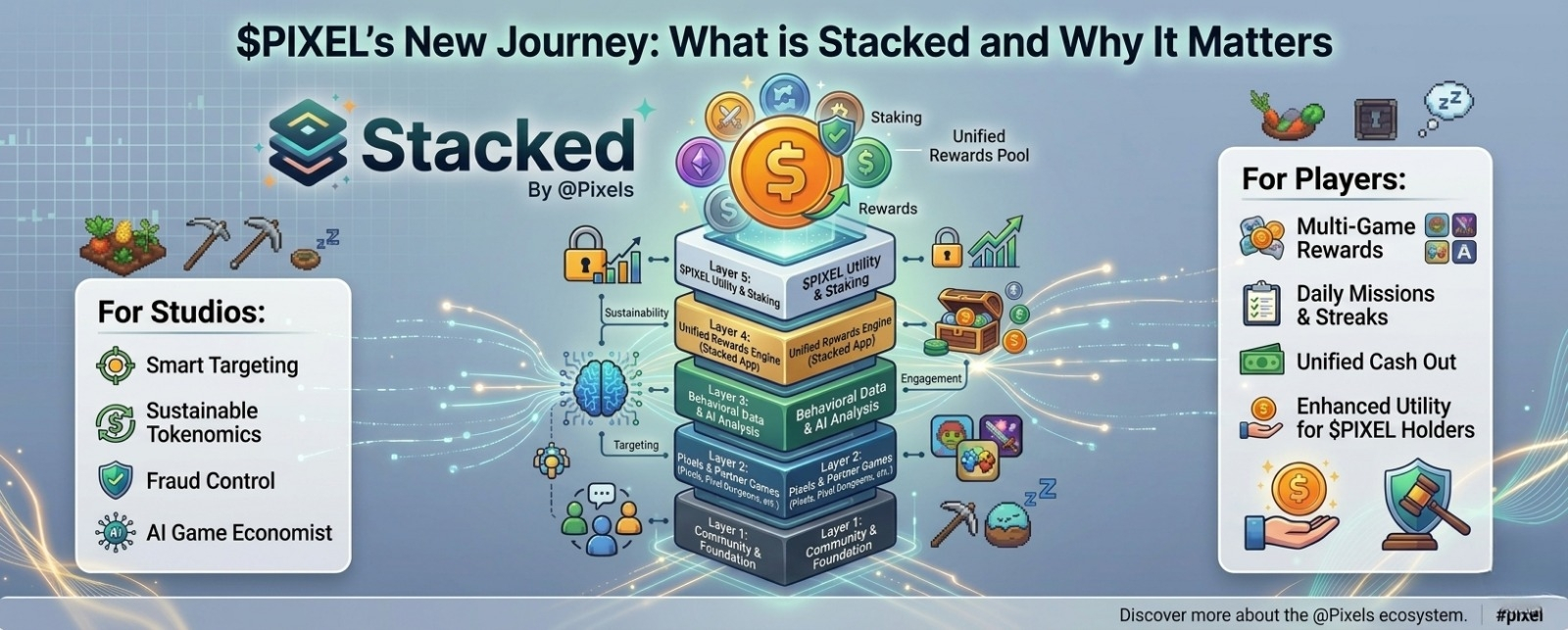
The foundation of Stacked is built on five key layers (as shown in our ecosystem map):
Layer 1: Community & Foundation, the essential base of any sustainable project.
Layer 2: Pixels & Partner Games, the games that use Stacked's SDK to enhance their LiveOps and rewards.
Layer 3: Behavioral Data & AI Analysis, a central hub that anonymizes and reviews player interactions to understand value creation.
Layer 4: Unified Rewards Engine (Stacked App), the player-facing interface that gathers tasks and rewards.
Layer 5: PIXEL Utiliy & Staking, the final layer for utility and governance.
For Players: A Rewarding, Unified Journey
For gamers, stacked simplifies the experience and makes it enjoyable. It acts as a single app where you can manage your progress across multiple games.
Multi-Game Rewards: You aren’t limited to a single game’s economy anymore. Players can take on missions and build streaks in various games, collecting different rewards—including Pixel and partner tokens—into one wallet.
Engagement-Based Missions: Instead of repetitive grinding, stacked lets studios assign tasks based on your play style. This might include returning to your farm, completing a dungeon with friends, or trying a new partner game. Focusing on genuine engagement makes the gameplay more meaningful.
Unified Cash Out: When you're ready, stacked offers a straightforward way to convert or cash out your hard-earned rewards across the entire network. It simplifies the management of multiple game assets.
For Studios: The Brain of Reward-Driven LiveOps
The true power of Stacked comes from what happens behind the scenes for game studios. It's the system pixel wished for from the start—a smart LiveOps engine built and tested in real time.
Smart Targeting: Instead of using one-size-fits-all reward systems, studios can now query player behavioral data to segment their audience. They can create personalized offers for loyal players, re-engage those who haven’t spent recently, or target specific groups with unique challenges.
AI Game Economist: This is one of the most exciting features. Stacked includes an AI component that can generate reports, identify important player groups, and recommend reward strategies based on actual results, like improved retention or revenue. It acts as a virtual data science team, enabling developers to make smarter economic choices.
Fraud Control: Creating a safe and fair environment is essential. Stacked includes advanced tools to track and prevent bot activity, multi-accounting, and economic abuse, ensuring the ecosystem remains intact for legitimate players.
The Role of $PIXEL: The Core of Governance and Utility
The token pixel is central to this new, Stacked-powered economy. While it is still a premium in-game currency, its use is greatly expanding.
Pixel utility now spans the entire network of partner games, becoming the main method for accessing special features, unlocking unique assets, and participating in the larger economy. The sustainability of this model is crucial: Stacked ensures that rewards are based on real game revenues and player engagement, creating a healthy feedback loop.
Moreover, a new staking mechanism is being introduced. $PIXEL holders will be able to lock their tokens to earn rewards and gain voting rights. This means that community members will Pixel have a direct say in the future direction of the ecosystem and the operation of the Stacked platform.
Conclusion: $PIXEL's New Beginning
$PIXEL's journey is moving into a more mature and powerful phase. With Stacked, is not Pixel just creating a game; they are building the framework for the next generation of sustainable Web3 gaming. It is an ecosystem grounded in data, intelligence, and a true commitment to rewarding real community involvement.
The future includes new partner game integrations, upgraded AI models, and exciting new ways for $PIXEL holders to engage. To stay updated with the latest news, detailed guides, and community discussions, be sure to follow the official @Pixels profile here on Binance Square.
Disclaimer: "This is not investment advice. Please DYOR (Do Your Own Research).
