
The first time I saw Pixels, it gave me a strange feeling because it wasn't that kind of project that shouts, "look at me, here’s the money." Rather, it gave me the impression that it wanted to try something quieter: whether a simple, repeatable, and somewhat calm experience can be worth more than an explosion of incentives at the beginning. 🏴☠️ And honestly, that seems much more interesting to me than most of the models I've seen in Web3. Because one thing is to attract people with noise, and another very different thing is to get people to come back without having to push them with a reward every two minutes.
That was the first thing that started catching my attention. In almost every game project I've seen, the incentive hits so strong and so fast that it kills the relationship. People come in, squeeze out what they can, and bounce. In other words, they don't build an experience; they build a race for the prize. Pixels seems to be going in a different direction. It doesn't try to buy your attention with a shower of tokens from the get-go. What it does, at least from my reading, is ask for something a bit rarer: presence. That you come back. That you move around. That you do small things. That you get into a routine that doesn't always seem spectacular, but in the end, it makes more sense than an inflated reward.

And then an idea clicked for me that hardly anyone mentions when talking about Web3 games: the real value isn't always in the token 🚾, but in the time people are willing to invest in the system. Because if the game only exists while the incentive is high, then the game isn't worth much. But if it manages to keep people around for the experience, for the feeling of progress, for the habit of coming back, then you're no longer solely dependent on the prize. You're dependent on the system having something that people want to inhabit. To me, that's a huge difference. A token can attract. A habit can sustain. The weirdest thing about Pixels is that it feels like it's trying to turn repetition into value without making repetition look ugly. That's not easy, because normally when a game starts leaning on routine, it becomes a drag. But here the point seems to be different: making that routine feel smooth, almost natural, and getting the player to understand that not everything has to be instant to be useful. I like that logic because in Web3 we’re way too used to projects that promise too much right off the bat and then end up empty. Pixels seems more patient. And in this space, patience is already a rare advantage.
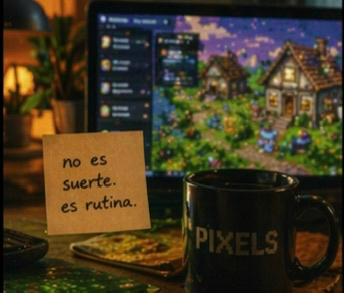
There's something crucial that stands out to me: the game doesn't just reward action; it rewards persistence. And that totally shifts how one interprets the system. Because when persistence holds value, the user stops being just an incentive hunter and starts becoming part of the ecosystem. That's way harder to replicate than an AirDrop. 🚀 Way tougher to inflate. Harder to sell as smoke. And that's why I think Pixels can hit harder than it seems, if it manages to maintain that line without losing the simplicity that makes it unique. Not because it's a revolutionary idea on the surface, but because in a market filled with noise, understanding that sticking around also has value is already pretty rare. In my opinion, that's the part that grabs my attention the most. Pixels doesn't need to feel like a lottery to work. It can feel like a place where time adds up ➕, where routine doesn't kill the experience, and where the player isn't racing after an empty promise but building presence within something that still has room to grow. And that, bro, is exactly the kind of angle that a lot of folks overlook, but it could end up getting more views because it feels more real. @Pixels #pixel $PIXEL
