
I’ve seen a lot of play-to-earn projects come and go.
At first, they all feel exciting and easy rewards, quick growth, big hype.
Then the same thing happens.
People figure out how to farm the system. Bots show up. Rewards lose value. Real players slowly disappear.
So when I look at @pixels, I don’t see hype anymore. I try to see what they did differently.
And honestly, the biggest difference is that they didn’t pretend the problem didn’t exist.
They went through it… and then built around it.
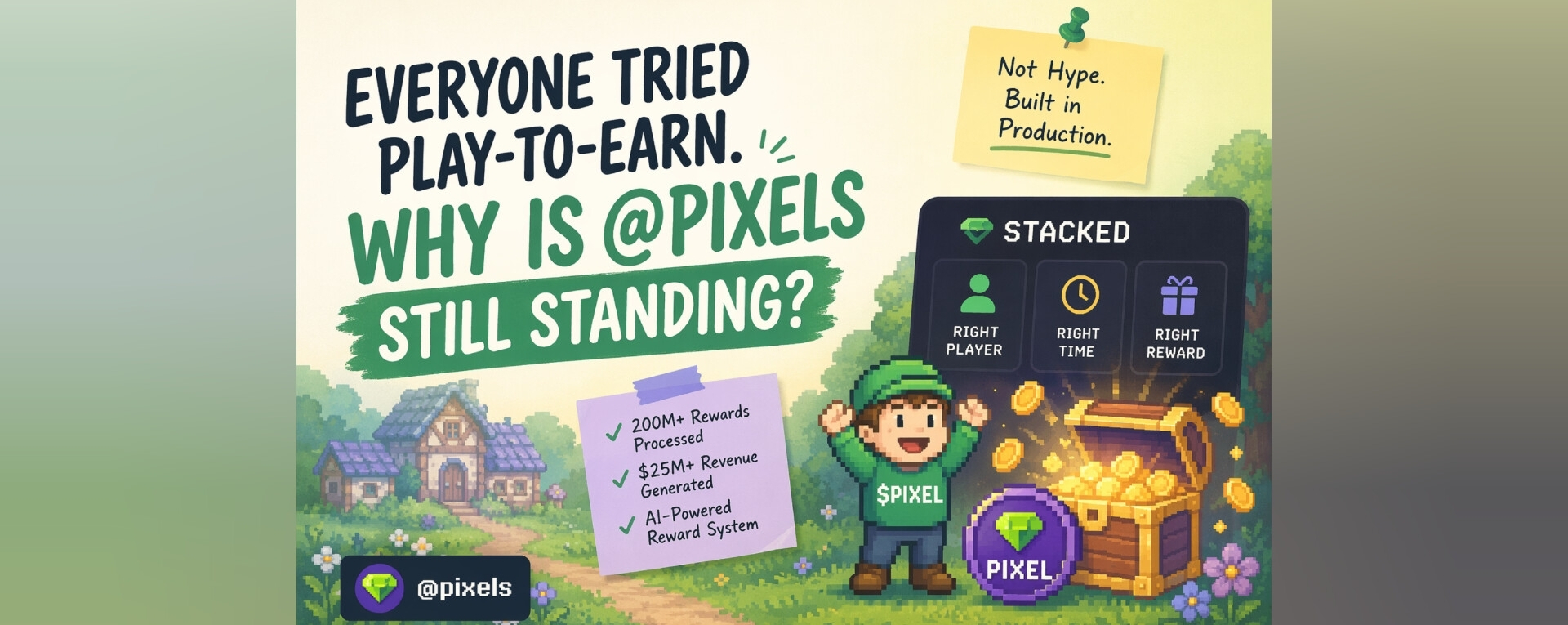
That’s where Stacked comes in.
It’s not just a rewards app. It feels more like a system that tries to answer one simple question:
who should actually be rewarded, and when?
Because giving rewards is easy.
Giving them in a way that keeps a game alive is the hard part.
From what I understand, Stacked focuses on actual player behavior.
Not just activity… but meaningful activity.
Like:
Who keeps coming back after a few days?
Who is about to quit?
What kind of players actually add value to the game?
And then rewards are used in a more controlled way not just thrown at everyone.
That alone fixes a big part of what usually breaks these systems.
Another thing I find interesting is that this isn’t just an idea they’re trying to test.
It’s already been used inside the Pixels ecosystem.
So it’s coming from experience, not assumptions.
And that matters a lot in this space, because we’ve seen how many “whitepaper ideas” never really work in real conditions.
Now the part that connects all of this is $PIXEL.
Before, it felt like just a game token.
Now it looks like it’s slowly becoming something bigger.
If this reward system expands to more games, then $PIXEL isn’t limited to one ecosystem anymore.
It becomes part of a wider network.
More games → more usage → more demand over time.
Also, there’s another angle that people don’t talk about much.
Game studios already spend huge amounts on ads just to bring users in.
Most of that money goes to platforms, not players.
If even a part of that budget gets redirected into rewards for real users,
that changes the whole dynamic.
Players get value.
Games get better retention.
And the system becomes more measurable.
I’m not saying this guarantees success.
But compared to most projects, this feels more thought through.
Less about hype, more about fixing a real problem.
That’s why I’m keeping an eye on @Pixels
Not because it’s loud…
but because it’s quietly building something that might actually last.