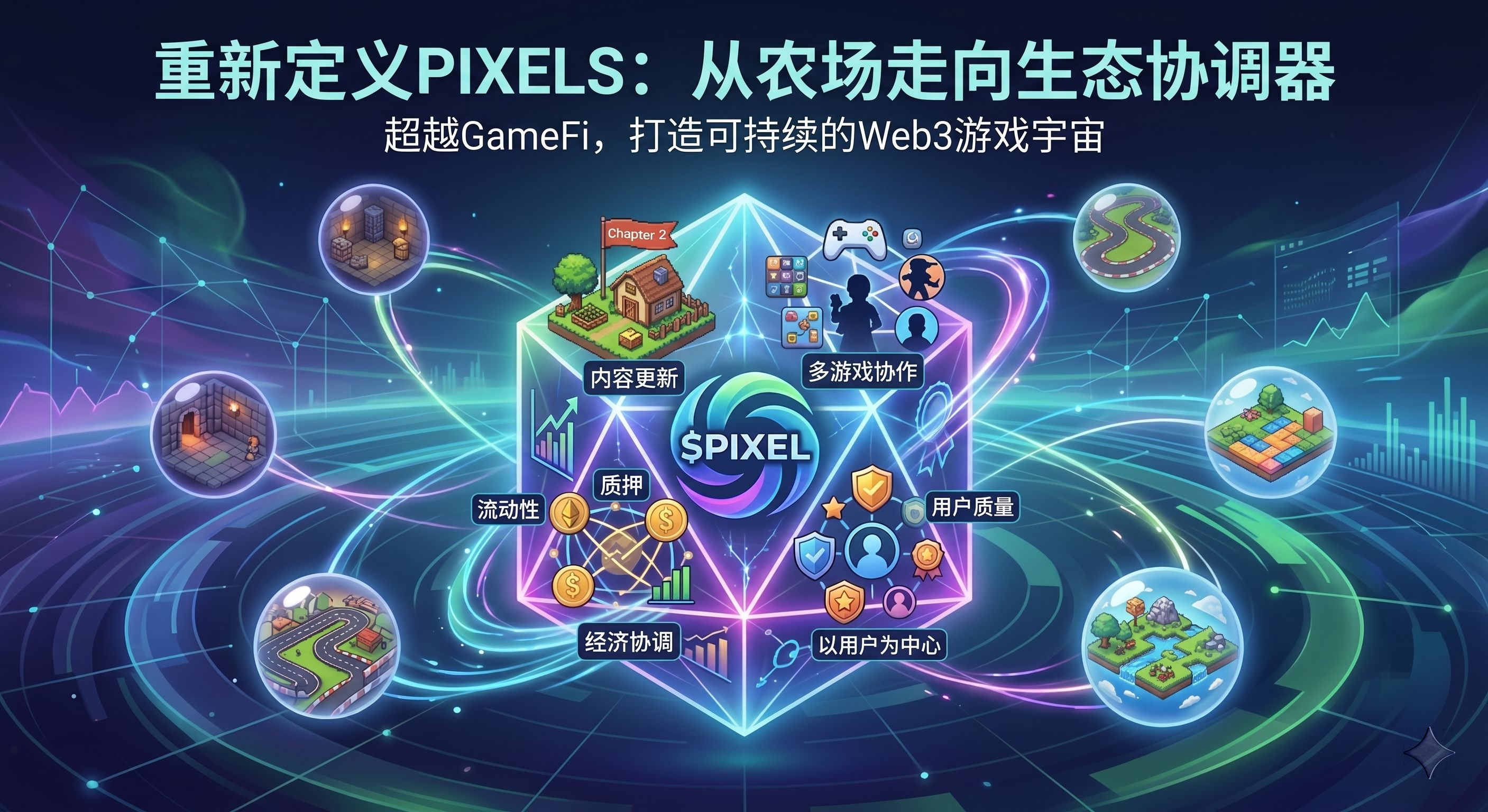
In the past few days, many people have been talking about Pixels. The first reaction is still "old-school chain games", "farming projects", "nostalgia coins", but I feel this understanding is a bit outdated. What is truly worth revisiting is not whether it has become popular again due to events, but rather what direction it is currently heading towards. After reorganizing my thoughts, the conclusion is very clear: Pixels is no longer just a GameFi relying on farming cycles to maintain its popularity; it is pushing itself towards the direction of "continuous content updates + multi-game interactions + coordinated economic ecosystem", and the role that $PIXEL plays in this is clearly no longer just a simple game reward token.

Many GameFi projects encounter the same problem as they progress: the lifespan of the game cannot keep up with the lifespan of the token. When a project is just gaining popularity, everyone focuses on returns, airdrops, and token prices; once the main loop fatigues, users start to flow away, and tokens lose their anchor as well. What makes me feel different about Pixels this time is that it has not continued to package itself as 'a chain game that gives out more rewards', but is continuously reshaping the content layer and economic layer. The official website is not currently promoting a slogan like 'Play to Earn', but a combination of Chapter 2, staking, pets, and bi-weekly updates. This signal is very important because it indicates that the team is selling not a one-time heat but a worldview that operates continuously and new content that is continuously launched.
When I look at PIXEL now, the biggest change is that it is increasingly resembling an 'ecological coordinating asset'. In the past, many people understood game tokens as either consumables or speculative products. But the third answer that Pixels provides now is more interesting: it wants to make PIXEL a connector between different games, different gameplay, and different user layers. The official staking mechanism is no longer simply locking coins there waiting for returns, but allows support for different game projects. What is this action essentially doing? It is transforming tokens from being 'vouchers for single products' into 'tools for capital flow throughout the entire ecosystem'. Which gameplay is more attractive, which project can retain people better, and which sub-game is more worthy of support, PIXEL will ultimately participate in this distribution process.
Why is this important? Because the single-game ceiling is a hurdle that most chain games cannot bypass. As long as a project remains at the level of 'is my game fun enough', its upper limit is very clear: once the novelty wears off, the narrative will thin out, and it will be difficult for the token price to maintain new value support. However, if the project begins to move towards being a platform, the situation changes. The platform logic is not about betting that one gameplay will always be popular, but rather about enabling as many gameplay options as possible to share the same batch of users, the same asset system, the same liquidity, and the same token hub. In this way, even if a certain gameplay loses popularity, the entire ecosystem may not necessarily cool down. For me, this is the most worthwhile aspect of PIXEL right now.
Another point that is underestimated by many is that Pixels is increasingly attentive to 'user quality'. Many projects verbally oppose witch hunts, studios, and pure bots, but the mechanisms they create often end up being very rigid in words and soft economically. Pixels has now truly connected Reputation, Farmer Fee, gameplay permissions, transaction and withdrawal restrictions, which makes a difference. To put it bluntly, it's not just about identifying who the real players are, but setting different friction costs for users of varying quality. High-quality, long-term participants with more complete social relationships and deeper asset bindings face lower ecological friction; while pure exploiters, pure bots, and short-term profit accounts incur higher costs. This design may not be perfect, but the idea is very sound, as it for the first time provides a clearer pricing for 'real participation' at the economic level.
This also explains why Pixels has never let go of elements like Land, VIP, Pets, guilds, and Live Ops. Many people feel that these are just content fillers or stacked modules, but in my view, they are more like the infrastructure of the Reputation system. What you own, how much you have spent, whether you are long-term online, whether you have completed tasks, and whether you have participated in social and guild activities—these behaviors have been disconnected in many chain games in the past; now Pixels is attempting to consolidate them into a unified user profile. As long as this profile continues to move forward, the project's barrier is not just about 'how many players there are', but 'how many high-quality and retained users there are'. For any chain game, the latter is worth much more than the former.
Looking at the content side, the significance of Chapter 2 is not just about new maps and new mechanics. The truly important thing is that it makes the market realize again: Pixels is not stuck in the old version logic repeatedly drawing old users, but is still pushing forward world expansion and gameplay reorganization. Adding pets, continuous activities, and bi-weekly updates to this rhythm, the project's focus is already very clear—it's not about creating a wave of buzz and then going quiet, but about bringing users back to a continuously changing world. For Web3 games, this sense of rhythm is very critical. Because tokens can create emotions in the short term, but only the frequency of content updates can create retention.
I also particularly care about one point: Pixels has long been beyond just wanting to do a piece of land or a few fields. It has repeatedly emphasized openness, interoperability, and allowing other projects to continue building on this infrastructure in its early documentation. Now, with gameplay like Pixel Dungeons being incorporated into $PIXEL ecology, this line is becoming clearer. This means that what decides PIXEL's imagination in the future may not just be the main game itself, but whether 'the Pixels system' can grow into a lightweight, multi-play, unified economic entry micro-game universe. As long as this direction continues to be validated, the market's perception will slowly change: from 'chain game tokens' to 'ecological platform assets'.
So when I look at @Pixels , I won't just focus on short-term trends, nor will I only see if this round of activities can push the popularity a bit higher. I am more concerned about four things: First, can the content updates after Chapter 2 continue to connect? Second, will staking continuously introduce new ecological games? Third, can the Reputation mechanism genuinely create a gap between user quality and economic returns? Fourth, can $PIXEL stay more within the ecological internal cycle, rather than just being played around in exchanges? The first two determine content ceilings, while the latter two determine token quality. As long as two or three of these four matters continue to be fulfilled, Pixels' journey is not over yet.
In this round, many people will interpret the warming of Pixels as part of a unified rebound in GameFi, but I don't entirely see it that way. It will certainly be influenced by the sentiment of the sector, but what it really wants to prove now is no longer whether 'players can earn a little from the game', but whether 'a blockchain game world can truly retain users through content, identity, social interaction, and multi-game structures, making tokens the coordinator of this world'. If this proposition holds, the story of PIXEL will not just stop at farming, nor will it stop at the popularity of activities, but it will turn into a bigger question: can a game ecosystem with sustained content production ability emerge from Ronin? What I value most about Pixels now is not a short-term explosion, but that it is increasingly resembling a system, rather than a single product.