
The situation in the Middle East has taken a significant step forward last night.
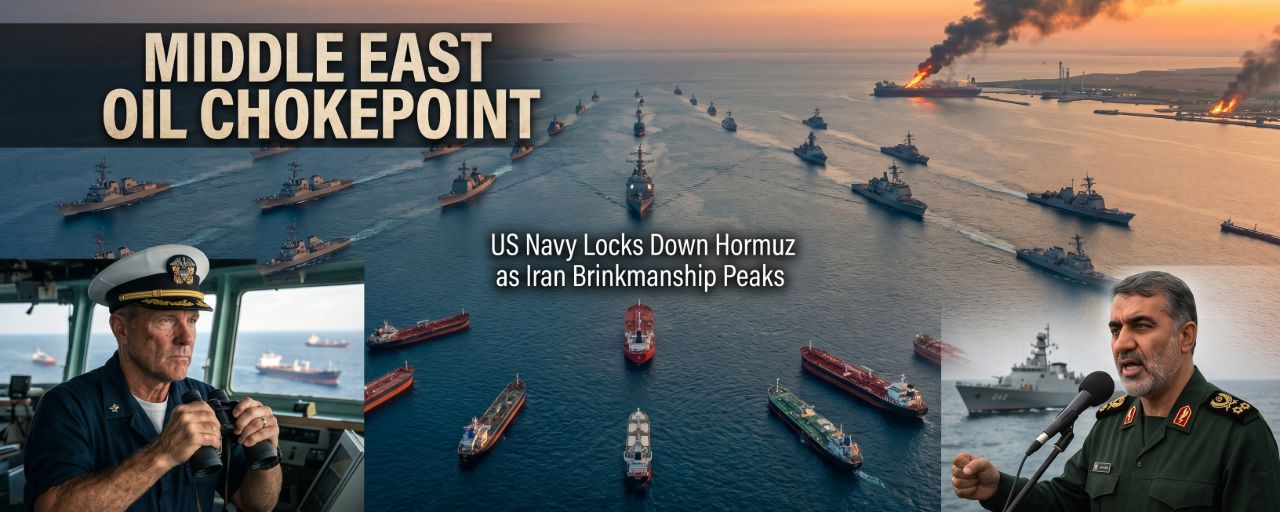
On April 14, one of the scenarios that the market is most concerned about is gradually unfolding: the U.S. maritime blockade against Iran officially took effect last night local time.
Currently available information shows that more than 15 warships have been deployed, and the U.S. military has also begun intercepting vessels entering and exiting the Strait of Hormuz. Trump has taken a very hard stance, directly claiming that 158 Iranian naval ships have been destroyed, and has warned that any 'fast attack boats' attempting to approach the blockade area will be immediately eliminated.
The key to this matter is not just verbal threats, but that the Strait of Hormuz, a global energy lifeline, is beginning to lose stability again. Shipping data has already provided feedback, with a large number of oil tankers starting to reroute. The already extremely fragile efficiency of the strait is once again interrupted. Meanwhile, the International Energy Agency has also confirmed that the conflict has resulted in damage to more than 80 oil and gas facilities in Iran. This means that the conflict is no longer just a military confrontation but is beginning to have a real impact on energy supply, shipping costs, and the pricing of global risk assets.
Iran has not retreated either.
Iran's acting defense minister has announced that the armed forces have entered the highest level of alert; the Islamic Revolutionary Guard Corps has also sent out a stronger signal, stating that if the conflict continues to escalate, they will employ 'new operational methods.' It is also worth noting that the Iranian military is not just countering verbally but has directly proposed to establish a so-called 'permanent mechanism to control the Strait of Hormuz.'
This statement carries significant weight. Because this is no longer a short-term deterrent, but rather sending a signal to the outside world: if the security pattern of the Persian Gulf and Oman ports is broken, Iran will consider pulling the entire region's shipping security into uncertainty.
The Iranian side's original words are also very direct - if the safety of relevant ports is threatened, then the safety of all regional ports will either 'belong to everyone or belong to no one.'
In other words, this is no longer a single-point conflict but a typical escalation of navigational safety games.
And regarding Trump's high-profile declaration of a blockade, the spokesman for Iran's Supreme National Security Council characterized it as: bluffing.
But the market knows that the most dangerous aspect of geopolitical situations is often not when verbal attacks are the fiercest, but when both sides are unwilling to back down while still keeping a window for continued talks. Because this stage is when misjudgments are most likely to occur, and it is also when localized friction can escalate into systemic risk.
The current situation is: the front line is heating up, and negotiations have not stopped.
Officials from the U.S. and Iran have confirmed that contacts are continuing, with the current largest disagreement focused on the duration of uranium enrichment suspension. The U.S. side wants 20 years, while Iran is clearly only willing to accept a shorter period. Russian media have also reported that the next round of negotiations may take place on the 16th in Islamabad, Pakistan, and the Pakistani Defense Minister has also stated that the prospect of restarting negotiations still exists.
Meanwhile, Iranian Foreign Minister Amir-Abdollahian has spoken with Russian Foreign Minister Lavrov to coordinate on the latest situation. Another detail worth pondering for the market: the Iranian vice president revealed that Iran had prepared to dilute 450 kilograms of enriched uranium to show goodwill.
What does this action indicate? It shows that at least at some stage, Iran has not completely left negotiating chips on the table. The problem is that the current battlefield and blockade rhythm have clearly outpaced the diplomatic rhythm; the window for negotiations is still open, but it is being rapidly compressed by the front line's tensions.
More troubling is that there is not just one front.
In the direction of Lebanon, Israeli airstrikes on southern Lebanon continue, resulting in at least 7 deaths. The Israeli military has also announced an expansion of military operations, claiming to have killed hundreds of Hezbollah militants, aiming to establish a deeper security buffer zone.
The statement from the Israeli Prime Minister is also very sensitive - he publicly stated that the ceasefire with Iran 'may soon end' and clearly supports Trump's maritime blockade against Iran.
What does this mean? It means that the market originally hoped for 'localized conflicts to be locally digested,' but now it seems that Israel, Iran, the United States, and southern Lebanon are increasingly intertwined.
Hezbollah continues to respond strongly, with leaders clearly stating: they will not disarm and will continue to resist.
However, the Lebanese government is attempting to cool the situation. The Lebanese Foreign Minister stated that direct negotiations between Lebanon and Israel have been confirmed, and that the Lebanese issue and the Iranian issue are independent, with both lines progressing in parallel. This is actually telling the outside world that Beirut does not wish to be completely drawn into a broader regional confrontation.
But the problem is also very realistic: politically, it can be said that there are two parallel tracks, but militarily, it may not be so cleanly separated.
So if we summarize the current situation in one sentence, it is:
Maritime blockades are rewriting expectations for energy transport. Iran is on high military alert while diplomatically keeping the door ajar, and Israel continues to apply pressure on the northern front. On the surface, everyone has not yet played their final card, but in reality, the entire Middle East has re-entered a dangerous zone of 'high misjudgment, high volatility, and high spillover.'
For the market, the next core observation point is not the war of words itself, but three things:
First, will the blockade and rerouting of the Strait of Hormuz continue to expand? As long as shipping costs and time continue to rise, oil prices and risk aversion sentiment will be difficult to truly decrease.
Second, will the negotiations around the 16th really materialize? As long as the dialogue mechanism is still in place, the market will retain a glimmer of 'crisis controllable' pricing; once talks collapse, risk premiums may rise again.
Third, will southern Lebanon become a new flashpoint for escalation? If the northern front further expands its gains or casualty scale, the entire situation might shift from 'multi-point tension' to 'linkage loss of control.'
In short, what is most concerning right now is not a single battle report, but the lines of blockade, shipping, energy, negotiations, and northern front conflict are forming a resonance.
This is also why the global market's sensitivity to news from the Middle East has obviously increased recently. Because everyone understands that once the variable of the Strait of Hormuz is out of control again, the impact will not only be on crude oil but also on the entire global risk appetite system.

