
The peace plan already exists. The problem is that no one believes it can last.
There is a question that almost no one is asking: what if Iran and the U.S. could actually come to an agreement?
Not a peace agreement, not a nuclear framework, not a grand strategic reorganization — just a basic ceasefire agreement that can truly last. A piece of paper with two signatures that won't be torn up six months later.
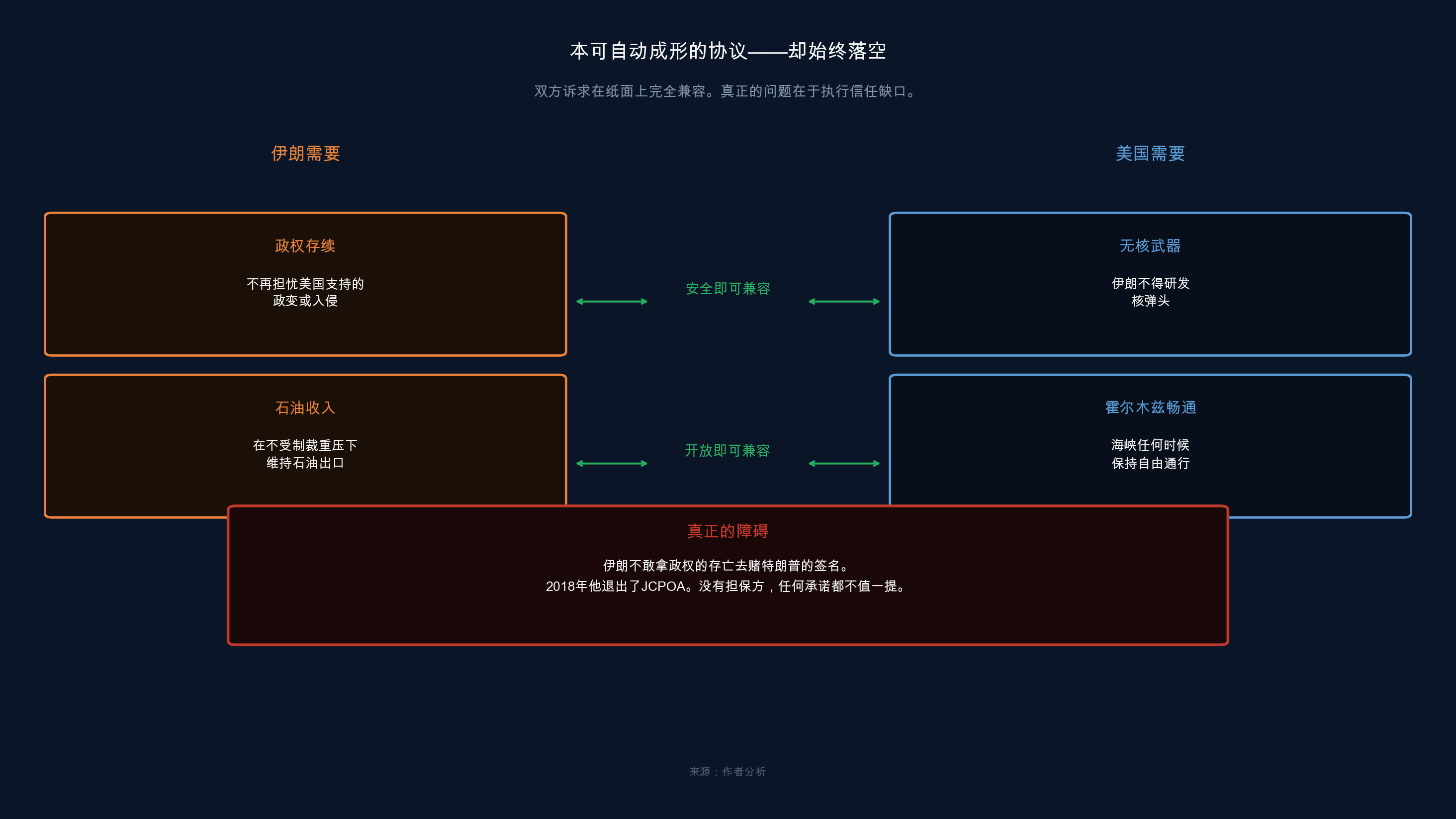
Because there is an unsettling fact here: the things both sides truly need are not as far apart as the headlines suggest. Iran's Islamic Revolutionary Guard Corps — the ones who actually control Tehran's foreign policy — only need two things. They need to continue exporting oil to make money. They need to no longer worry about the U.S. invading and overthrowing the regime. That's it. All the nuclear enrichment, all the proxy militias, all the anti-American rhetoric — are products of these two core fears.
Washington's list is equally brief. The US needs Iran to not possess nuclear weapons aimed at Israel or anyone else. It needs the Strait of Hormuz to remain open. That's all.
If you place these four demands side by side, you'll notice something strange: they aren't actually contradictory. If Iran is no longer afraid of invasion, it won't need nuclear weapons. If Iran keeps the Straits open, the US won't need regime change. On paper, this agreement could almost be drafted automatically.
Why is there no agreement?
The man who shouted "Deal!"
The answer begins in 2015. The Obama team spent years negotiating the Iran nuclear deal—a deal that, however flawed, was a working agreement. Iran suspended enrichment. Monitors were granted access. Sanctions were partially lifted. The framework worked.
Then Trump tore it apart. Not because Iran violated it, but because Trump wanted to.
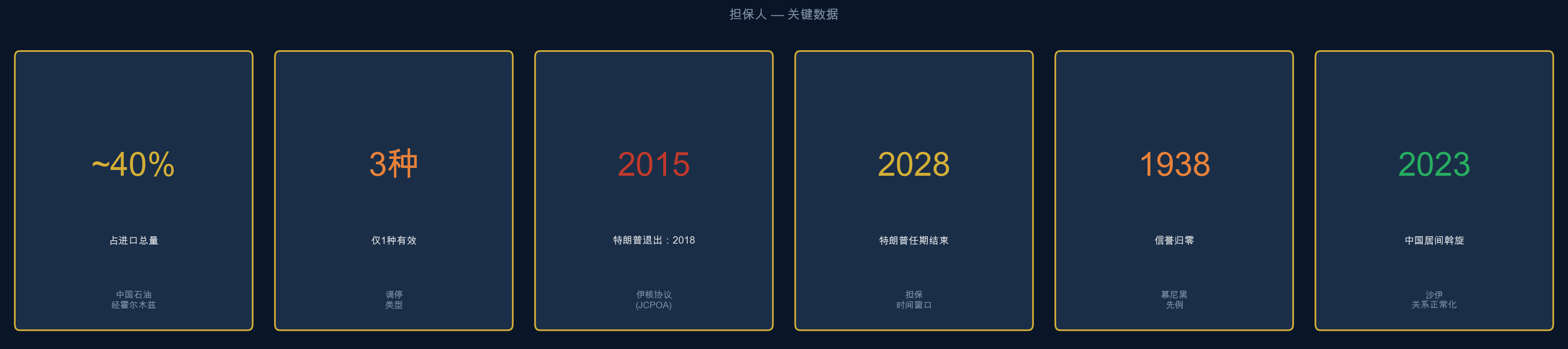
In 2018, he withdrew the US from the agreement and reimposed maximum pressure sanctions, effectively telling Iran, "What you sign on paper means nothing to us." This message was received. When Trump returns to the White House in 2025 to discuss a new agreement, Tehran's response will be roughly equivalent to the diplomatic language: "Of course, come back to me when you've got God as your judge."
This is a matter of credibility. And it's not a small one.
History offers an enlightening analogy. In 1938, the leaders of Britain and France signed the Munich Agreement, allowing Hitler to annex the Sudetenland in exchange for a promise not to make further territorial claims. Six months later, German tanks rolled into the rest of Czechoslovakia. The appeasers in London and Paris lost all political credibility overnight. The lesson—which has been remembered by everyone who has seriously studied international relations since—is that the success of an agreement depends on the credibility of the signatories.
"To put it mildly, Trump's diplomatic credibility is no better than Hitler's in 1938."
He withdrew from the Iran nuclear deal. He renegotiated NAFTA, then threatened to withdraw from the alternative. He threatened to impose tariffs on allies, then withdrew them, then reimposed them. Every one of his diplomatic adversaries operates on the same basic assumption: what Trump signs today, he may withdraw tomorrow.
Therefore, Iran's position is rational. It is not that it refuses to negotiate, but that it refuses to gamble the life and death of its regime on the promises of a documented habitual breacher of agreements.
Three types of mediation, one of which is effective.
When the two parties cannot trust each other enough to establish an agreement, the classic solution is to introduce a third party. However, not all third parties are equal. There are three forms of mediation.
Neutral mediation requires a third party with no stake in the outcome and who is trusted by both sides. Think of Switzerland during the Cold War, or the secret channels Oman used for communication between the US and Iran. The problem today is: every credible neutral mediator has been compromised. The EU lost its neutrality after the Russia-Ukraine war. India is trying, but lacks the influence to implement any agreement. The UN Security Council is paralyzed. There is no credible person sitting in the middle.
Pressure-based mediation operates differently—a powerful third party pressures one party to force them to accept an agreement. A classic example is 1895, when Russia, France, and Germany forced Japan to return the Liaodong Peninsula after their victory in the First Sino-Japanese War. The three powers directly told Japan, "Return it, or we will deal with you together." Japan complied. In the current crisis, the Gulf states—Saudi Arabia and the UAE—could theoretically issue a joint ultimatum to Iran. They have leverage. But Iran has the capability to attack desalination plants and oil infrastructure throughout the Gulf. This is a threat that both sides would rather not test. Pressure-based mediation requires someone to be willing to take real risks, and no one does so voluntarily.
Guarantee mediation is the third option—and the most complex and sophisticated. Here, a third party not only mediates the agreement but also formally endorses it. It states, "If Party A breaches this agreement, we will intervene on behalf of Party B." This transforms the agreement from a piece of paper into an insurance policy. The guarantor's own credibility is now at stake, significantly increasing the cost of betrayal for everyone involved.
This is precisely the mechanism Trump himself attempted to establish in the Russia-Ukraine conflict—positioning the US as a guarantor to prevent further Russian advances. This mechanism is not unfamiliar. The question is who can play this role in the Iran scenario.
It's not Europe, not the United Nations, not India.
Russia could theoretically do it. But Russia is currently benefiting immensely from the high oil prices triggered by the Hormuz crisis. Moscow has little incentive to help resolve a conflict that is enriching its treasury. Putin is happy to sit in his villa and watch others scramble to make a move.
That leaves only China.
Beijing's Impossible Proposal
China is the only country on Earth today that meets all three criteria for an effective guarantor: it has a profound strategic interest in resolving the crisis, it has leverage on both sides, and it possesses—at least—the credit that Washington has squandered in Tehran.
First, consider the strategic interests. Approximately 40% of China's oil imports pass through the Strait of Hormuz. A prolonged blockade would not only raise fuel prices; it would threaten industrial supply chains, exacerbate inflation, and risk triggering social unrest. For Beijing, the Hormuz crisis is not an abstract geopolitical concept—it is a direct threat to the implicit pact between the CCP and the Chinese people: the government provides economic stability, and the people provide political loyalty.
Now consider the leverage. China is Iran's largest trading partner and one of its few lifelines under sanctions. Beijing buys Iranian oil at discounted prices and invests heavily in Iranian infrastructure. Tehran cannot afford to offend Beijing. China can also offer Iran something no one else can: a concrete security guarantee backed by military credibility and the veto power of a permanent member of the UN Security Council.
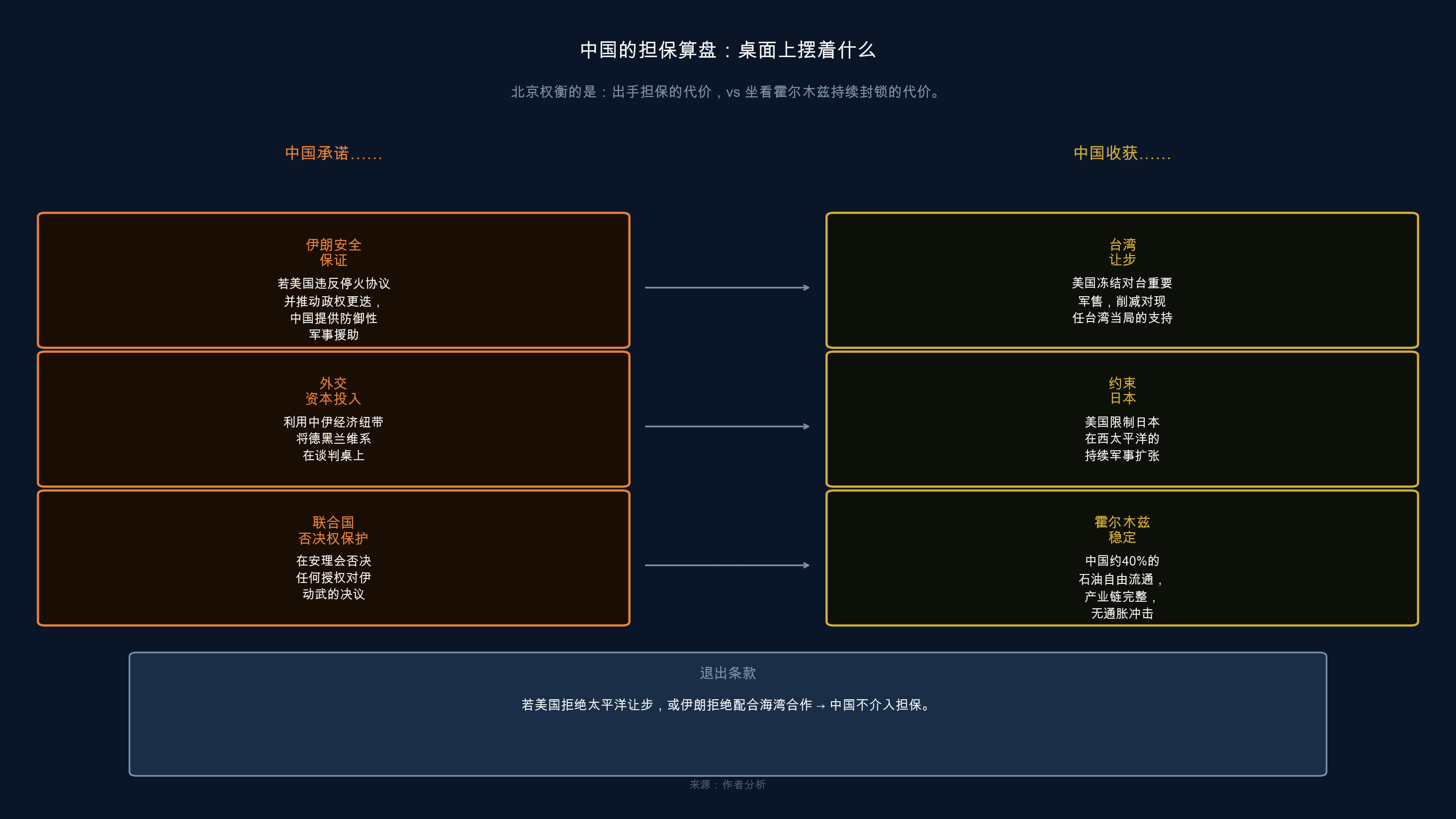
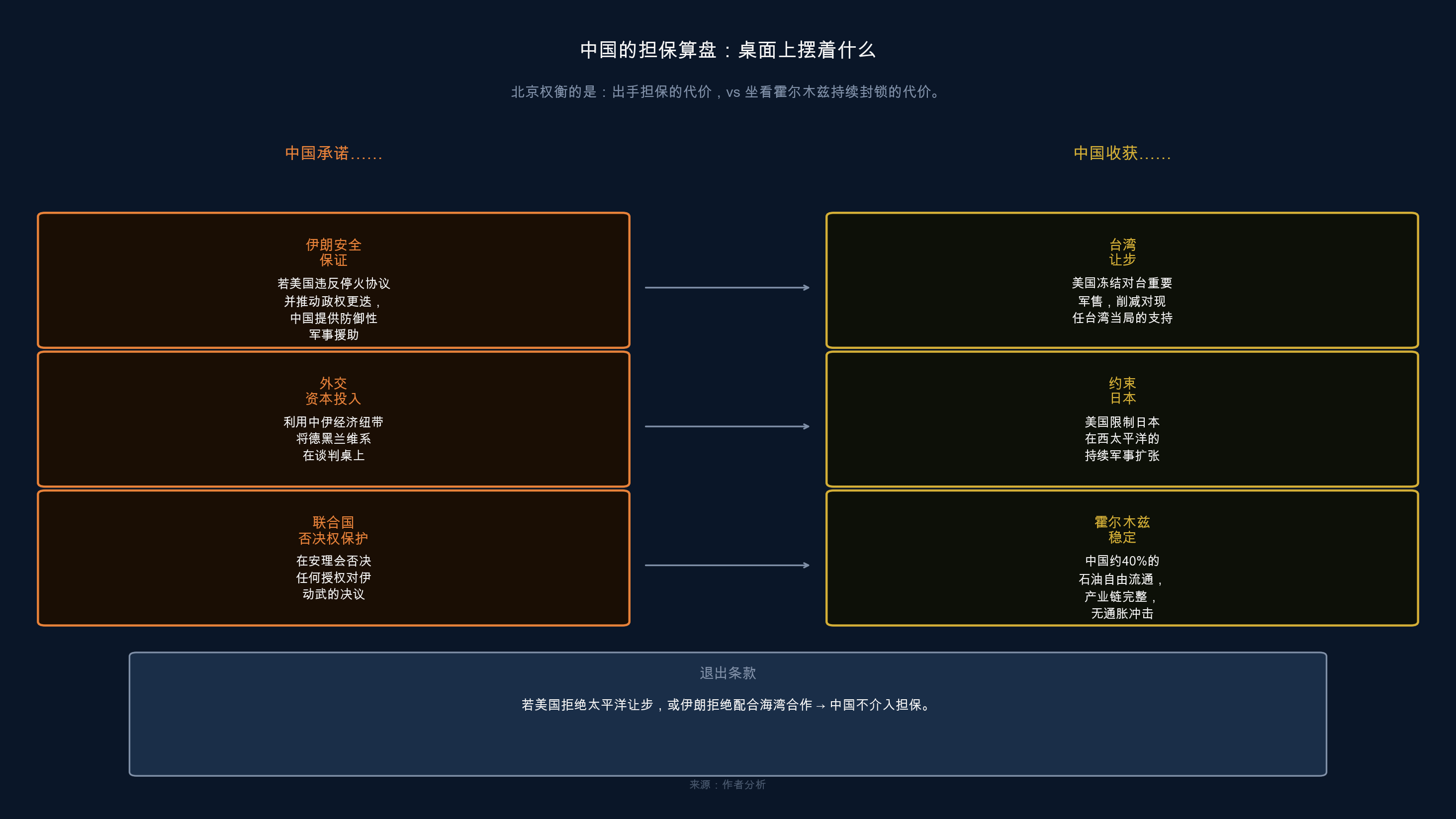
The assurance Beijing can offer Tehran is straightforward: if the US violates the ceasefire and moves toward regime change, China will provide defensive military assistance. This is no small promise. But it fundamentally alters Iran's calculations. For the first time, Iran will not only be signing a promise made by Trump—but by China. And China, regardless of its other characteristics, has no written record of reneging on agreements on a whim.
Price
The analysis begins to get really unsettling here—because the cost of China's guarantees is not paid in dollars, but geographically.
The agreement, as it might actually be constructed, would roughly be as follows: China pledges to guarantee Iran's safety from U.S. regime change efforts. In exchange, the U.S. makes a series of low-key concessions in the Pacific.
Specific terms need to be negotiated, but the outline is predictable. Washington may agree to freeze major arms sales to Taiwan, reduce support for the current Taiwanese government, and restrain Japan's ongoing military expansion. It's not a formal abandonment of Taiwan—not that dramatic, and politically impossible—but a substantial cooling of the US posture in the Western Pacific.
"The cost of China's guarantees is not paid in dollars, but in geography."
However—this might just be the deal that actually goes through. Because there's a key difference that explains why all this is possible: there's a rift between America's needs and Trump's personal needs, and it's widening.
The United States, as an institution, needs a strategic approach in the conflict with Iran: maintaining free passage through the Strait of Hormuz, preventing nuclear proliferation, and upholding its credibility as a guarantor of security in the Gulf. A maximized version of this objective might require military action, regime change, or a protracted occupation—costly, bloody, and politically complex.
Trump's personal needs are simpler. He needs oil prices to fall before the 2026 midterm elections. He needs to avoid a crisis of fallen soldiers that would alienate his political base. He needs headlines like "Trump ends the war with Iran," not "The war with Iran enters its second year."
A Chinese-backed agreement provides all three. Oil prices stabilize. Troops go home (or don't need to be deployed at all). Trump gets his victory parade. The detail that the agreement requires Washington to quietly soften its stance on Taiwan is manageable, concealed—or, as those familiar with this administration know—outright denied.
Boundaries of Guarantee
However, this does not mean that an agreement will necessarily happen. Several conditions need to be met for this to be established.
First, the guarantee must have a time limit. China should not promise to guarantee Iran's security indefinitely. The guarantee should be clearly limited to Trump's current term—around 2028. This would prevent Beijing from being dragged into a permanent Middle East quagmire that is not in any Chinese interest.
Second, Iran must fulfill its obligations. This means cooperating with China's diplomatic efforts to repair relations between Iran and the Gulf states—especially Saudi Arabia, on which China has invested significant diplomatic capital since the 2023 Saudi-Iranian reconciliation. A sullen, uncooperative Iran that continues to destabilize its surrounding region while hiding under China's guarantee umbrella is not a partner, but a burden.
Third—and this is the crucial exit strategy—China should not intervene if Washington refuses to offer any concessions in the Pacific, or if Tehran refuses to cooperate with regional stability efforts. This agreement is only meaningful if the expected benefits outweigh the costs of potentially being drawn into a US-Iran military confrontation. If the costs outweigh the benefits, don't pursue it.
Another consideration rarely seen in Western analysis is: if the Strait of Hormuz remains closed, who will suffer the most? Not the United States—its oil production now relies primarily on domestic resources. Those truly devastated by a prolonged blockade are Japan, South Korea, India, and the European Union—economies dependent on the free flow of Gulf oil. These countries have ample reason to pressure both Washington and Tehran to reach a settlement. China's leverage is real, but it is not isolated.
Those unspoken words
In the market, the possibility that this ceasefire will be more than just a 14-day suspension has already begun to be priced in. Oil futures prices have retreated slightly from the crisis peak. Risk assets—including cryptocurrencies—have stabilized, with the market logic being that if a guarantee agreement emerges, it will lock in a near-normal state for the next few years.
A more realistic interpretation is that the market is pricing in the hope of a guarantee agreement, not the agreement itself. The ceasefire window has expired. The aircraft carrier has arrived. Negotiations continue. All parties are waiting for the other to blink first.
Beijing understands—and Washington strategists are only beginning to acknowledge—that this 14-day countdown is also a window of opportunity. Once the second carrier strike group arrives in the theater, military options will once again become irresistibly tempting. Hawks on both sides will argue that negotiating from a position of absolute superiority is always better than negotiating from a position of relative superiority.
Tactically speaking, they may be right. But tactics are not strategy. And this time, strategy needs a guarantor.
The question is not whether China wants this role.
The question is whether Trump is willing to pay for it.
A peace agreement is a contract. A guarantee is an insurance policy. Iran doesn't need the US to sign the contract; it needs someone to co-sign the guarantee for the loan.