

In fact, I don't think I will have to stop for long when reading the description of the resource and item values in Pixels. But the more I read, the more I see an underlying layer of assumptions that can be easily overlooked if not careful.
It's not doubt, nor is it exactly caution. It's like you realize a “play-and-own” system is talking about the value of items as if the market is always ready to absorb them, while that has never been guaranteed.
In most blockchain games, the presentation is quite familiar: what you can farm, what you can craft, how much you can sell, and what the current price is. Those numbers are often accurate at the time they are written. But the problem lies in the fact that they are viewed as a stable characteristic, while in reality, they are just a snapshot of the market at that moment.
The value of an item in Pixels is not fixed. It continuously changes based on the number of sellers, the number of buyers, and more importantly, the actual demand of players at each stage. An item today may be very necessary, but after an update, it may become redundant.
In traditional games, this only affects gameplay progress. But in the play-and-own model, it directly affects players' decisions to invest time and resources.
I do not deny that Pixels' marketplace is real. There are transactions, there is volume, there are prices reflecting demand. But liquidity is not something that is “available.” It depends on how many people are actually participating and continuing to trade.
And this is the point that makes me think more.
When a player decides to invest in a production chain, they almost assume that the output product will sell at the current price. But that price only reflects the current conditions: the number of players, game content, and the external crypto market context.
If you build a crafting system based on today's prices, you are betting that that demand will still exist when you complete the product.
This is no longer a gameplay decision, but rather a form of market positioning.
The issue of the market's “depth” also begins to emerge upon closer inspection. Thin marketplaces often exhibit a clear behavior: in the early stages, prices fluctuate wildly due to few buyers and sellers, then gradually stabilize as the player base increases. But if the growth rate slows down or the meta changes, liquidity may concentrate on a few types of items, while others see almost no trading.
At that point, you don't lose the item. You lose the ability to liquidate.
Another detail that is rarely stated directly is that the pricing mechanism is entirely determined by the players. This is a strength of an open economy. However, when the number of participants is not large enough, just a few big sellers can significantly impact the price.
If you are producing the same type of item as many others, you are not just competing on price, but also relying on how they behave. A person dumping items can pull the entire price floor down, whether you want them to or not.
This makes “calculating profit” much less certain than it is often presented.
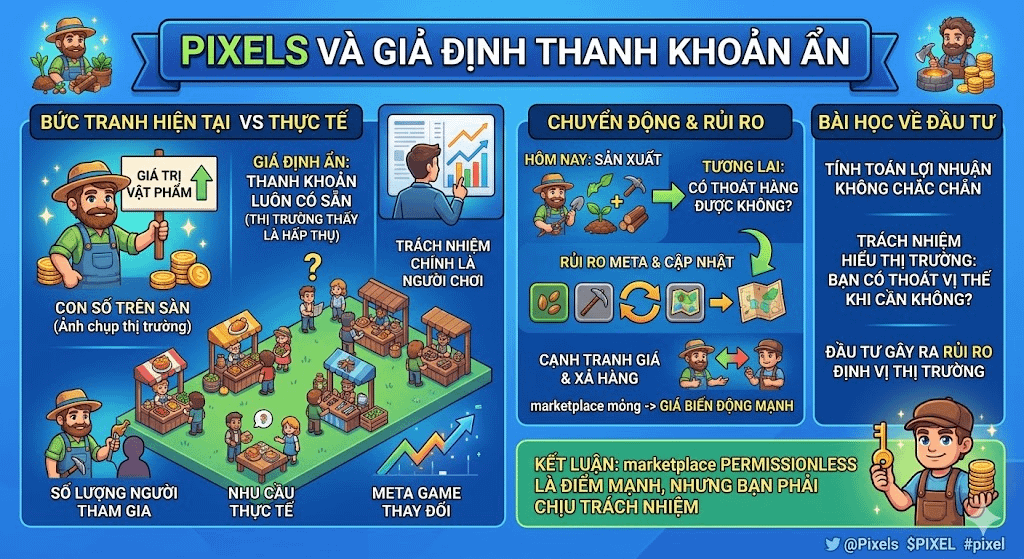
Still, I appreciate Pixels' direction in keeping the marketplace permissionless. Prices determined by players always reflect reality better than being interfered with by developers. No floor price also means no artificial safety net.
But for that reason, the responsibility to understand the market lies entirely with the players.
The important question is not how much this item is selling for today. But rather: is its liquidity deep enough for you to exit your position when needed?
And this only truly becomes clear when you have finished investing in the production system, not when you are still considering.
Trading always carries risks. AI suggestions are not financial advice. Past performance does not guarantee future results.