
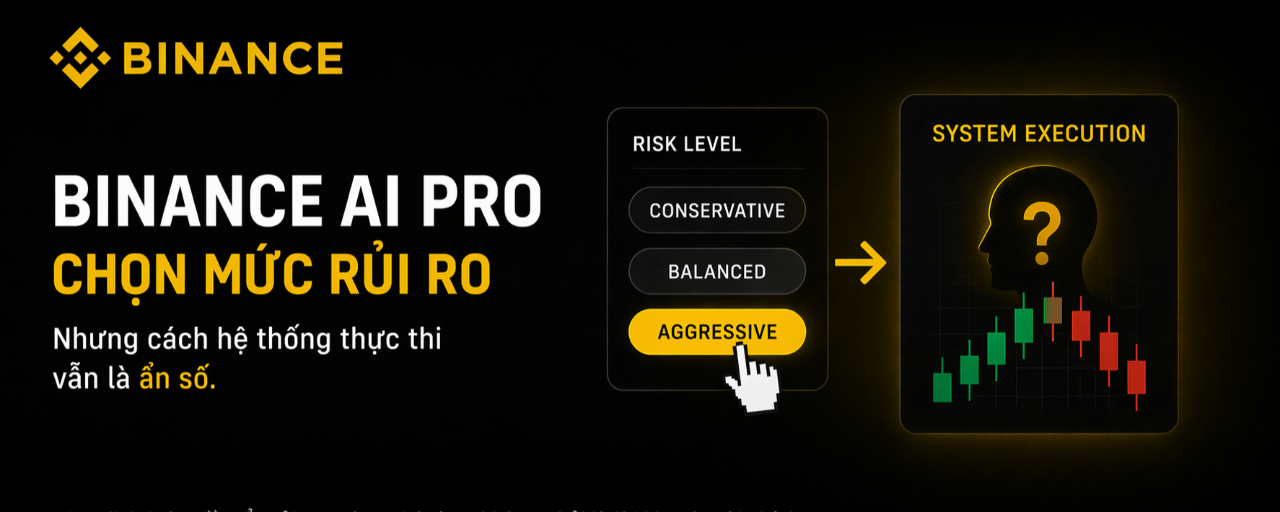
At first, I found the “risk level” selection in Binance AI Pro quite good. The interface is clear, you just need to choose between conservative, balanced, or aggressive. It feels like I am actively shaping the way the trading system operates rather than being forced into a default strategy.
But the more I think about it, the more I realize that the “active” part has a layer behind it that the user cannot see.
In traditional trading, when it comes to the risk level, you can control each part: how much capital to invest, where to set the stop, how to use leverage. But with an AI system, choosing the “risk level” is not just a preference. It is a configuration command. And that command will translate into a series of specific behaviors: how to allocate capital, how to place orders, how to handle when the market goes against you.
The problem is that these details are not clearly displayed.
When you choose 'conservative', the system will run according to the corresponding logic. But conservative by what criteria? Reducing position size? Reducing leverage? Tightening stop loss? Or is it a combination of all those factors? There is no information specific enough for users to understand exactly what is changing.
This creates a quite noticeable gap. You make a choice about risk, the system accepts that choice, but how it interprets it is entirely internal.

If you look a little deeper, the issue is not just a lack of transparency, but also how these choices interact with the market.
The same conservative level, but during a quiet market phase, the actual risk level can be very low. Conversely, when volatility spikes, the same setup can lead to much larger drawdowns. If execution parameters do not adjust according to market context, then the label 'low risk' only reflects the user's intention, not the actual conditions the system is facing.
In other words, the label is fixed, but the environment is not.
One more point I've noticed is the performance display of strategies. Win rate, historical profit... are all useful data. But all of it is past data, created under specific market conditions. When conditions change, the same execution logic can yield very different results.
If users choose a strategy based on performance without understanding how it works underneath, they are essentially choosing 'results' rather than the 'mechanism that produces those results.'
This is not wrong. It is quite common in trading. But with AI systems, where the logic is more hidden, the gap between results and causes is even larger.
I don't think this is a specific weakness of Binance AI Pro. On the contrary, allowing users to customize risk levels is a step forward compared to many other platforms, where everything is locked into a single strategy. The interface is user-friendly, onboarding is clear, and customization capabilities are real.
But precisely because there is an option, users also need to understand what they are choosing.
A level of risk is not just a nice-looking profile. It is how the system will behave with your money when the market moves.
And perhaps the most important question is not whether to choose conservative or aggressive, but: do you understand what the system is doing differently when you choose one of the two?
In the running market, that difference does not lie in the setup screen. It lies in how each order is placed and each position is managed.
Trading always carries risks. AI suggestions are not financial advice. Past performance does not guarantee future results. Please check the availability of the product in your area.
\u003cm-48/\u003e \u003cc-50/\u003e \u003ct-52/\u003e\u003cc-53/\u003e