


I want to start by mentioning something that makes me a bit uncomfortable: I once publicly stated in a friend's group that the reward system direction of Web3 games simply doesn't work. The reason is simple; historically, no project has truly achieved sustainability. All 'play-to-earn' eventually turns into 'play-to-collapse.' I was very certain when I said this because I've seen enough cases, enough collapse paths, and enough 'this time is different' that ultimately proved to be indeed different—different in the speed of collapse, whether faster or slower. Real person research · life preservation first, I am not the kind of person who is easily moved by stories; I need data, I need ledgers, I need proof of survival in a real adversarial environment.
Then I started to seriously study @Pixels 's Stacked, and I realized that I needed to correct my judgment. It's not because their story is told well, but because what they present is not a story, but operational records. More than 200 million real rewards distributed, over $25M in real revenue from in-game activities, and the actual operating data of three games: Pixels, Pixel Dungeons, and Chubkins—these are not the predicted values in white papers, but numbers left from things that have already happened. I have a habit in my research of comparing what a project says with the evidence it can provide, to see how far apart the two are. For most Web3 projects, this distance is canyon-level, but the distance here for Stacked is much smaller than I expected, which is the direct reason for my transformation from an 'open skeptic' to a 'continuous observer.'
What truly changed my judgment was not just the existence of data, but what the data indicated behind it: this system has survived in a real adversarial environment. The most brutal test faced by Web3 reward systems is not technical but human nature—bots, account farming, arbitrage, and witch attacks. These elements will swarm to any profitable system immediately after it appears, causing most systems to either collapse under this pressure or impose increasingly strict restrictions that keep real users out, ultimately pleasing neither side. Stacked has experienced all this internally within Pixels and has survived, generating $25M in revenue data. This is not luck; it is a victory of system design under real pressure, and such victories cannot be manufactured in a laboratory; they can only be earned with time and real users.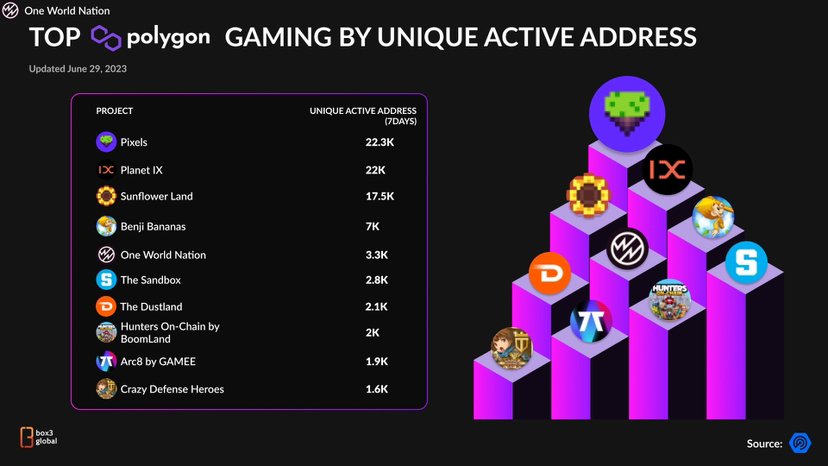
$PIXEL In this logic, I now understand its position like this: it is the medium of value flow within the entire Stacked ecosystem. Game companies inject growth budgets into the system, and real players withdraw these budgets in the form of $PIXEL through genuine participation. The demand for $PIXEL comes from this flow process itself, rather than from the popularity of any single game. Pixels, as an open-world game on the Ronin Network centered around farming, exploration, and creation, has already accumulated a considerable real user base, which is the starting point of the entire ecosystem. But the starting point is not the end; Stacked is now beginning to open up to external studios. If the quality and pace of external integration meet expectations, the demand for $PIXEL will shift from the scale of one game to the scale of an ecosystem. If this leap occurs, the valuation logic will undergo fundamental changes.
I also want to express my lingering doubts, because the phrase 'survival first' is not just for show. The first doubt is: what will the retention rate be after external studios integrate with Stacked? Willingness to try once does not equal willingness to rely long-term. The true value of B2B products can only be validated in customer renewal data, and I currently do not have enough information to assess this data. The second doubt is: is the incentive to hold $PIXEL strong enough? The logic of cross-game reward currency holds only if players are willing to spend $PIXEL across different games rather than selling it immediately upon receipt. If the consumption scenarios are not rich enough, the reward distribution will ultimately only create organized sell pressure. I keep both of these questions in mind, and I will continue to monitor relevant data. If logical cracks appear, I will speak out immediately.
$PIXEL Currently priced at $0.00828, with a 24-hour increase of +3.63%. The highest in 24 hours reached $0.00861, and the lowest was $0.00745, with a trading volume of 552 million PIXEL and a transaction amount of 4.4596 million USDT—this trading volume has significantly increased compared to the previous period, and this change in volume is worth paying attention to. In terms of moving average structure, MA7 is reported at 0.00820, having crossed above MA25 at 0.00798, and MA99 is currently at 0.00744, continuing to rise. The three lines are in a bullish arrangement, with a cumulative rebound of over 20% from the low of $0.00685. This time, @Pixels has launched the CreatorPad activity with a total reward of 15 million PIXEL, with an exclusive 7.5 million PIXEL for the Chinese-speaking region, ending on April 28, and the current number of participants in the Chinese-speaking region is 478. Real research prioritizes survival; the synchronous amplification of volume and price, combined with the bullish arrangement of the three lines, makes this structure more valuable than a simple price increase. Whether it can maintain MA7 without breaking is the key signal I will be observing continuously.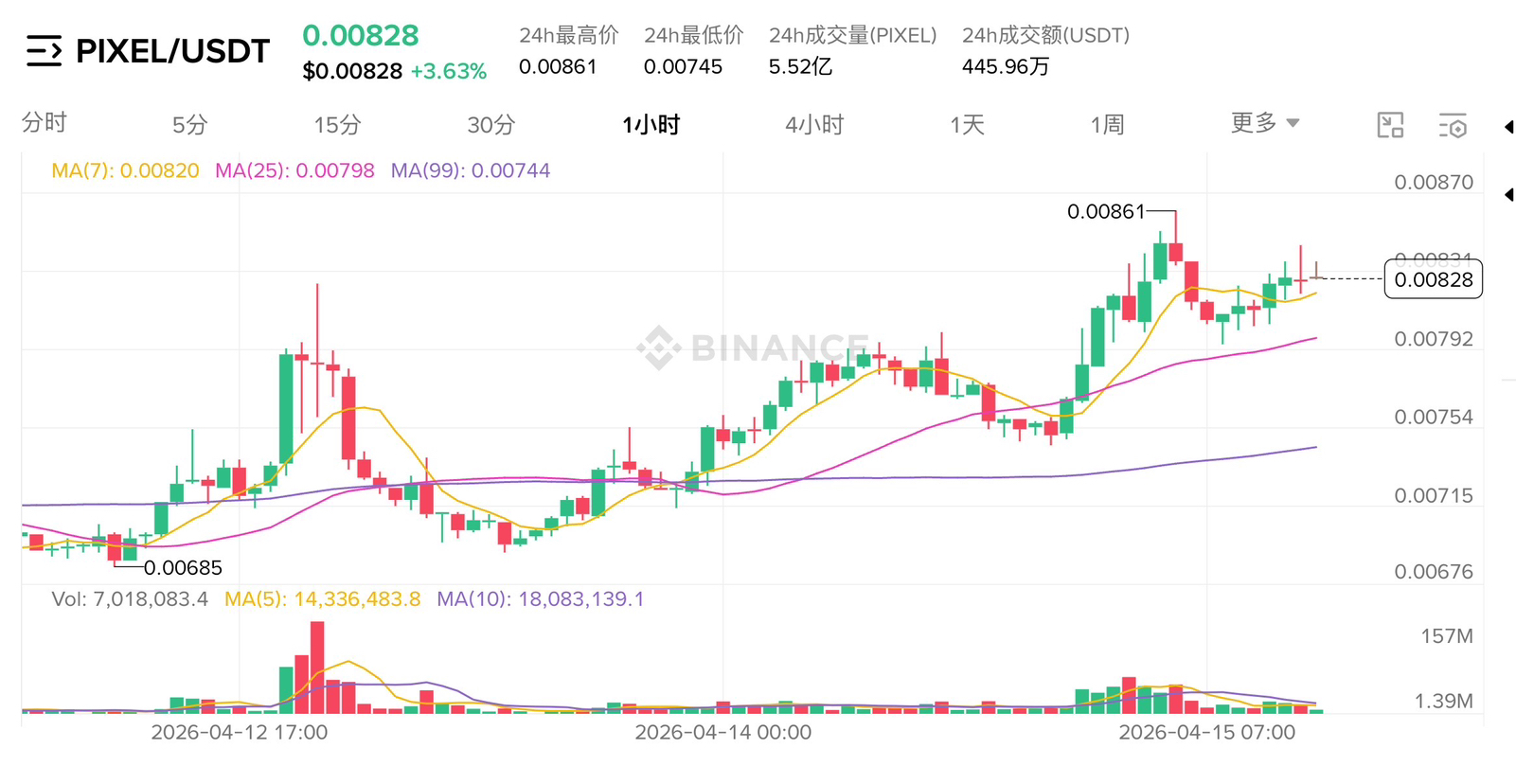
Finally, I want to say something that may make some people uncomfortable, but I think it must be said: the most dangerous thing in this industry is not bad projects, but evaluating good projects using the logic of bad projects. I almost categorized Stacked into that pile of 'another unsuccessful Web3 reward system' due to overly generalizing my doubts. Fortunately, my research habits led me to look at the accounts before drawing conclusions, and the accounts told me a different answer. I'm writing this process not to recommend anything to anyone, but to leave a reference for myself and others who are also seriously researching. Real research prioritizes survival; judgments can be wrong, but they must be mistakes that come from genuine consideration, not from following the crowd.