
There's a moment every AI Pro user has to confront, usually in the first week. You configure a strategy, fund the sub-account, and then you close the interface. The AI keeps running. The positions are live. The monitoring is active. And you're not there.
For someone who has only used manual trading before, that moment is the most significant change AI Pro introduces. Not the analysis quality. Not the multi-model ensemble. Not the skills ecosystem. The moment you first leave a live AI-managed position unattended and trust that the system will behave as configured.
I've spent six weeks thinking about what it means to trade continuously through an AI that doesn't sleep, doesn't get distracted, and doesn't lose focus. The answer is more complex than "it's automation, this is normal."
what continuity without presence actually enables
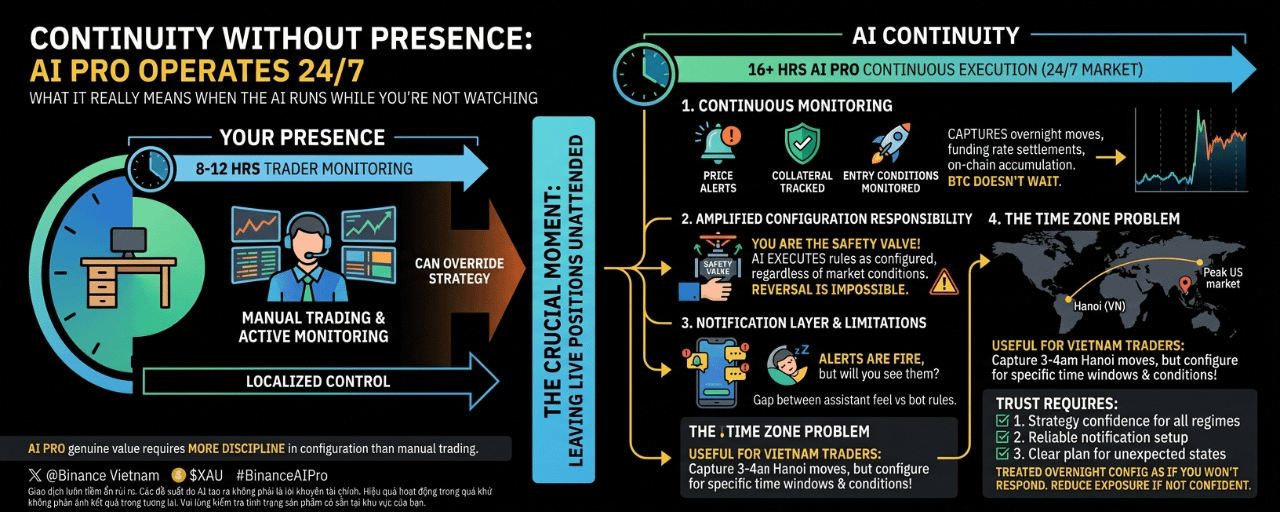
A human trader can be present in a market for maybe 8 to 12 hours a day if they're dedicated. The other 12 to 16 hours, they're not monitoring. Markets, especially crypto markets, don't have the same schedule. BTC doesn't wait for 9am to make significant moves. Funding rate settlements happen at specific UTC times that may or may not align with your waking hours. On-chain accumulation happens without announcement.
AI Pro's continuous monitoring means the configured strategy is active during those hours when you're not. Price alerts fire. Collateral ratios are tracked. Configured entry conditions are monitored. If you've set a limit order to trigger when BTC reaches a specific level at 3am UTC, and it reaches that level, the AI executes.
That's a real and meaningful capability. Missing overnight moves because you were asleep is one of the most consistent sources of frustration for active crypto traders. Continuous monitoring addresses it directly.
the configuration responsibility that continuity creates
Continuous presence doesn't eliminate the human responsibility for the strategy. It amplifies it. When you're present in a trade, you can override bad configuration in real-time. If market conditions shift and your strategy parameters no longer make sense, you can exit manually. The human presence is a safety valve.
When the AI is running continuously in your absence, that safety valve requires you to be reachable and responsive. The monitoring layer will alert you when configured thresholds are hit. But between those alerts, the AI is executing your strategy as configured, regardless of what's happening in the market.
A strategy configured for normal conditions will execute in abnormal conditions until you intervene. If you're unreachable — asleep, traveling, in a meeting — and the market moves in a way your parameters didn't anticipate, the AI continues executing the parameters it has. It doesn't recognize that the conditions have changed. It executes your instructions.
This is the irreversible aspect of continuous AI execution that most users don't fully internalize before they first leave a position unattended. The execution is irreversible in the moment. You can exit after the fact, but you can't un-execute a trade that happened while you were away.
the notification layer and its limitations
AI Pro's monitoring layer generates alerts when configured conditions are met. Price level alerts, collateral ratio alerts, execution confirmations. You receive these notifications through the Binance app on your phone.
What happens when you miss the notification? You're asleep. Your phone is on silent. You're in an environment where you can't respond. The alert fires, you don't see it, and the situation it was alerting you about continues to develop.
This is not a problem AI Pro created. It's the fundamental reality of any automated trading system. But the conversational, assistant-like interface of AI Pro creates a different intuition than a traditional bot. When I interact with an assistant, I expect it to manage the situation until I respond. When I interact with a bot executing rules, I understand that it follows rules regardless of whether I'm available.
AI Pro is executing rules (your configured parameters) but feels like an assistant. That gap between the feel of the interface and the actual behavior of the system is something users have to consciously correct for.
the time zone problem in crypto trading
AI Pro's continuous monitoring is particularly relevant for traders in time zones out of sync with peak liquidity periods. BTC/USDT peak liquidity is typically during US and European market hours. Asian traders in Singapore, Vietnam, or Japan are often at maximum sleep depth during peak US market hours.
Continuous AI monitoring means a Vietnamese trader can configure a strategy to capture moves that happen at 3-4am Hanoi time and know the execution layer is active during that window. The strategy captures the opportunity; the trader reviews the results in the morning.
This is genuinely useful. But it assumes the strategy was well-calibrated for those market conditions. A strategy configured for low-volatility periods may behave poorly during the high-volatility hours when US macro data releases. The trader who set it up at noon Hanoi time and went to bed at 11pm is not awake to adjust when the 9:30am EST data drops.
The solution: configure specifically for the time window your strategy is meant to cover, not for general conditions. Use different configurations for different sessions if your trading approach varies by session. AI Pro supports this kind of configuration specificity. Whether users implement it that way, or configure one strategy and leave it running across sessions with varying characteristics, is a user behavior question that beta feedback may be able to address.
what trust in continuous execution actually requires
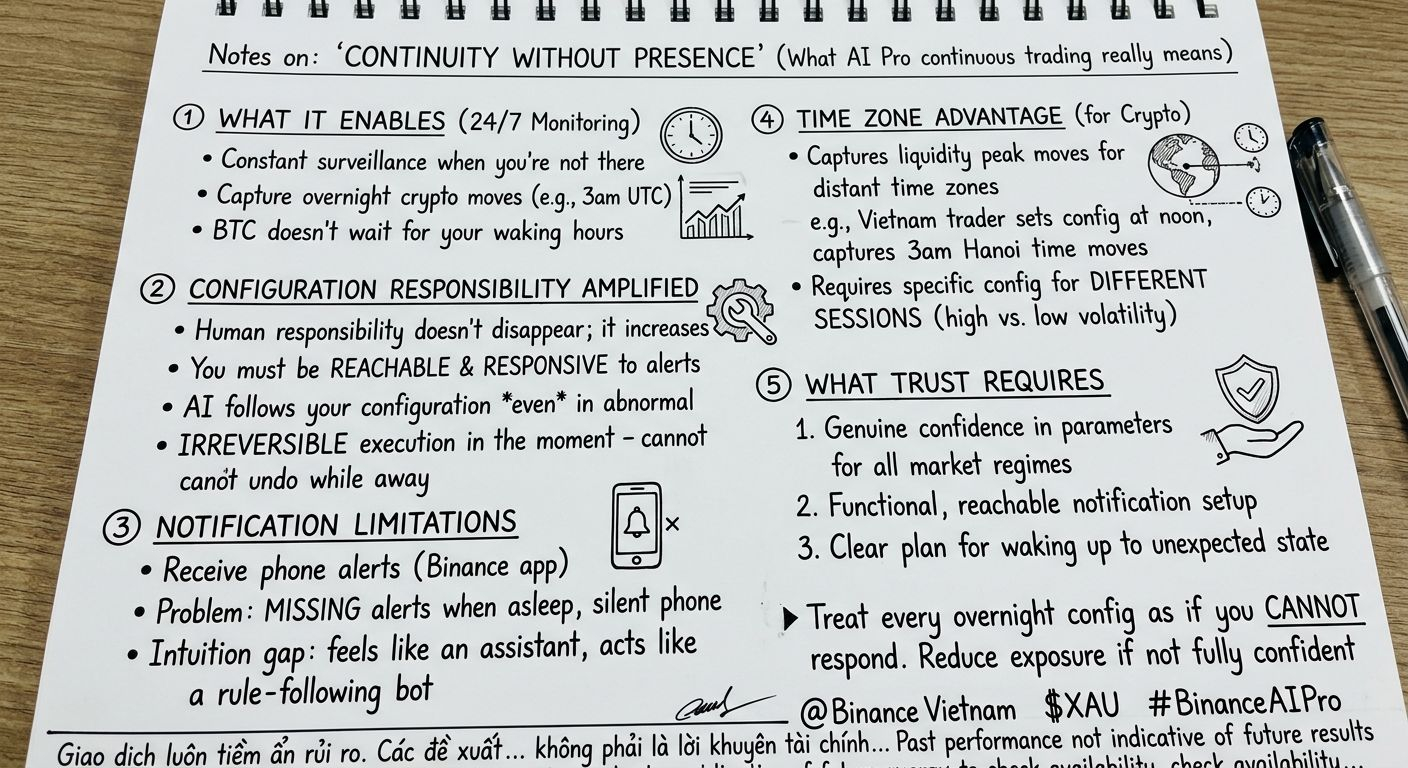
Trusting an AI-managed position overnight requires three things that are easy to say and harder to do. First: genuine confidence that your strategy parameters are correct for the current market regime, not just for normal conditions. Second: a notification setup that actually reaches you in time to respond to material changes. Third: a clear plan for what you'll do when you wake up and find the position in an unexpected state.
Most traders have the first condition partially — they think the strategy is right, they're not fully confident. Most have the second condition imperfectly — phone sometimes on silent, not always near it. Most have the third condition vaguely — they'll figure it out.
That's not failure. It's the realistic state of most traders adopting a new tool. The risk it creates is specific: a position that develops overnight in a way the trader didn't anticipate, with the AI having executed faithfully against parameters that turned out to be wrong for the session, and the trader waking up to a situation they need to manage under time pressure.
I've been in that situation once in six weeks. Not a disaster. Not nothing. The lesson: treat every overnight configuration as if you won't be able to respond to any alert. Configure accordingly. If you're not confident the strategy survives without your intervention for 8 hours, reduce the exposure until you are.
The AI Pro continuous monitoring layer is genuinely valuable. It requires more discipline in strategy configuration than manual trading does, not less.
@Binance Vietnam $XAU #BinanceAIPro
Giao dịch luôn tiềm ẩn rủi ro. Các đề xuất do AI tạo ra không phải là lời khuyên tài chính. Hiệu quả hoạt động trong quá khứ không phản ánh kết quả trong tương lai. Vui lòng kiểm tra tình trạng sản phẩm có sẵn tại khu vực của bạn.