
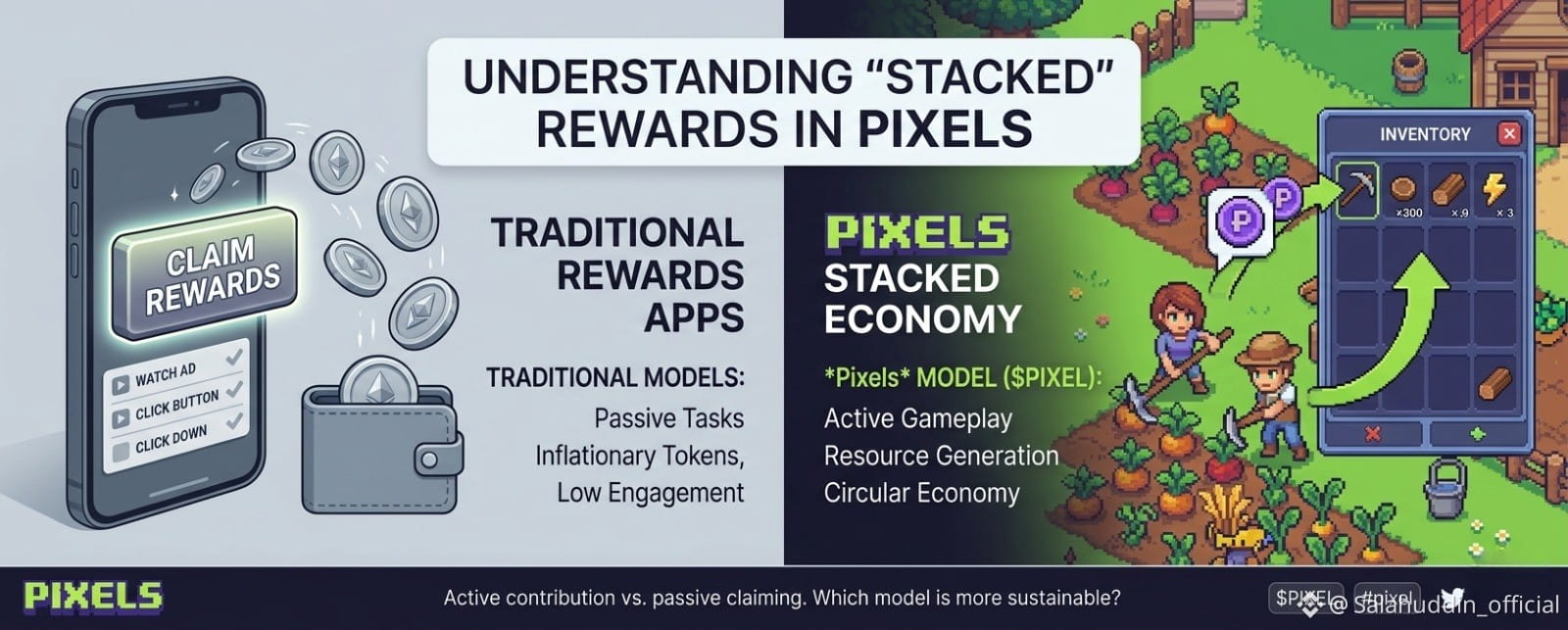
The Web3 gaming scene is crowded with promises of rewards. However, a closer look reveals a clear distinction between the passive rewards apps that helped kick-start early adoption and the complex, integrated, stacked economic systems currently emerging in leading projects, such as Pixels Understanding this difference is not just a theory; it is crucial for distinguishing between short-term marketing tactics and sustainable, long-term ecosystem growth.
The traditional rewards app model, which led early crypto, mainly works as a top-down incentive system. The process is straightforward: users perform low-engagement tasks like watching ads, completing surveys, or simply clicking a "claim" button every few hours. In return, they receive a project’s native token.
The main weakness of this approach is its lack of connection to creating intrinsic value. These actions do not support a circular economy; they act as a marketing expense. The resulting tokens often face immediate sell pressure since the only use for the reward is cashing out. This leads to a downward spiral that hurts long-term sustainability.
The Pixels Paradigm Shift: Defining the "Stacked" Mechanism
Pixels breaks this pattern by implementing rewards through an active, stacked utility model. In Pixels, earning rewards is about actively creating real value in the game world. Players do not just receive pixel they earn it through a series of productive actions.
To earn $PIXEL a player must engage in the main activities of the game: growing crops, crafting rare resources, managing specialized industries, and completing complex quests. These are not random tasks; they are essential to the virtual economy. Every action produces a resource needed for another player’s advancement. This requirement for active participation guarantees that pixel emissions always match an equivalent productive output. This sets it apart from arbitrary airdrops or simple click-based rewards.
Sustainability through Utility: The Circular Economy Advantage
The key difference in the Pixel’s stacked economy is its sustainable nature. Instead of encouraging a passive drain on the ecosystem, the system is designed so that the $PIXEL earned has immediate, valuable uses within the game.
When a player earns $PIXEL, they don’t face just one choice of "cash out or wait." They encounter dynamic strategic decisions. Players can reinvest $PIXEL to purchase essential land upgrades, buy higher-tier tools for better efficiency, unlock specialized crafting stations, or access exclusive game content. This creates ongoing, natural demand for the token, driven by the game’s core mechanics rather than speculative trading.
While traditional rewards apps create a straightforward path to token dilution, the Pixels stacked model builds a strong ecosystem where players actively contribute. They generate both the demand for and the utility of the tokens they earn. By prioritizing active value creation and internal utility, Pixels is setting a new standard for sustainable Web3 gaming that goes beyond shallow rewards and toward true economic strength.
A New Standard for Sustainable Value Creation
Pixels is introducing a new method of creating long-term value within the gaming sector through the use of integrated economies that allow players to receive rewards based on their impact on gameplay. Pixels has created a real economy based on the productive output of virtual worlds using PIXEL tokens, not just a token that will be sold for speculative purposes. The PIXEL token provides true utility to all players by changing how we participate in value creation, clearly distinguishing it from basic reward systems. The new approach to creating real value with PIXEL will foster a stronger and more developed GameFi ecosystem.
Disclaimer: "This is not investment advice. Please DYOR (Do Your Own Research).
@Pixels #pixel #PIXEL/USDT #PIXEL📈 #PixelTokens


