
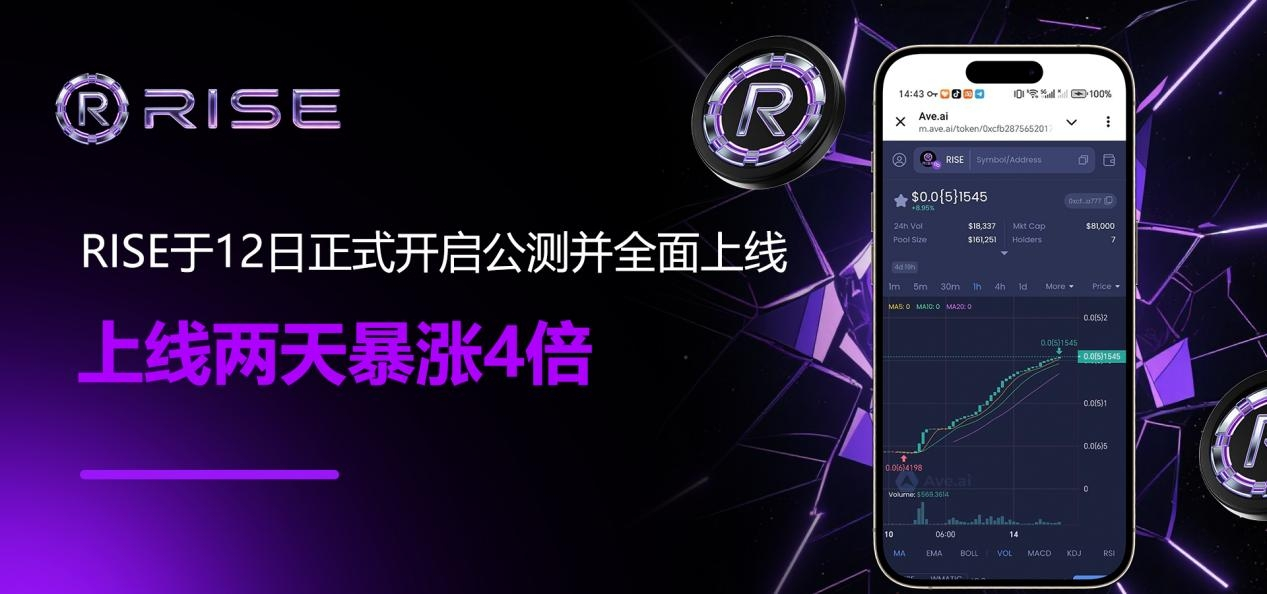
The year 2026 is defined as the year of rebirth for the Polygon ecosystem. After experiencing a strategic upgrade from Matic to POL, the Polygon consensus protocol 2.0 has reached another milestone event — the core ecological incentive token RISE officially launched its public beta and went fully live on the 12th, skyrocketing 4 times within just two days. As a 'symbol of rebirth' personally defined by Polygon founder Sandeep Nailwal, RISE not only carries the mission of ecological value reconstruction but also, with its contract completing third-party security audits, completely discarding administrative privileges, permanently locking initial liquidity, and having an extreme security design of zero pre-mining and zero private placement, has become a rare 'clean project' in the current blockchain industry, creating a participation environment for users that is free of manipulation, backdoors, and risks.
Looking back on the development of Polygon, its original intention was to solve the Ethereum network congestion and scalability issues. In 2017, Matic Network was born, rapidly rising after its mainnet launch in 2020, with TVL soaring from $150 million to nearly $10 billion, becoming a core infrastructure in the DeFi field. In 2021, the project was officially renamed Polygon, starting a strategic transformation into 'the network of networks', upgrading from a single public chain to a multi-chain ecological cluster. In September 2024, Polygon completed the token upgrade from MATIC to POL, with a conversion rate of over 85%, confirming the community's high consensus. POL, as a 'super productivity token', allows holders to obtain multiple benefits by verifying multiple chains, laying the foundation for the security of Polygon 2.0.
In 2025, founder Sandeep Nailwal returned to serve as CEO of the Polygon Foundation, focusing on the research and development of the AggLayer cross-chain liquidity protocol, advancing the ecosystem towards 'value internet' evolution. The launch of RISE is a key lever for the implementation of Polygon 2.0 technology and ecological explosion. Unlike many speculative tokens on the market, RISE is not an independent altcoin project but is deeply integrated as an official core component of the Polygon ecosystem, forming a 'dual-drive' pattern with POL—POL is responsible for network consensus security and Gas consumption, while RISE focuses on ecological application incentives and community governance, collaborating to support the upgrade of Polygon from an Ethereum scaling solution to an independent value layer infrastructure.
The RISE public beta launch has drawn the most attention in the industry for its extreme security and fairness design. First, the RISE smart contract has completed a security audit by a third-party professional organization, achieving high standards in audit coverage of key modules. The core code, including contract logic, deflation mechanism, mining distribution, and destruction rules, has passed strict validation, eliminating vulnerability risks from a technical perspective. Secondly, after the token deployment, the project party immediately discarded all administrative permissions. The contract has no centralized control entry, meaning tokens cannot be arbitrarily issued, nor can trading rules be modified, trading paused, or assets transferred, truly implementing community autonomy under the principle of 'code is law'. In addition, the initial liquidity pool of RISE is 100% fully added and permanently locked, eliminating the possibility of the project party pulling out the pool and running away, ensuring long-term stable trading depth and safeguarding user trading safety.
In terms of issuance mechanism, RISE completely abandons unfair models commonly seen in the industry, such as pre-mining, private placements, and team reserves. The total supply of tokens is 100 billion, all injected into the decentralized LP pool at once, with no institutions, teams, or individuals holding low-priced chips. The only way for users to acquire tokens is by providing liquidity for core trading pairs like POL/USDT and POL/ETH and participating in mining through staking LP certificates. This 'everyone can mine' model allows all participants to compete fairly under the same rules, receiving RISE rewards based on their liquidity contribution, with a minimum of only 1000 POL required to participate, truly achieving 'everyone can participate, everyone can benefit', fundamentally avoiding issues like institutional dumping and project party harvesting.
The economic model design of RISE also possesses industry-leading characteristics, adopting a threefold destruction mechanism to achieve continuous deflation, with a theoretical daily deflation rate of up to 2%. The first layer is daily output destruction, with 0.5% of daily RISE output directly sent to a black hole address for permanent destruction; the second layer is LP removal destruction, where 50% of RISE tokens in LP are immediately destroyed when users exit liquidity; the third layer is protocol operation destruction, with POL consumed for user binding, querying, and other operations all used to buy RISE on the market and destroy it. The combination of the threefold destruction forms a powerful deflationary spiral, continuously providing upward momentum for token value under stable demand.
At the same time, RISE has constructed a diversified revenue system, where participants can obtain threefold returns through LP mining: first, the basic transaction fee income from trading pairs, settled and distributed daily; second, the real-time release rewards of RISE tokens; third, the asset appreciation brought by long-term holding of POL. If RISE earnings are reinvested into liquidity, users can also enjoy the compound interest effect, achieving exponential growth of 'tokens generating tokens'. In addition, the project has set up a community promotion incentive for 1-10 generations, with computing power increasing by 0.5% daily, encouraging users to participate early for higher weight, fostering long-term ecosystem building and forming a virtuous cycle.
On the technical level, RISE relies on the four core advantages of Polygon 2.0 to achieve both efficiency and security. The PoS consensus mechanism guarantees efficient block production, combined with ZK zero-knowledge proof technology to ensure ultimate security; relying on the AggLayer aggregation layer, it achieves 'one mining, multi-chain circulation', connecting all chains built by Polygon CDK and breaking liquidity islands; the interoperability layer enables efficient communication of messages between chains, ensuring seamless circulation of RISE across multiple chains; the zkEVM Validium upgrade brings infinite scalability, supporting long-term ecological development.
The year 2026 is a key transformation period for the blockchain industry. The Ethereum upgrade continues to catalyze the reevaluation of the L2 ecosystem, with technologies such as Polygon 2.0's AggLayer and ZK proof already implemented. POL is at a low value, and the RISE public beta launch coincides with a historic opportunity. After the public beta begins on the 12th, users only need to prepare Polygon mainnet POL and transfer it to the contract address (0xcfb287565201763743a77c556dca44a673d0a777) to automatically add liquidity and start mining, with daily earnings credited automatically, supporting selling, reinvesting, or inviting friends to participate at any time.
As the core symbol of Polygon's rebirth, RISE redefines the issuance standards of blockchain projects with its secure, fair, and self-driven design. Contract audits, permission discarding, locked pools, and universal mining—these four safety bottom lines allow users to worry less about risks; the deflationary model, diverse revenue, and technological empowerment provide three major value supports for co-builders to share ecological dividends. With the launch of RISE, the Polygon consensus protocol 2.0 will officially enter the ecological explosion period, and the 'Phoenix rising from the ashes' Polygon will undoubtedly join hands with the global community to jointly build the next-generation value internet infrastructure.