

I still remember the moment Pixels really caught my attention—and it had nothing to do with gameplay.
It was the chart.
One of those strange days where volume just explodes out of nowhere. Timelines full of green candles, screenshots, people calling it “the next big thing.” And there it was—a farming game token suddenly trading like it belonged in the top tier of the market.
That kind of behavior doesn’t excite me anymore. It makes me slow down.
Because I’ve seen how these phases usually end.
What pulled me in wasn’t Pixels alone, though—it was where it lives. The Ronin Network already proved something most chains haven’t: it can onboard real users through games. Not just wallets, not just speculation—actual players. That gave Pixels a different starting point. I wasn’t looking at it as just another GameFi token. I was looking at it as a second attempt at scale after Axie.
So naturally, I dug into the token.
And that’s where the tone shifted for me.
A 5 billion total supply immediately changes how I frame things. You don’t look at valuation the same way. You don’t look at price the same way. At launch, only a fraction was unlocked, but over time that circulating supply has grown significantly—and there’s still more to come.
That’s the part people like to ignore during hype cycles.
The allocation is familiar too. A big chunk set aside for ecosystem rewards—which sounds great on paper, but in reality, it’s emissions. Incentives. Fuel to keep people showing up. Then you’ve got early investors who entered at extremely low prices, and a sizable portion reserved for the team and advisors.
None of that is unusual. But it creates a certain kind of pressure.
Because I’ve watched this structure play out over and over again:
tokens get distributed to bootstrap activity, the market rallies, and then supply quietly unlocks into strength while attention is still there.
Pixels followed that script almost perfectly at the start.
The launch phase was intense—massive volume, heavy exchange activity, airdrops, farming incentives. It looked like organic demand on the surface, but if you’ve been around long enough, you can see the layers underneath. Claims, transfers, liquidity routing, market makers doing their job. It’s not fake—but it’s not pure either.
It’s a redistribution phase.
And lately, I’ve noticed the same pattern in smaller bursts. Sudden spikes in volume that don’t quite match the underlying market cap. That kind of imbalance rarely sustains itself. It usually resolves through volatility—and then things cool off.
So I keep coming back to the same question:
What’s actually underneath all this?
At a design level, Pixels is doing something sensible. It doesn’t try to force everything on-chain. The gameplay stays off-chain—fast, responsive, usable. The blockchain layer is used where it actually matters: ownership, assets, value settlement.
That balance is important.
Too much on-chain, and the game becomes clunky. Too little, and the token loses meaning. Pixels sits somewhere in the middle, and that part, at least, feels thought through.
But design isn’t the hardest problem here.
Retention is.
It’s always retention.
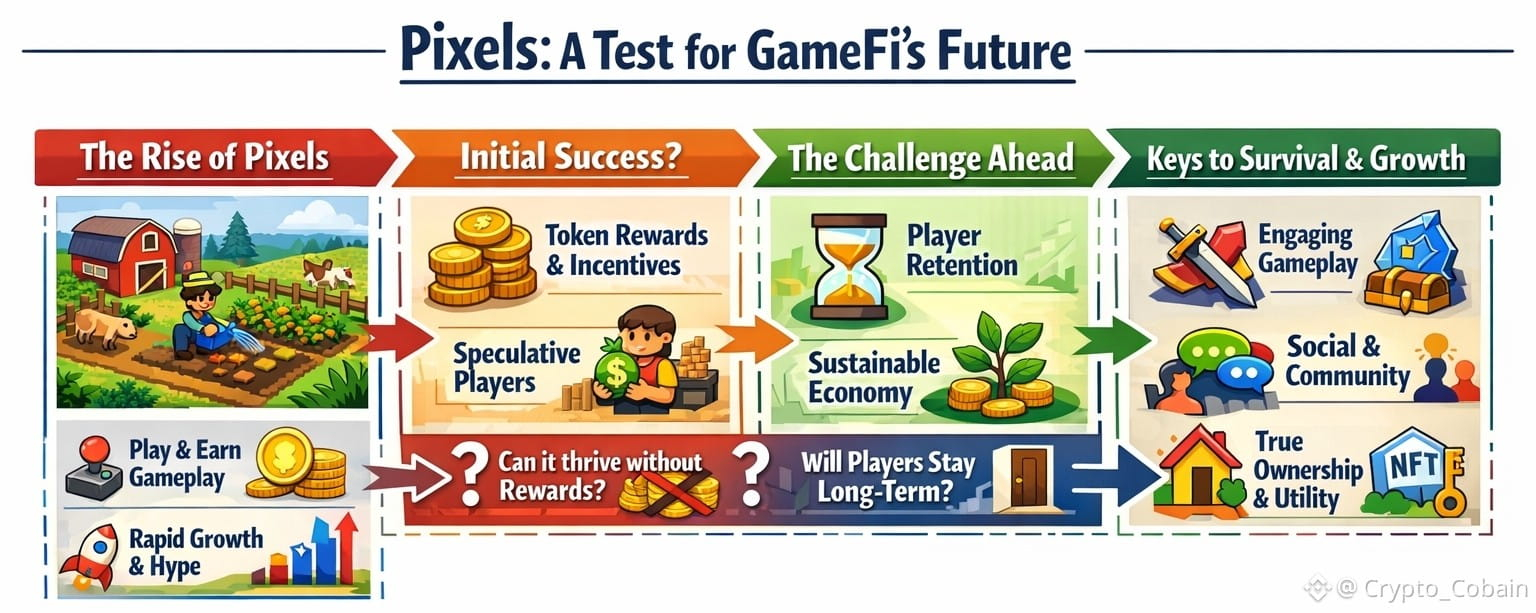
It’s easy to attract users when rewards are flowing. Task systems, farming loops, token incentives—those work. They always work. We saw it in the last GameFi cycle too.
The real test comes later.
What happens when the rewards slow down?
If people are there to earn, they leave when earning gets weaker. That’s just how these systems behave. And if that happens, the whole economy starts to look less like a game and more like a temporary liquidity program.
Pixels seems aware of that. There are clear attempts to build something deeper—social interactions, land mechanics, player-driven systems. That’s the right direction. Because if the game becomes a place people want to be, not just a place to farm, everything changes.
That’s when a token starts to represent participation, not just payouts.
I’m also watching how the ecosystem evolves beyond a single game. Because one game, no matter how successful, rarely sustains a token economy forever. Expansion matters. New modes, collaborations, external integrations—those are the signals of something trying to become a platform rather than a one-hit cycle.
Still, I can’t ignore the risks.
The supply overhang hasn’t disappeared. It’s just stretched out over time. Unlocks will keep happening. Early players and investors are still sitting on profits at levels far below peak prices. And attention in this market is fragile—it rotates fast.
So I simplify it for myself.
If rewards disappeared tomorrow… would people still log in?
Right now, I’m not fully convinced.
But I’m not writing it off either.
Because Pixels has already done something most projects never manage—it has real activity. Not perfect, not purely organic, but real. There are players. There is movement. There is an economy trying to form.
That’s a foundation.
For me, it stays in that middle zone—cautious, but open.
If retention holds as emissions slow, if the in-game economy starts standing on its own, if player behavior looks less like farming and more like actual engagement—that’s when my view shifts.
Until then, I keep watching the same quiet signals:
wallet flows, exchange deposits, unlock schedules… and the feeling of the game itself.
Because in the end, the chart might bring you in—
but it’s the players who decide if something survives.
