
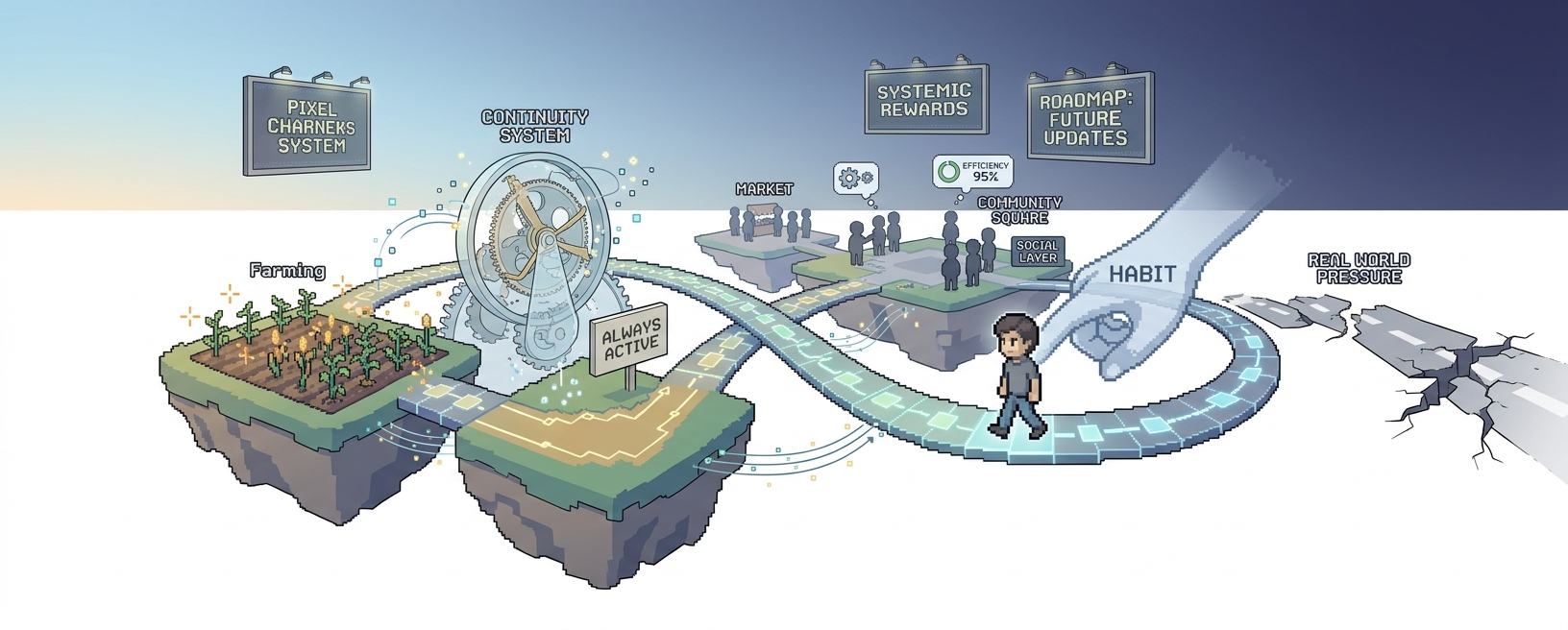


I noticed something small the other day: I kept coming back to Pixels without really deciding to.
Not out of urgency, not because I had something specific to finish. Just a quiet return, like checking on something that continues whether I’m there or not. That made me pause. What exactly is pulling me back?
At first glance, it looks simple. Farming, collecting, interacting. But the more I sit with it, the more I feel like the loop isn’t built around actions alone. It’s built around continuity. The system seems designed to make absence feel like a break in something ongoing, not just a missed session. I can’t tell if that’s intentional design or just a side effect of persistent worlds, but it creates a subtle kind of attachment.
Then I think about rewards. Not in a transactional sense, but in how they’re structured within the system. The outputs of effort don’t feel isolated. They feed back into the environment, into progression, into interaction. It creates a loop where activity reinforces itself. But I also wonder how sustainable that loop is. If the inputs slow down, does the system still feel alive, or does it start to flatten?
The social layer complicates this further. On paper, Pixels encourages interaction, but I’m more interested in how it handles competition. Not direct, aggressive competition, but the quieter kind. Players optimizing their space, their time, their decisions. I keep asking myself whether the system balances cooperation and competition naturally, or if one slowly starts to dominate the other as players become more experienced.
What’s interesting is how addictive the experience feels without being intense. It’s not driven by pressure or urgency. It’s more like a low-level pull that builds over time. That kind of engagement is harder to design than obvious hooks. But it also makes me question where the line is between engagement and habit. At what point does returning to the game stop being a choice and start being routine?
The accessibility angle adds another layer. It’s relatively easy to step into Pixels without needing deep technical understanding. That lowers the barrier, which makes sense if the goal is broader adoption. But I wonder if simplifying the entry point risks hiding complexity that players only discover later. Sometimes systems feel easy at first, then slowly reveal friction as you go deeper.
I also keep thinking about how Pixels retains players compared to other systems. Retention isn’t just about features. It’s about whether the system adapts to player behavior or expects players to adapt to it. I’m not entirely sure which direction Pixels leans toward. It feels flexible, but I can’t tell how that flexibility holds up under scale.
And then there’s the roadmap. It sits in the background like a promise, but also like a variable. Future updates could strengthen the loop or disrupt it. The more interconnected the system becomes, the harder it is to change one part without affecting everything else. That makes me cautious about how much stability can really be maintained over time.
Even outside the game, I think about real-world pressure. People don’t engage with systems in isolation. Time, attention, and competing platforms all push against consistency. If engagement drops, even slightly, the effects might not be immediate but could build quietly in the background.
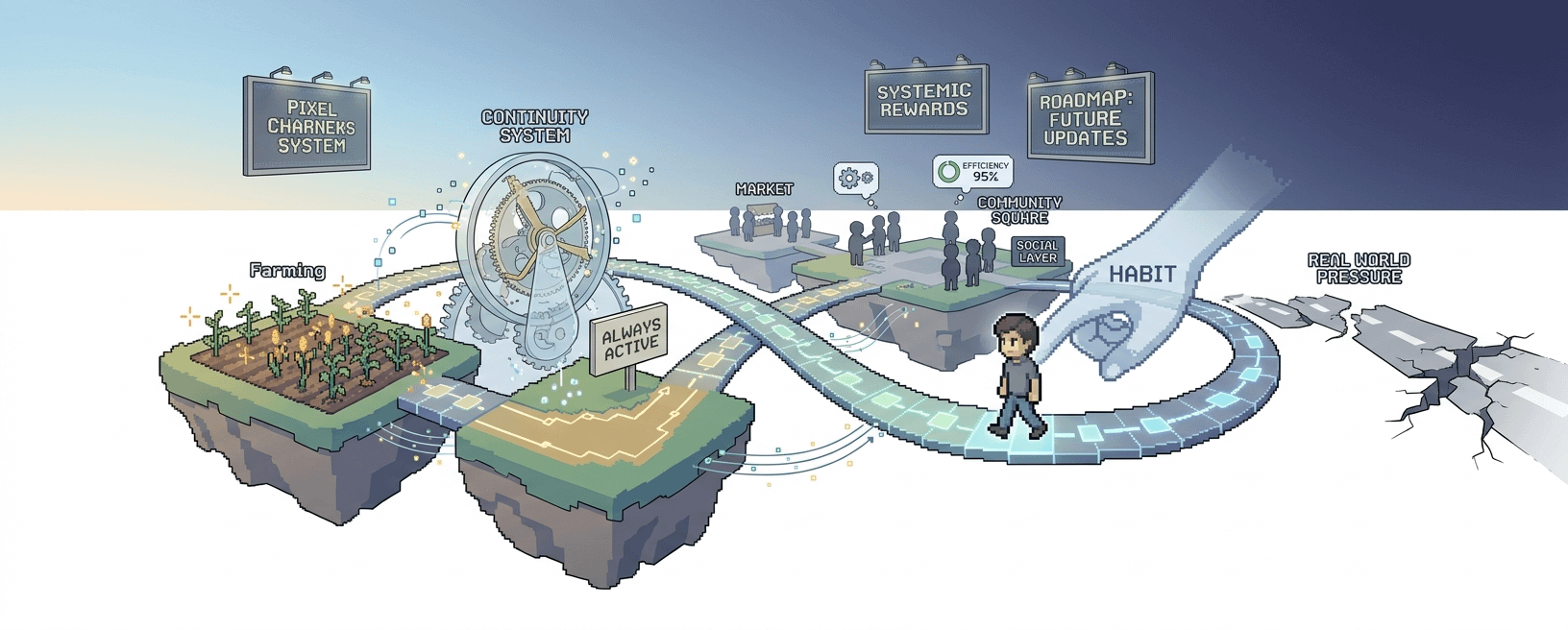
So I’m left with this thought: Pixels seems less like a game you play and more like a system you step into and gradually align with. The question is whether that alignment holds, or slowly fades when the rhythm breaks.