
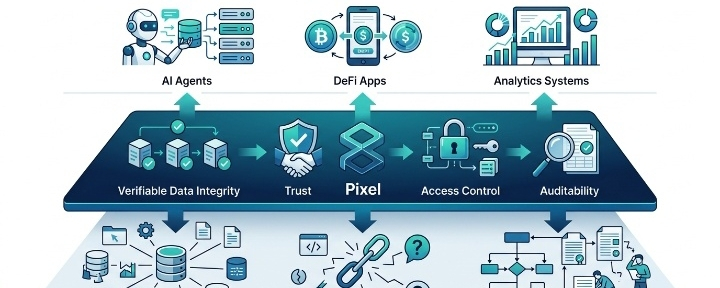
I noticed there's a lot of noise around "AI + blockchain" projects right now. Most of them dress up basic automation in tokenomics and call it infrastructure. Pixel is different, and the reason it's different comes down to what it's actually solving at the protocol layer — not the application layer, not the dashboard layer, but the base mechanics of how autonomous agents operate on-chain.
The first real problem is trust without identity. When a human transacts on-chain, there's at least some accountability chain — a wallet, a signing key, a jurisdiction somewhere. When an agent acts on-chain, none of that exists natively. The protocol has no way to know if the entity executing a transaction is a verified machine operating within defined parameters or a rogue process doing something it shouldn't be. Pixel addresses this by building machine identity into the protocol itself. Agents get on-chain identities that are verifiable, not assumed.
The second problem is provenance of action. In a multi-agent system — say, an AI pipeline where five agents are passing tasks between each other — tracing what happened, who authorized what, and where a failure occurred is nearly impossible without a proper record layer. Pixel creates an attestation trail for machine actions. Every meaningful operation can be anchored on-chain, which means auditability becomes a first-class feature rather than an afterthought bolted on later.
I think the third problem is governance over agents. Right now, if you deploy an autonomous agent with capital access, the controls are mostly off-chain — API keys, rate limits, manually written rules. That's fragile. Pixel moves the governance layer on-chain, so the rules an agent operates under are programmable, verifiable, and tamper-resistant. You're not trusting a config file. You're trusting code that's publicly auditable.
The fourth and maybe the most underappreciated — is economic coordination between machines. The agent economy isn't just agents taking instructions from humans. It's agents hiring other agents, paying for compute, settling micro-transactions, and doing all of this at a speed and frequency no human-facing payment rail was designed to handle. Pixel's protocol-level design accounts for machine-to-machine value transfer as a primary use case, not a secondary one.
What ties all of this together is that none of these are UX problems. They're not problems a better front-end solves. They're structural gaps in how blockchains were designed — built for human actors, human latency, and human-scale transaction frequency. Pixel is rebuilding the assumptions at the base, not papering over them at the top.
That's what makes it infrastructure rather than application. And that distinction matters enormously when you're thinking about where long-term value accrues.
Another issue that Pixel addresses at the protocol level is the challenge of credentialing for agents working across various chains. Currently, an agent that is verified on one network lacks transferable proof of that verification when transitioning to another. It essentially starts over each time.
The design of Pixel facilitates the movement of credentials and attestations alongside the agent as it navigates different chains, ensuring that trust is not limited to a single context. This is significant. In a truly multi-chain future, an agent that cannot carry its trust history will struggle to expand effectively.