
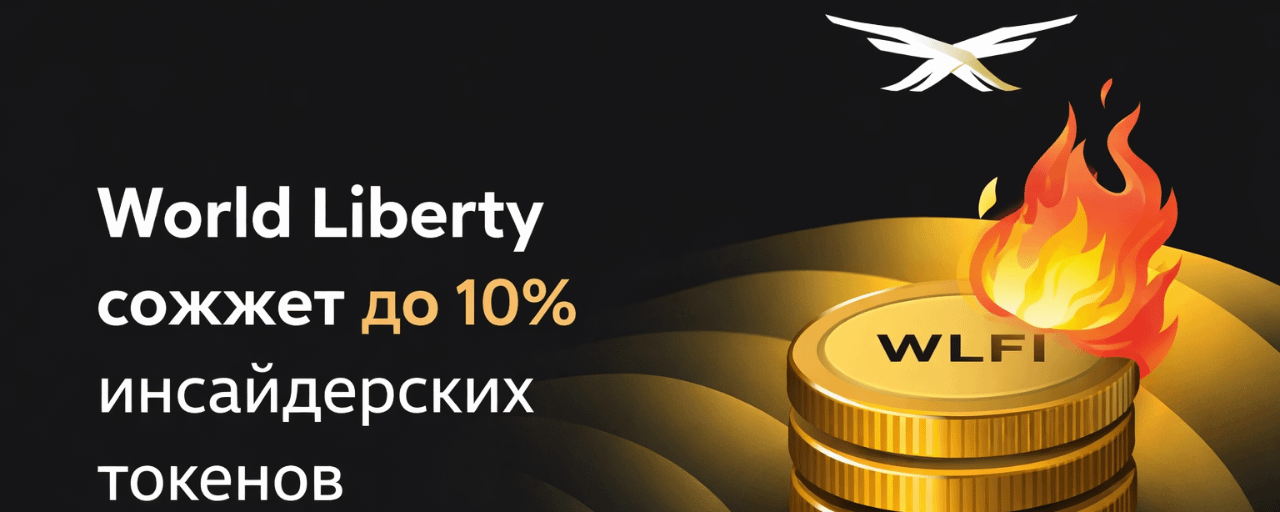
The World Liberty Financial project, associated with Donald Trump, has put forward a proposal for a major restructuring of WLFI tokenomics. This involves transferring 62.28 billion tokens from an indefinite lock-up mode to a phased unlocking model, as well as the potential burning of part of the allocation for founders, team, advisors, and partners.
According to the proposal, all participants in the new scheme will first be subjected to a two-year cliff period. After that, different vesting schedules will begin to apply for different categories of tokens. For early supporters of the project, a two-year linear vesting is provided after the cliff, meaning that full unlocking should be completed by the fourth year. Founders, team members, advisors, and partners are offered a stricter model: after the two-year cliff, tokens will be distributed for another three years, and the full cycle will stretch to the fifth year.
The key detail of the proposal is the mandatory burning of up to 4.52 billion WLFI, which corresponds to 10% of the total locked allocation of insiders of 45.24 billion tokens. For early supporters, such a mechanism is not provided: their 17.04 billion WLFI is proposed to be transferred to the new schedule without a burn component.
If the initiative is approved, participants will need to separately confirm their agreement to the new terms. Those who do not will remain in the previous mode: their tokens will retain an indefinite lock-up. A quorum of 1 billion WLFI is established for the voting itself, decisions are made by a simple majority, and the voting period will last seven days. After the relevant functionality is launched, holders will have another ten days to join the new scheme.
For the project, this is not just a technical adjustment of the token's trading rules. In fact, World Liberty is trying to replace the vague model with an indefinite blocking period with a more predictable proposal structure. For the market, this is an important signal: investors receive a clear schedule for potential token exits, and the burn of part of the insider share looks like an attempt to reduce concerns about price pressure from the team and affiliated participants.
What is happening around WLFI
The proposal emerged against the backdrop of the expansion of the World Liberty Financial ecosystem. The team links the further development of the platform with the stablecoin USD1, which has already been deployed across several networks, as well as with lending and borrowing features within the WLFI interface. Against this backdrop, it is important for the project to demonstrate a more transparent and long-term token management model.
Additional context to the news is the recent public conflict between World Liberty Financial and Tron founder Justin Sun. He claimed that the WLFI smart contract allegedly contains a blacklist function that allows freezing holders' tokens. The project rejected these accusations. Against this backdrop, the initiative for the new vesting scheme also appears to be an attempt to stabilize the perception of WLFI by the community.
According to The Block, at the time of publication, WLFI was trading at $0.082, which is 75.1% lower than the historical maximum of $0.33. Therefore, the discussed restructuring is both a matter of corporate discipline and an attempt to restore predictability for market participants.
The text of the proposal was published on the official governance forum of the project: World Liberty Financial Governance.
Source: The Block