CZ Big Brother@CZ Join the live broadcast at Binance Square to interpret the new book, with core thoughts shared only this once. Don't worry if you missed the live stream!
The most comprehensive整理 on the internet is ready for you. Take some time to read it thoroughly, and I believe you'll gain a lot!
Let's see what was discussed. The content of the entire live broadcast is as follows:
Summary:
Personal update: Currently focused on project consulting and passive investment, with no plans to return to Binance or start a new venture. Continuing to monitor the AI field, and my YZi Labs has also invested in AI, biotechnology, and other sectors.
Entrepreneurship & Insights from Low Points: Starting from scratch requires strict risk control; there are no shortcuts to success. Don't lose heart in low points, cut expenses, keep learning, and gradually you will break through.
New book information: The content of the book is true and straightforward, polished for a long time, with most of the revenue from the overseas edition donated to charity, and the domestic simplified version is also being actively promoted.
Investment selection logic: More emphasis is placed on founders with mission and strong execution, favoring bear market layouts, and judging long-term value of projects through code activity.
For confused young people: Avoid being addicted to games, short videos, and other short-term pleasures. Persistently improve yourself every day, and mastering a core skill gives you a chance.
Views on the crypto industry: The industry is still in its early stages, and ordinary people still have the opportunity to cross class barriers. The potential of AI + blockchain is enormous, but MEME coins carry high risks and should be approached with caution.
Original intention of writing the book: To sort out and reflect on past experiences, clarify misunderstandings in the outside world about the industry and Binance, and share the most authentic entrepreneurial stories and industry views.
Detailed version (Q&A format):
1: Are you still full of the entrepreneurial spirit from starting from scratch as a project consultant? Is the chapter of Binance completely over, and will you start another venture in the future (for example, in AI or non-crypto fields)?
My current state is that I am a project consultant and a passive investor, enjoying the current rhythm.
The Binance team's capabilities are very strong. Even in the face of regulatory pressure and dual supervision, operations remain stable. I currently do not plan to return to Binance, nor do I have plans to start another venture.
I have been continuously paying attention to the AI field, and YZi Labs has also invested in AI, robotics, biotechnology, and crypto-related tracks.
As I get older, my physical strength is not what it was ten years ago. Entrepreneurship is very physically demanding, but I do not rule out any possibilities for the future; people change over time.
If I find it boring in the future, I may consider starting a business, but I currently have no related plans.
I also encourage those who want to start a business to take action early and manage risks well. I am also willing to help quality founders.
2: How can someone who starts from scratch gain entrepreneurial confidence and persevere? How to believe in the path they choose?
When I was young, I had exposure to small startups, worked as a developer, and spent time in large companies. Later, I found that I was not suited for large companies or the 9-to-5 fixed model.
I prefer a free, small team, and flexible atmosphere in the entrepreneurial environment, and I have experienced many entrepreneurial failures.
The core advice for everyone is: Entrepreneurship must control risks. If you fail, don't incur huge debts. Try to use investments instead of loans to start projects. I have previously fully compensated investors of failed projects.
First, accumulate technical skills, then refine sales and business skills, gradually solidifying yourself. I caught the ICO boom in 2017, and by consistently adhering to the principle of protecting users, I slowly built up Binance.
There are no shortcuts to success. I worked for 17 years before founding Binance. I am not the type to drop out of college and start a business in a garage. Everyone's growth path is different. Find a direction that suits you and create value for the world, and you will surely succeed.
3: The book says, 'If you continue walking in the valley of life, you will eventually come out,' but many people work hard and see no results. Is it that the direction is wrong? Why has Binance always been able to choose the right direction? Have there been any wrong turns?
'Continuing to walk in the valley' is a principle I understood from a young age. When in a low point, wait a few days. Either your mindset will gradually adapt, or things will improve. The situation is far from as bad as imagined.
When I was young, I worked as a freelance consultant, and every month I was unsure if my contracts would be renewed. The economic pressure was particularly high, and it was this principle that helped me get through tough times.
If the direction is wrong, adjust in time. Most people get stuck in place, and the core reasons are: excessive consumption, bad habits, and repeating ineffective behaviors.
Advice for ordinary people: Regardless of how much you earn, learn to save. Cut down on unnecessary expenses like bars, dinners, and beer.
Squeeze out some time every day to learn new skills and read, continuously improving yourself.
Even if you are doing physically demanding jobs like a construction worker, waiter, or dishwasher, you can still find time to improve yourself. Controlling expenses and improving daily will surely help you out of difficulties. Staying optimistic is really important.
4: What is the feeling of publishing a new book and openly sharing your difficulties and successes? What is the core lesson you want readers to learn?
The first feeling after finishing the book is relief. Writing the book took a lot of time, with revisions, editing, cover design, ISBN applications, self-publishing, etc., involving many details.
I referenced many memoirs; the first draft was very rough, and I revised it a dozen to twenty times, with each revision taking two to three weeks.
Writing a memoir inevitably offends people because it involves telling real experiences and facing past issues. It can't all be glamorous content, but I can now face external evaluations calmly.
Social platforms are all about short content, while books can present a complete perspective on life and clarify misunderstandings about me, Binance, and the crypto industry.
The book deleted many explosive content mainly because these events happened too recently, some even involve litigation and disputes. Perhaps in ten years, these contents will be added in a reprint.
The core message I want to convey: Let everyone understand the experiences of Binance, the logic behind decision-making, and my views on the industry. Without deliberately preaching, real stories are inherently valuable.
5: In 2017, all VCs rejected the creation of Binance. Now that you are making investments @yzilabs (YZi Labs), how do you avoid becoming the VCs of that year? What do you value most when looking at projects and willing to be a consultant?
It is inherently difficult to judge whether early projects will succeed. It was actually normal for VCs to reject me back then. If I were in that position, I might have missed out too.
Investing will inevitably lead to missing out on quality projects. VCs cannot invest in 100% of projects. Early-stage investments can only gamble on the founders.
What I value most is mission-driven founders, not just those focused solely on making money or market size.
I prefer to invest in bear markets: Founders who are still doing solid work in bear markets are the true long-termists; in bull markets, project valuations are inflated, making it hard to discern the real from the fake.
I also value execution ability: the ability to quickly create product prototypes without getting stuck in one phase. Ideally, there should already be a tangible product or demonstration. In the AI era, making prototypes is much easier.
YZi Labs will conduct professional due diligence, but I mainly rely on my intuitive judgment of the founders.
The Chinese book version: The editor originally added many complex words, and I requested that they all be replaced with straightforward and easy-to-understand language, so both the Chinese and English versions are very accessible.
6: In the current bear market, how do you judge whether crypto narratives have long-term viability or are just short-term speculation?
The key is GitHub activity: if there are many code submissions and developer contributions, it indicates the project has sustained vitality.
Look at the project’s experience cycle: projects that have endured through multiple bull and bear markets and continue to develop will be more reliable.
Projects that only shine for one cycle and then fade away are mostly speculative, like the quantum chain and NEO of 2017.
Look at the founder’s past experiences: Founders who frequently switch tracks usually have short lifespans for new projects.
Those who have been deeply engaged in one field for a long time are more reliable. Don't just look at the coin price; code activity is the core signal for judging a project's long-term value.
7: Are there any behind-the-scenes stories in the book that have never been disclosed and can overturn everyone’s understanding of Binance’s entrepreneurship?
The early Binance team was really hard-working. Many people slept in the office for years; the exchange operated 24/7, and everyone was always on standby. During that time, I was also constantly staring at my phone.
The outside world severely underestimates the physical toll of entrepreneurship. The work intensity was particularly high in the early stages. Later, as the team expanded and the system improved, the intensity gradually decreased. This part is not detailed in the book, but it is actually the core contribution of Binance's entrepreneurship.
8: You started school at 5, had average grades, and only figured things out in high school. Many young people today are ordinary and lack self-discipline, surrounded by many outstanding peers, feeling lost about the future. What advice do you have?
The future holds many more opportunities than the past. As long as young people persist in learning and improving themselves every day, avoiding excessive indulgence in games, short videos, and bars, there are infinite possibilities.
Young people learn the fastest, have high brain plasticity, improve quickly, and have a higher ceiling. As one gets older, learning slows down; this is a normal physiological rule.
There’s no need to stubbornly tackle programming. AI will solve complex technical problems. At least mastering one core skill is enough, such as marketing or finance.
With technologies like cloud, AI, internet, and blockchain, the speed of entrepreneurship is much faster than before. Although competition is fiercer, opportunities are also greater. There's no need to be anxious; improve a little every day, and persistence will surely yield results.
9: (1) When will the physical book of (Binance Life) be available in the country?
The ISBN application for the domestic simplified version is relatively difficult, and we are currently coordinating with domestic publishers.
The choice to self-publish was to go online quickly. Amazon only supports English and traditional versions, not simplified versions.
Currently, there are many pirated PDFs. Once the official version is released, the situation will improve. We are continually pushing forward, and it will be online soon.
70% of the revenue from the overseas version will be donated to charity. Authors of domestic publications can only receive 10%-15% of the revenue, with most going to the publisher. I do not encourage piracy, but I hope everyone maintains a positive mindset; if you like this book, support charity.
(2) What plans does Binance have for the native community MEME coins? How to help build a long-term community?
I do not trade MEME coins myself and will not deliberately focus on MEME. I usually just post tweets normally.
The book title (Binance Life) actually comes from a MEME coin, and I think this name is very appropriate.
The BNB chain ecosystem, including Binance, Pancake, etc., supports MEME culture and has complete infrastructure. However, MEME coins are highly volatile and risky, with most lacking long-term value, just like ordinary crypto projects. Only a few can survive, which still relies on individual judgment.
10: During the writing process, did it change your view of your experiences, decisions, and personal identity?
My personal identity has not changed much, but writing the book has allowed me to deeply reflect on many past decisions.
Since starting my business, I have been very open. People generally know my experiences but are unclear about the internal perspective. This book happens to fill that gap.
Writing the book has made me more mature and completed a psychological loop, such as the experience of my father's death and incarceration. By making these past experiences public, I have completely let go and turned the page.
I also suggest that everyone try writing, facing their past directly, first writing for themselves and then considering whether to publish.
11: In the midst of significant controversy in the industry, most people choose silence. Why did you choose to publish a book now?
Traditional media has many negative and incorrect statements about the crypto industry. This industry is unfairly portrayed, and someone needs to stand up and speak out to clarify the truth.
I have faced all my past experiences calmly, including the four months of incarceration, not avoiding or concealing, willing to share my perspective for others to judge.
Publishing the book helps me complete my psychological loop and allows more people to understand the Binance story, which also aids the development of the crypto industry.
12: You sold your house to buy Bitcoin early on. Now the industry has changed (ETF approval, traditional institutions entering). Do ordinary people still have the opportunity to cross class barriers? After big funds enter, what advantages do ordinary people have?
The crypto industry is still very much in its early stages, far from hitting a ceiling. The internet, blockchain, and AI are the three core technologies, and the potential of blockchain has not been fully unleashed.
Blockchain involves the financial sector and has been strictly regulated and suppressed. Currently, crypto assets account for less than 1% of global wealth, with only 7%-10% of users. The potential for growth is at least a hundredfold.
Blockchain cannot be measured with traditional financial metrics; it can support AI agents, global transactions, and new trading models. The future market size will far exceed traditional finance.
Currently, AI has siphoned off hot money from the market, leaving behind only true long-term builders in the crypto industry, which is actually beneficial for the healthy development of the industry.
In the future, AI will rely heavily on blockchain for applications like cross-border transactions and agent payments, along with many application scenarios that have yet to be explored.
Bitcoin currently has no competitors, and the medium to long-term performance of leading coins is worth looking forward to. Ordinary people still have plenty of opportunities.
That’s all the key points from this live broadcast by my cousin at Binance Square. Everything he said is based on his personal experiences. Whether it's about entrepreneurship, mindset, or industry judgment, all of it is worth our careful consideration. I believe everyone will find inspiration after watching!

Article
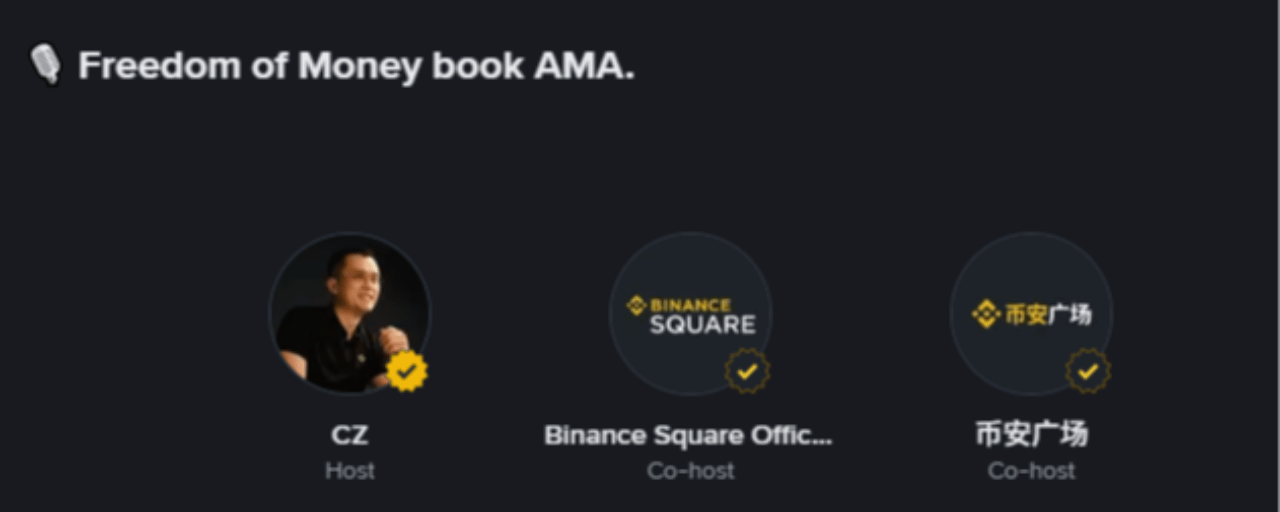
CZ Big Brother joins the live broadcast at Binance Square to interpret the new book. The most comprehensive整理 on the internet is ready for you. Take some time to read it thoroughly, and I believe you'll gain a lot!
--
Disclaimer: Includes third-party opinions. No financial advice. May include sponsored content. See T&Cs.