Many people are now looking at Pixels and still tend to view it from a very old blockchain gaming perspective: Is it gaining popularity again? Can it be mined again? Can it raise the coin price through events? But if you only look at it this way in this round, I think you will miss its truly critical changes. Because what is most worth studying about Pixels now is no longer whether 'a farming game can regain its volume,' but whether it has the opportunity to slowly grow from a single product game into a central hub of a blockchain game ecosystem with content updating capabilities, user filtering capabilities, and multi-game integration capabilities. And this turning point is precisely written in the recent character changes of $PIXEL .
Why do I see it this way? Because the main issue with most GameFi projects in the past has not been 'unable to issue tokens', but rather 'too good at issuing tokens'. They focus all their attention on incentives, and what they ultimately produce is not a game, but a rewards distribution system. New users come in, not for the worldview, not for the gameplay, nor for social connections, but just to withdraw rewards from the system and exchange them for more stable assets. The result is that the more a project emphasizes returns, the more tokens become tools for outflow; the more users there are, the more stable the selling pressure becomes. Many blockchain games do not die due to a lack of players, but rather because everyone only wants to be an ATM inside.
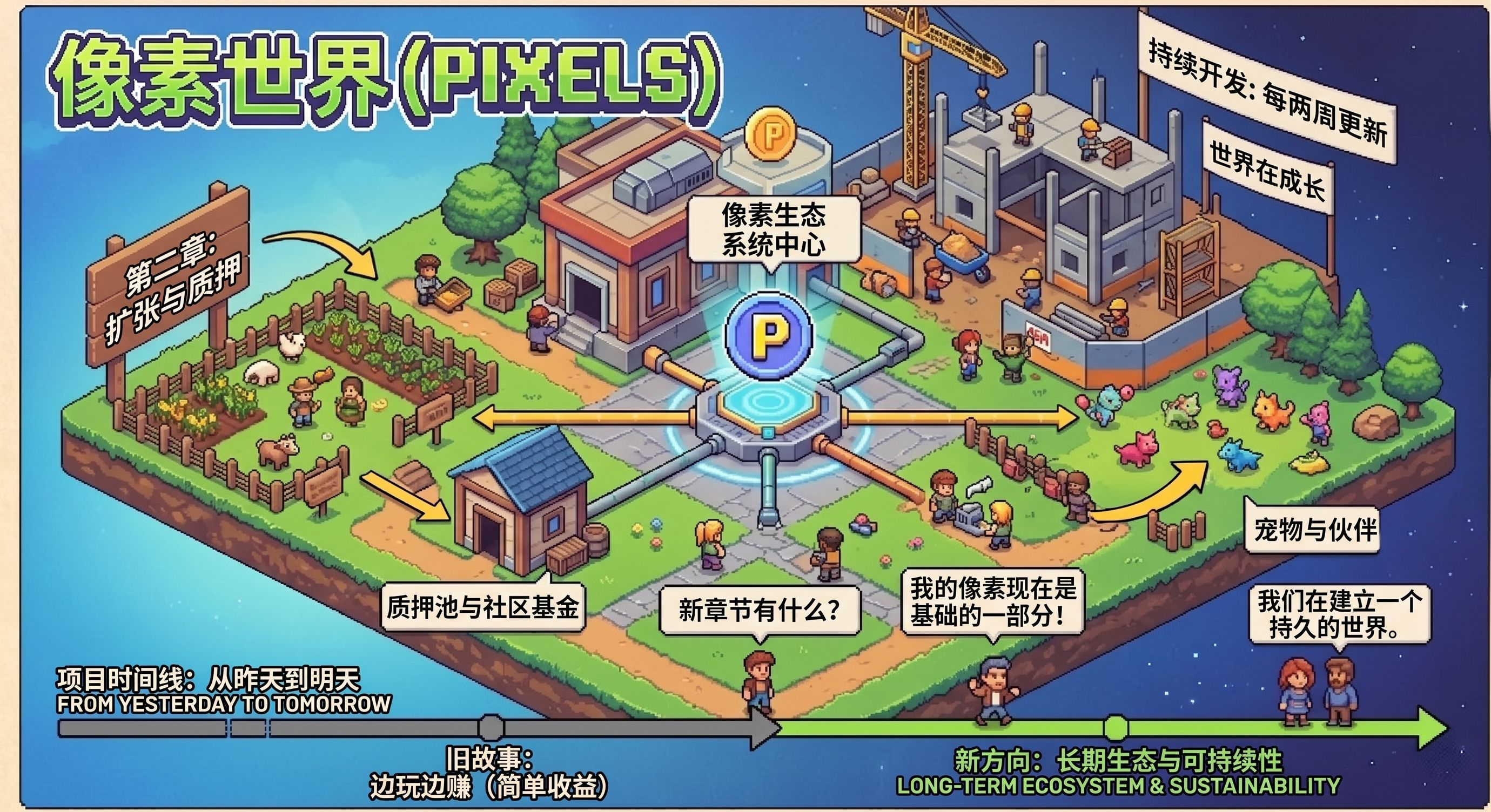
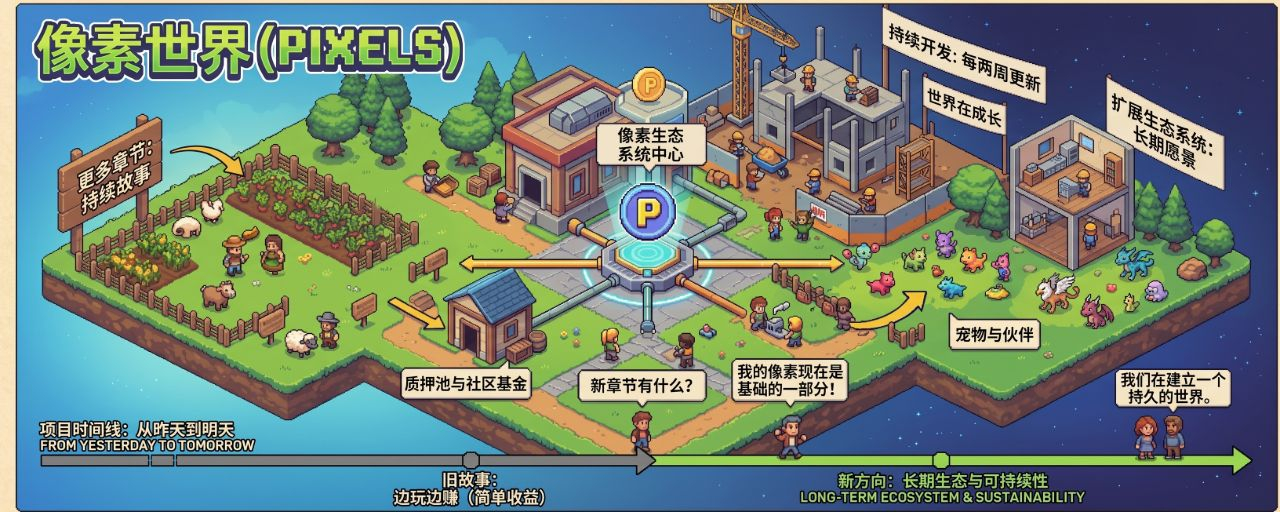
This round of Pixels has made me reassess it because it is starting to very explicitly turn in another direction: not continuing to tell you the old story of 'more play, more earn', but trying to make PIXEL the core of an ecological coordination mechanism. The keywords emphasized on the official website recently are not about a single gameplay, but rather Chapter 2, staking, pets, continuous updates, and platform capabilities. When viewed together, this combination completely changes the flavor. It is not telling you 'there's a new activity you can dive into', but rather informing you 'this world is still expanding, and it’s not just content that’s expanding, but also the economic structure.'
Many people underestimate the expression 'Chapter 2', thinking it’s just an ordinary version update. But in blockchain games, version updates are never just about content; they essentially redefine the project's time scale. Because once a game has no new chapters, no new goals, and no new activity rhythms, even the strongest token narratives will quickly falter. In contrast, as long as the ability to update content remains, the project has a chance to extend users' expectations from 'Can I withdraw today?' to 'What will happen in the next phase?'. That's why I feel that Pixels is not really trying to sell short-term emotions, but rather long-term rhythms. The official website placing 'bi-weekly updates' so prominently is a signal: the team hopes the market begins to understand it as a 'continuously operating world' rather than a 'one-time gaming reward pool'.
But what truly makes me feel that @Pixels is changing is not just content updates, but its increasingly clear attitude toward 'what kind of players deserve rewards'. In the past, many projects verbally opposed studios, witches, and scripts, but in the end, they did not really distinguish between good and bad players in economic design; anyone who was a bit skilled could exploit the system. Pixels is now pushing the concept of Reputation to a more core position, and I believe this is one of the most noteworthy aspects of this round. Because it is no longer just a simple labeling system, but an attempt to let user quality directly determine economic efficiency.
The implications of this matter are significant. A high Reputation user is not just 'looking more respectable', but will feel the difference between themselves and low-quality accounts in very practical areas such as trading, withdrawals, market functions, and even Farmer Fees. In short, Pixels is turning 'real participation' from a vague slogan into a quantifiable, tiered, and profit-influencing economic variable. For blockchain games, this is actually a very critical upgrade. Because as long as a project cannot distinguish between real players and pure arbitrage accounts, it will forever remain in a rough incentive phase; once it can differentiate the costs and returns of these two, the economic system can begin to truly refine.
What’s more interesting is that Pixels has not made Reputation an isolated score, but has linked it to behaviors such as Land, VIP, Pets, Quest, Live Ops, guilds, social ties, and continuous gameplay. Many might think these modules are quite scattered, but I instead believe they are being gradually stitched together into a unified user profile system. Whether you've stayed long-term, whether you've paid for the ecosystem, whether you've participated in activities, whether you've formed social connections, whether you've managed your account into a 'historical' presence, all of these are slowly being incorporated into the same evaluation logic. This way, what Pixels wants to filter is no longer just 'living individuals', but rather 'those worthy of long-term service from this ecosystem'.
And when you look at Reputation and staking together, the role of $PIXEL becomes clearer. It is no longer just a token used for issuing rewards, trading, or volatility; it is gradually taking on the function of 'ecological capital'. The staking logic currently provided by the official team is quite interesting: it’s not just about locking tokens for fixed APR, but allows PIXEL to be staked in different game projects and ecological directions. What does this action essentially mean? It means PIXEL is transitioning from a reward medium for a single game to a resource allocation authority within the entire Pixels ecosystem. What deserves support, what deserves more attention, and which gameplay deserves to retain users, PIXEL is starting to participate in all of this.

This is more important than many people imagine. Because the issue with most blockchain game tokens does not lie in 'whether there are use cases', but rather that all use cases are too shallow. Buying items, drawing cards, upgrading, and reducing transaction fees can all be called use cases, but they are not enough to lead the market to revalue the tokens. What is truly imaginative is when tokens begin to possess the ability to 'organize internal liquidity within the ecosystem'. Pixels is making staking a gateway connecting different projects; this essentially attempts to allow PIXEL to become a directional capital: it is not just circulation, but also participation in support; not just payment, but also participation in selection. As long as this mechanism runs smoothly, PIXEL will be closer to 'ecological underlying assets' rather than 'single-use coupons' compared to traditional blockchain game tokens.
Of course, any GameFi project that only talks about tokens without discussing content will ultimately return to the old path. That’s why I emphasize that the recent changes in Pixels cannot be viewed in isolation. Chapter 2 is about content rhythm, Pets are about light social and emotional ties, Live Ops is about event stickiness, Reputation is about user quality screening, and staking is about ecological capital distribution. Each of these aspects may not seem earth-shattering when viewed alone, but once they are combined, they form a prototype very similar to a 'light MMO social system on-chain'. Users are no longer just coming in to complete tasks; they are forming identities, leaving records, accumulating points, obtaining permissions, and participating in the economy within this world. Thus, PIXEL’s role in this is no longer just about token price fluctuations, but about the value transmission when this system operates.
Another point that I think many people haven't fully grasped is that Pixels has actually been writing its story in the direction of a 'platform' for quite some time. The official website now states clearly that it aims to be a platform where users can build games and natively integrate digital collectibles. If this statement were made in the past, many might have dismissed it as just common buzzwords in blockchain game projects, but in light of the current staking structure, Pixel Dungeons, and the continually expanding ecological gameplay, it is no longer just a slogan. At least in terms of direction, Pixels is no longer satisfied with being a hit farm web game; it wants to become an entry-type universe within the Ronin ecosystem that can accommodate more lightweight gameplay, more social interactions, and more asset support.
Why do I think this line is more important than 'another wave of market'? Because market conditions are the result, not the structure. If a project’s structure does not change, even if it relies on activities to boost emotions, it is hard to go far; but if the structure truly begins to change, even if the short-term market has not fully reassessed, there is still room for continued fermentation. The CreatorPad activities this round will certainly bring new discussions to @Pixels , but for me, this is merely a surface-level catalyst. What truly determines whether PIXEL is worth keeping an eye on going forward still revolves around four matters: first, can the content updates after Chapter 2 continue to maintain the rhythm; second, can Reputation continue to genuinely separate the treatment of 'real players' and 'pure brushing accounts'; third, will the ecological projects connected through staking continue to increase; fourth, will PIXEL gradually remain more within the internal cycles of the ecosystem rather than just being trading chips in the exchanges.
If two to three of these four matters can continue to be fulfilled, I believe the market's valuation method for Pixels will gradually change. By then, when people discuss it, they may no longer just say 'this is an established blockchain game' or 'this is a recovering theme', but will start asking a more critical question: Is there a possibility for Ronin to produce a game ecological hub that truly possesses the ability for sustained content production, continuous social attraction, and enduring economic support? Once this question is seriously discussed by the market, the story of PIXEL will no longer just be about 'whether there will be a rebound', but will escalate to 'can this ecosystem truly accumulate long-term value'.
So if you ask me why Pixels is still worth watching closely this round, my answer is not that its activity reward pool is large, nor that its name is old and its community familiar, but rather that it is gradually breaking away from the old GameFi template of 'high incentives, short retention, and strong selling pressure', and attempting to build something more like an on-chain social system. This involves content, identity, filtering, social interactions, capital allocation, and ambitions for long-term retention. Many projects like to claim they are building ecosystems, but most of the time they merely place a few modules together; what I find more interesting about Pixels now is that it is truly beginning to let these modules interact with each other. For me, this is the reason why PIXEL is most worthy of reevaluation this round: it may not have completed its transformation yet, but it has at least embarked on a path that is harder and has higher limits than just 'issuing rewards'.