
If in previous years most blockchain games were competing in how well they could create momentum, now looking at Pixels, I increasingly feel that what is truly scarce about it is not a specific gameplay mechanic, not a certain version update, and not even completely about the token itself, but rather that it is slowly transforming a Web3 game into a 'sustainable operating system.' This may sound somewhat vague, but if you reexamine the reasons why most GameFi projects fail, you will find that this matter is, in fact, very concrete.
The vast majority of blockchain games die in similar ways. Before launch, they talk about the worldview; at launch, they discuss the profit curve; once the hype builds, they talk about ecological expansion. After the excitement fades, all that’s left for the market is the phrase 'there will be more gameplay in the future.' The problem is, many projects simply do not have the capability to turn 'future' into 'sustainability.' They can execute one airdrop, one event, or one new system launch, but they cannot provide users with a reason to stay every two weeks, they cannot turn short-term stimulation into long-term rhythm, and they cannot turn a one-time entry behavior into a habitual online presence. The most common overestimation in blockchain games is treating 'explosive potential' as 'vitality.'
What Pixels is most worth reevaluating in this round is not whether it can create another surge, but that it increasingly resembles a project that truly understands 'operational rhythm.' Many people underestimate the importance of operational capability, thinking it is less sexy than new gameplay, less stimulating than coin price elasticity, and less easy to spread than airdrops and events. But it is precisely this unassuming capability that determines whether a project can traverse cycles. Because gameplay can be imitated, economic design can be copied, and even a pixel art style, as the most superficial visual symbol, can be quickly replicated. However, the ability to sustain updates, manage user rhythm, connect activities, and expand worlds is the hardest to replicate. It is not a standalone function but a comprehensive set of organizational capabilities.
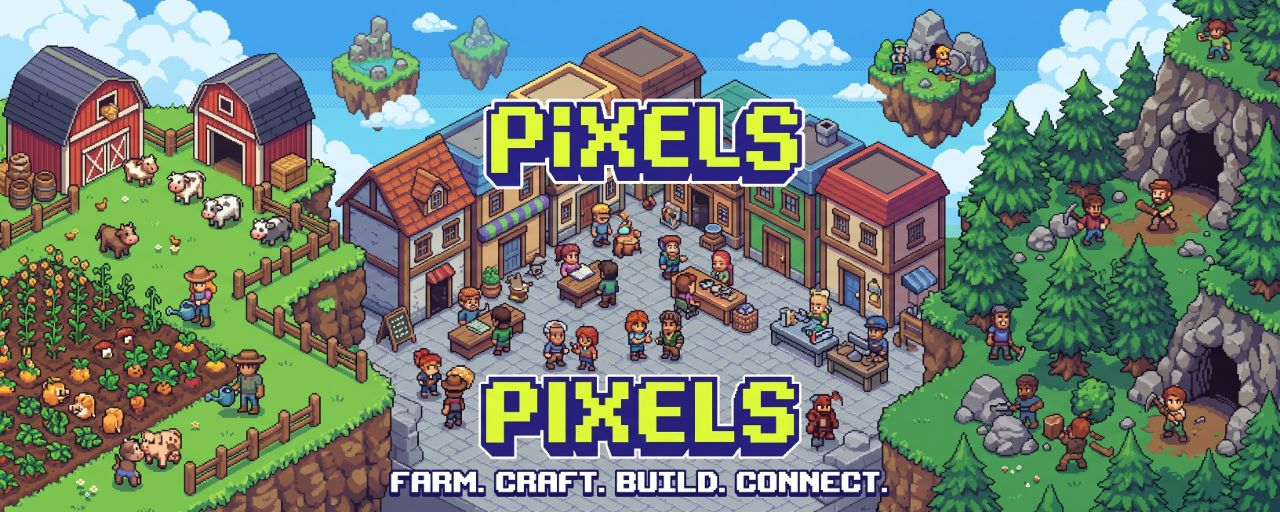
Many people still understand Pixels as staying within the old label of 'farm games.' This label is not wrong, but it is no longer sufficient. Looking at this project today, you will find that what it wants to sell has clearly changed. It no longer just tells you there are crops, land, pets, and tasks, but is continuously sending a stronger signal: this world will not stay in one version; it will continuously grow new layers, connect new gameplay, and pull old users back into the main loop. The significance of Chapter 2 lies here. It is not an ordinary update package, but a traffic light, signaling to the market that the temporal dimension of this project is still extending. Many blockchain games die quickly, essentially due to a short timeline, with everyone only focusing on current outputs and no one truly believing it will still be worth logging in three months later. The most important thing for Pixels right now is to use continuous updates to dismantle this distrust.
And why do I consider 'sustained operational systems' more important than single-point gameplay? Because Web3 games and traditional games have a fundamental difference: they not only need to provide content but also manage economy, community, identity, and exit paths simultaneously. Traditional games do poorly, and players may abandon the game; in blockchain games, if they do poorly, players will not only abandon the game but also take your tokens and liquidity with them. In other words, blockchain games are not merely content industries; they are fundamentally closer to a hybrid of 'content + finance + community.' Such products fear not a design flaw in gameplay, but rather the entire system losing its rhythm. Once the rhythm is lost, content will fragment, users will decouple, and tokens will become mere outflow tools. Many projects appear to die from the coin price, but in reality, they die from operational failures.
The smartest aspect of Pixels is that it has not continued to bet on the kind of one-off hype, but rather has been constantly providing users with reasons to 'come back and take a look.' Whether it's Chapter 2, Pets, tasks, or Live Ops, even the later staking, platformization, and multi-game support, they are essentially not isolated modules, but rather serve the same purpose: to keep this world dynamic instead of being consumed all at once. Users do not come in to complete a task list and leave; they are continuously pulled back into the system by new goals, new identities, and new resource allocation relationships. The real competition in blockchain games is not about who can make the best promises, but about who can make players expect that 'logging in next time will still be meaningful.'
Many people do not fully realize how valuable sustained operational capability is in blockchain games. The market is usually better at valuing 'new things' rather than 'the ability to keep going.' But the reality is quite the opposite. It is not particularly difficult for a project to come up with an interesting gameplay, but it is difficult to continuously operate that gameplay around economy and identity for one or two years, and still keep pulling users back into the main loop. The cheapest thing in the GameFi industry is the concept; the most expensive is execution. And the most costly layer of execution is not the development itself, but the ability to continue to operate stably, frequently, and rhythmically after the development is completed. To put it bluntly, what Pixels resembles the most now is not an 'old project that is still alive,' but a team that has gradually mastered the methodology of long-term online game operation.
The greatest value of this methodology is not just to increase retention but to reshape the meaning of tokens in the process. Previously, many blockchain game tokens were essentially just 'endpoints for reward distribution.' Regardless of how complex the project design is, what users ultimately do often ends up being the same: withdraw the tokens, sell them, and finish. The issue with that model is not that it lacks use cases, but that all use cases are too short. Short enough to be unable to support long-term expectations, short enough to make the market doubt that it is truly linked with user retention. Once a project possesses sustained operational capabilities, tokens have the chance to transform from an 'endpoint' into a 'hub within the process.' Because as long as content continues to be released, activities continue to iterate, and ecosystems continue to expand, the relationship between users and tokens will not remain a one-off game but will be continuously reorganized. For me, this is what makes Pixels worth watching: it is not about whether a new version can stimulate a price rally, but whether it has the capability to continuously create new token use scenarios and new reasons for user engagement.
Moreover, the key point is that Pixels does not understand 'sustained operation' as simply doing more activities but is growing towards platformization. The official website now describes itself not just as a game but as a foundational platform that allows users to build new games and natively integrate digital collectibles. If this statement were made about other projects, I might find it a bit empty, but in the case of Pixels, it feels fitting. Because only when a project possesses sustained operational capabilities can it be worthy of discussing platforms. A platform without sustained operational capability will only become a collection of entry points; only a platform that can continuously create rhythm, maintain order, and keep users returning is qualified to carry more gameplay. In other words, a platform is not just about creating a few sub-games; at its core, a platform is an ability to 'manage complexity.' Looking at Pixels now, it has at least started to move in this direction.
This is also why I feel many people's valuation logic is still stuck in the past. People are still accustomed to asking: How many people are playing this game? Is the heat of this event large? Can the version update bring about a data rebound? These questions are certainly important, but they remain on the surface. The truly critical questions should be: Has it made the most fragile connection in blockchain games—the connection between content and economy—more stable? Has it fostered a sustained expectation for the future of this world among players? Has it gradually shifted the project from being 'event-driven' to 'system-driven'? If the answers to these questions increasingly lean towards 'yes,' then its upper limit is naturally no longer the traditional concept of a farm blockchain game.
Furthermore, sustained operational capability has another often-overlooked byproduct: it will gradually improve the user structure. Short-term players prefer one-off high stimulation, high APR, high subsidies, and high volatility; those willing to stay long-term care more about stable content, stable rhythm, stable identity accumulation, and stable expectations. As long as the project increasingly leans towards sustained operation, the users it attracts will gradually shift from 'those who come to take advantage' to 'those who are willing to manage their accounts.' This kind of change does not happen overnight, but once it occurs, the entire ecosystem's flavor will change. You will find discussions no longer centered solely on profit strategies but begin to include content discussions, resource allocation discussions, identity position discussions, and ecological expansion discussions. This structural change in discussions is itself a manifestation of project maturity. A truly healthy blockchain game not only encourages users to discuss how much they earn but also prompts users to discuss how this world will grow next.
So now when I look at @Pixels , what I'm most interested in is not its single-point features, but whether it continues to deepen the concept of 'sustained operational systems.' For example, can bi-weekly updates be maintained; will there be new content layers after Chapter 2; can staking go beyond just locking assets and be linked with more ecological gameplay; can platform narratives evolve from mere slogans on the official website into increasingly specific carrying capabilities; can communities and events continuously pull old users back into the main loop. These questions may not seem so exciting, but they precisely determine the most important thing: whether this project is just a blockchain game that is occasionally remembered by the market, or a Web3 game world that truly possesses long-term operational capabilities.
I even think that what Pixels is most worth reevaluating in the market right now is not short-term elasticity, but the ability to 'organize time.' Many projects can organize traffic, organize emotions, and organize one-time rewards, but they cannot organize time. They do not break down user attention into multiple stages, do not expand the world into multiple connectable layers, and do not establish a real connection between today's login and next month's expectations. But once a project learns to organize time, it is no longer just a content producer, but begins to become a rhythm distributor. Why do users log in today, why do they come back next week, and why are they willing to continue investing next month? All of these will gradually be incorporated into the same system. This ability may seem the most abstract, but in reality, it is the most solid. Because what it determines is not just the data of a single day, but whether a project can have a 'future.'
So if you ask me why this round is still worth serious attention @Pixels , my answer is no longer 'Is it an old Ronin project?' or 'Does it have a new chapter?' and 'Will the coin price bounce back?' but rather that it is trying to prove a more difficult thing: blockchain games do not have to live like one-off financial products; they can also become a long-term operational system that continuously expands, updates, and creates online reasons. As long as this continues to be validated, the meaning of $PIXEL will not stop at reward coins, nor will it stop at hot events, but will gradually transform into the value hub of how this system continues to operate, expand, and attract users. For me, this is the most imaginative and easily underestimated aspect of Pixels right now. Not because it tells a newer story, but because it has finally started to show that it may really have the ability to tell this story long-term.
