
This “safe haven” breakdown might actually be the most important macro signal right now

There’s a moment in every cycle where things stop behaving the way they’re supposed to. This feels like one of those moments.
Gold should be flying right now.
Geopolitical tensions are rising. Oil has surged. Uncertainty is everywhere.

And yet… gold is down. Silver is down even more.
That contradiction is what caught my attention. Because when an asset refuses to behave according to its narrative, it usually means the narrative itself is wrong.
Gold Isn’t Behaving Like a Safe Haven Right Now
Let’s start with what’s clear.
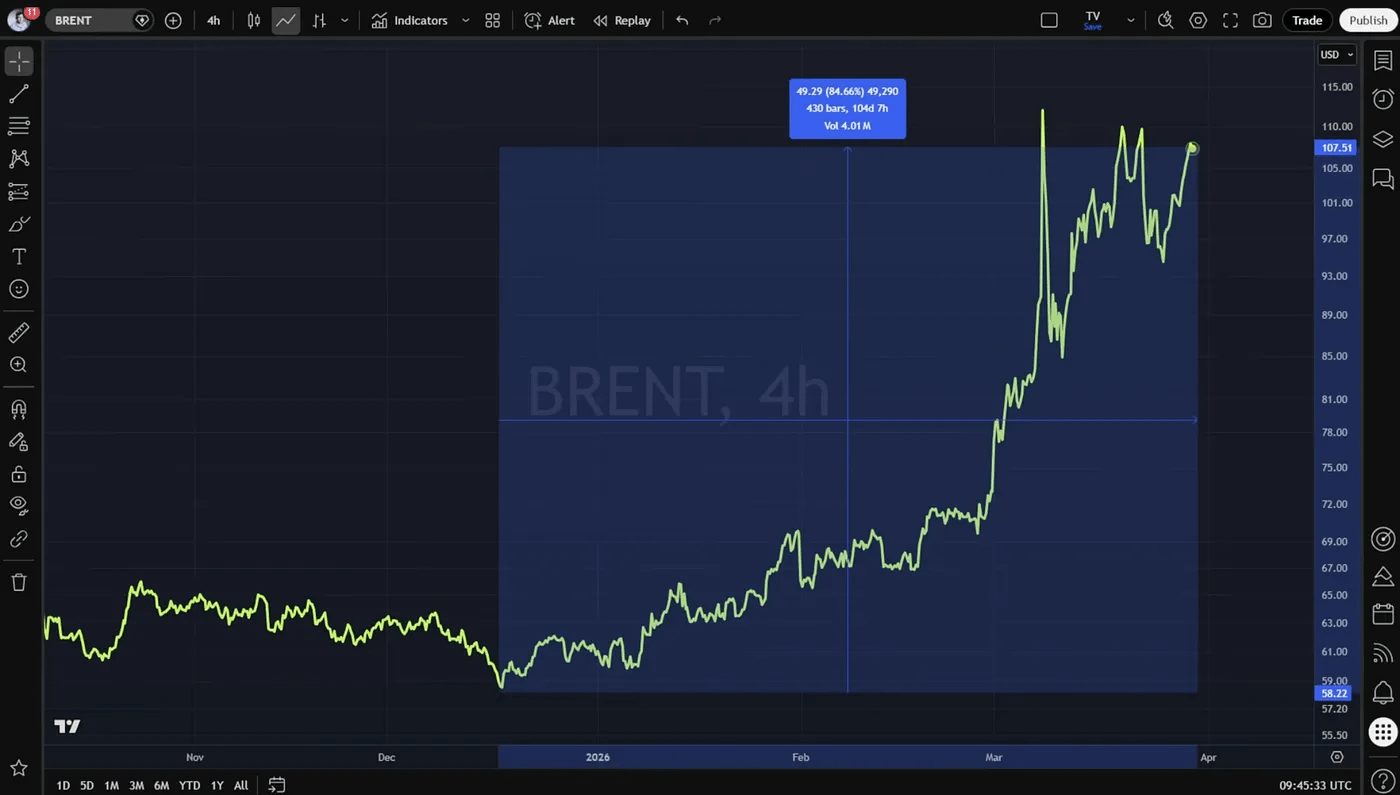
Gold is down roughly 18%, silver has dropped close to 41%, while oil has rallied about 84% in a short span.
That’s not just a small disconnect.
That’s a major shift in how the market is positioning.
For years, the narrative has been straightforward:
Crisis → gold
Inflation → gold
Currency weakness → gold
But markets don’t reward consensus.
They move ahead of it.
That’s where things get interesting.
Gold didn’t suddenly stop being a safe haven.
It likely already played that role before most people caught on.
Markets Move on Expectations, Not Events
This is where most people get it wrong.
They focus on what’s happening now and expect price to react instantly. But markets don’t work like that. They move ahead of reality.
Gold’s run over the past few years wasn’t random. It was pricing in:
Dollar weakness
Geopolitical tension
Loose monetary policy
And to be fair, all of that played out.
But by the time it became obvious, the opportunity was already gone.
So what we’re seeing now isn’t gold breaking down.
It’s the aftermath of a move that happened too early.
Looking at Prices in USD Can Be Misleading
This is where a lot of analysis falls apart.
Everyone measures performance in dollars. But the dollar itself is constantly being diluted.
Money supply in the US grows around 6.8% annually. That creates a natural upward drift in asset prices over time.
So when people say “gold is up” or “stocks are up,” a big part of that move is just currency losing value.
A better way to look at it is relative value.
Instead of asking what gold is worth in dollars, ask what it’s worth compared to stocks, liquidity, or other assets.
That’s where the real signals start to show up.
Gold vs. Stocks
Zooming out helps put things in perspective.
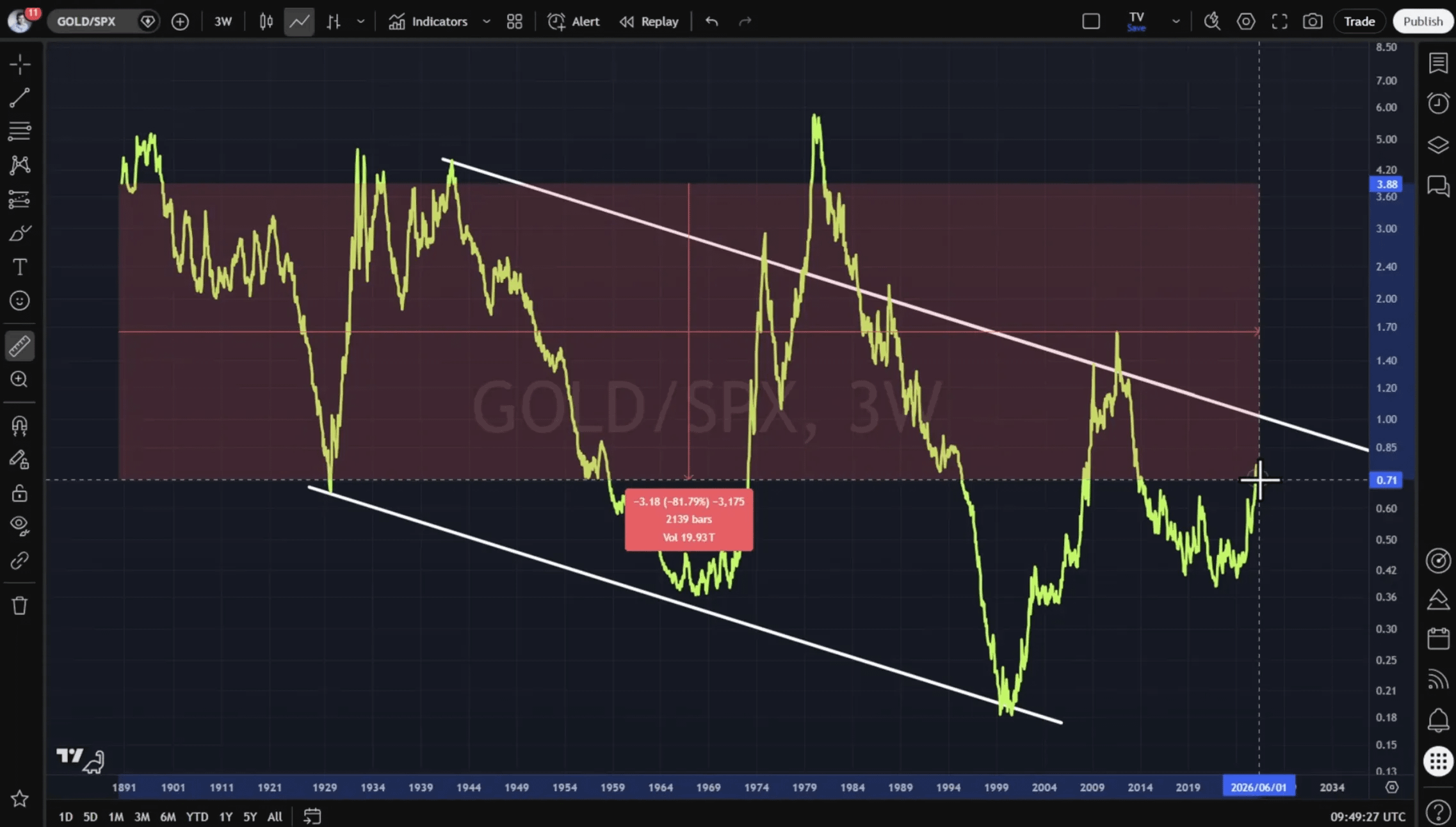
Over the past 140 years, gold has underperformed the S&P 500 by about 81%.
That catches a lot of people off guard. Gold is often seen as the ultimate store of value. But over long periods, productive assets like businesses tend to win.
Still, it’s never a straight trend.
These markets move in long cycles. There are phases where:
Stocks dominate gold
And phases where gold significantly outperforms stocks
For example:
One period saw gold fall 92% relative to stocks
Another saw gold surge around 1500% relative to stocks
So it’s not about choosing one “perfect” asset.
It’s about understanding the cycle you’re in.
Where Things Stand Now
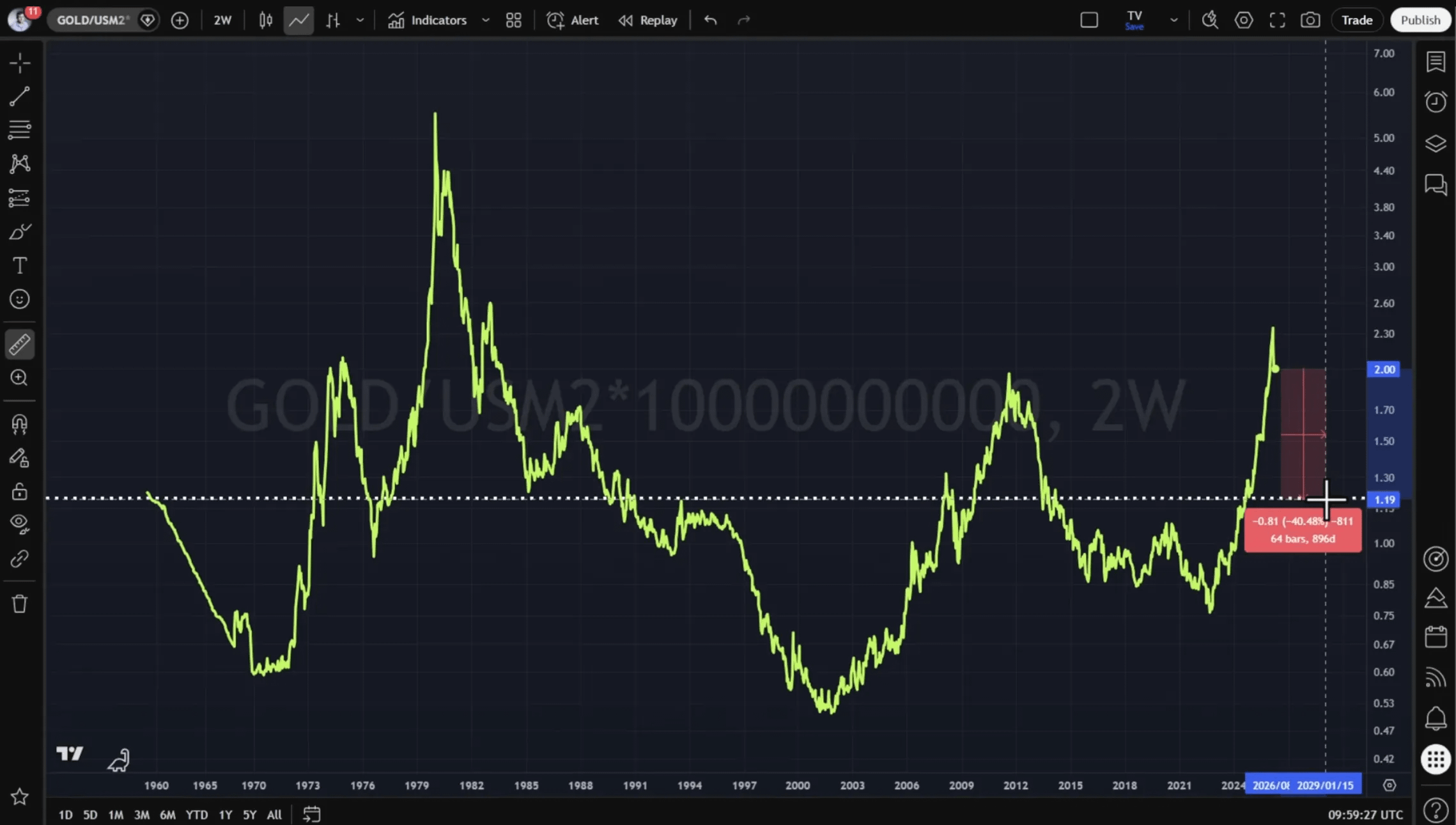
Looking at gold relative to the S&P 500 and the US money supply, it appears stretched.
Over the last four years, gold has outpaced money supply growth by roughly 200%.
Historically, when assets move that far from equilibrium, they tend to mean revert.
If that plays out, a move of around 40% to the downside would bring gold closer to more balanced levels.
That doesn’t guarantee it happens.
But it does suggest the risk-reward is starting to tilt.
Stocks Are Also Pushing Extremes
It’s not just gold.
Equities are stretched too.
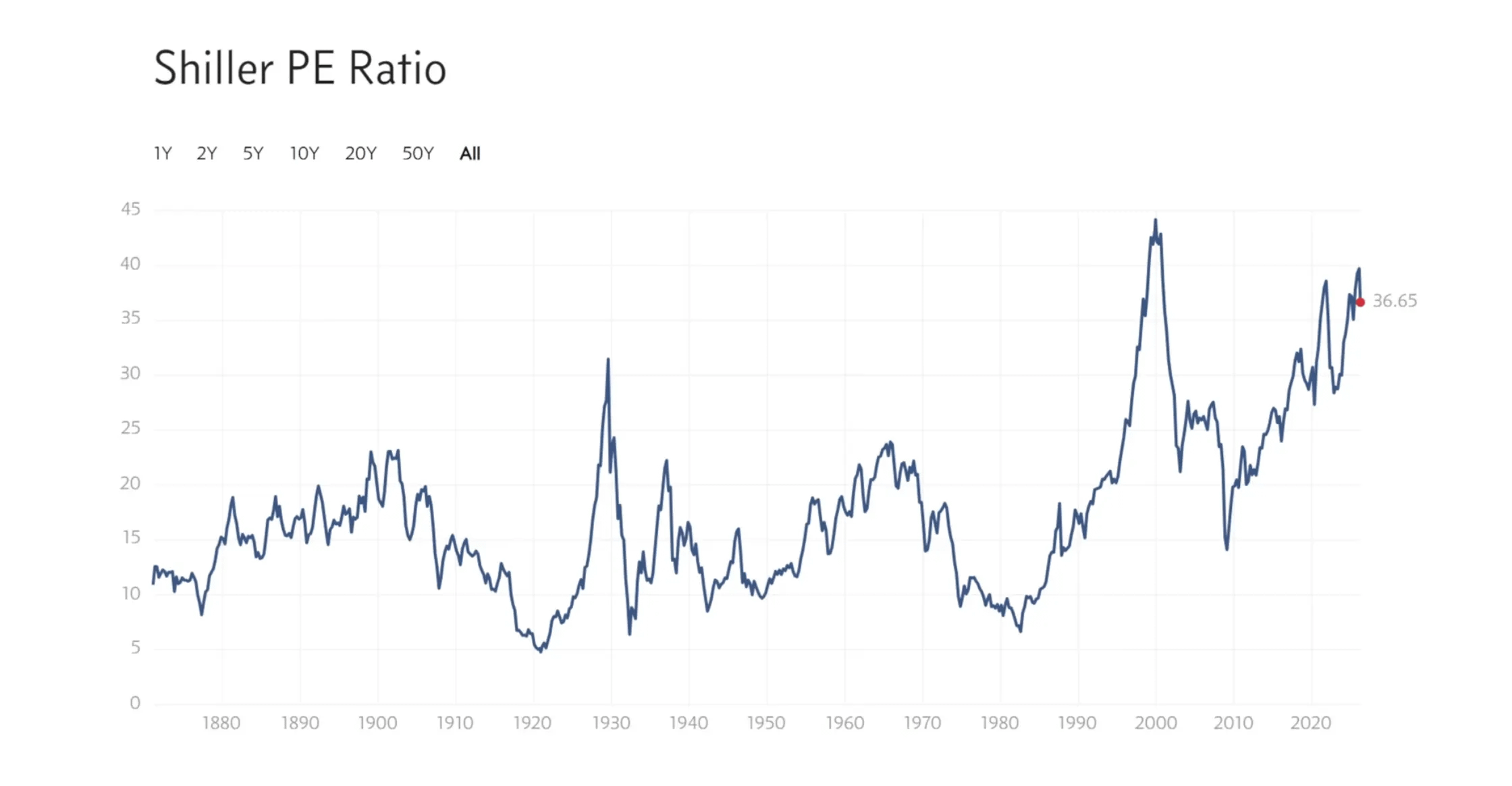
The Shiller PE ratio, one of the more reliable long-term gauges, is sitting near levels last seen during the dot-com era.
Historically, when valuations get this elevated:
Forward returns tend to compress
Drawdowns become more probable
Recovery cycles take much longer than expected
We’ve been here before.
After major peaks:
The Great Depression took decades to fully recover
The dot-com bubble needed over a decade in real terms
In some cases, getting back to prior highs adjusted for inflation took 25 to 35 years.
That’s the part most investors underestimate.
So If Both Gold and Stocks Are Expensive… Then What?
This is the part most people avoid.
The usual approach assumes you can rotate between:
Stocks
Gold
Real estate
But what happens when everything looks stretched at the same time?
That’s where the environment shifts.
It’s less about chasing upside and more about managing expectations.
We’re likely moving into a phase where:
Valuations across major assets are elevated
Returns start to compress
Passive strategies don’t work as easily
Here’s the key detail many overlook.
Gold doesn’t need a strong rally to outperform.
If equities go through a deeper correction, gold can come out ahead simply by holding value better or declining less.
So the next phase could look like:
Stocks pulling back hard
Gold staying relatively stable
That relative outperformance being misread as a new bull run
That’s very different from a full-blown breakout narrative.

The Bigger Problem: Wealth Creation vs Redistribution
There’s a deeper layer to all of this.
Financial markets have expanded far faster than the real economy. At some point, that gap has to close. And historically, that doesn’t happen through endless growth.
It happens through:
Repricing
Redistribution
Long stretches of low or even negative returns
That’s why cycles matter.
They’re not just about price moves. They reflect how capital shifts across the system over time.
Timing Matters More Than Ever
One thing keeps coming up for me:
Holding blindly isn’t always enough.
That strategy works best when:
You’re entering undervalued markets
You’re early in the cycle
But when everything is already extended, timing starts to matter more.
Not in the sense of calling exact tops or bottoms, but in:
Recognizing valuation extremes
Adjusting exposure
Staying flexible
Because cycles reward those who adapt.
When I step back and connect everything, this is how it looks:
Gold pulling back doesn’t mean it failed. It may have already peaked relative to other assets
Stocks are priced close to perfection, which rarely holds
The dollar continues to lose purchasing power, distorting price perception
Long-term cycles suggest a transition phase, not continuation
And most important, this market isn’t easy.
There are phases where momentum carries everything. This doesn’t feel like one of them.
This is where:
Old assumptions break
Narratives stop working
Independent thinking starts to matter
Gold not reacting to chaos is one of those signals.
It pushes a better question:
What if the market isn’t wrong
What if the framework needs to change
That’s usually where the real edge starts to form.