
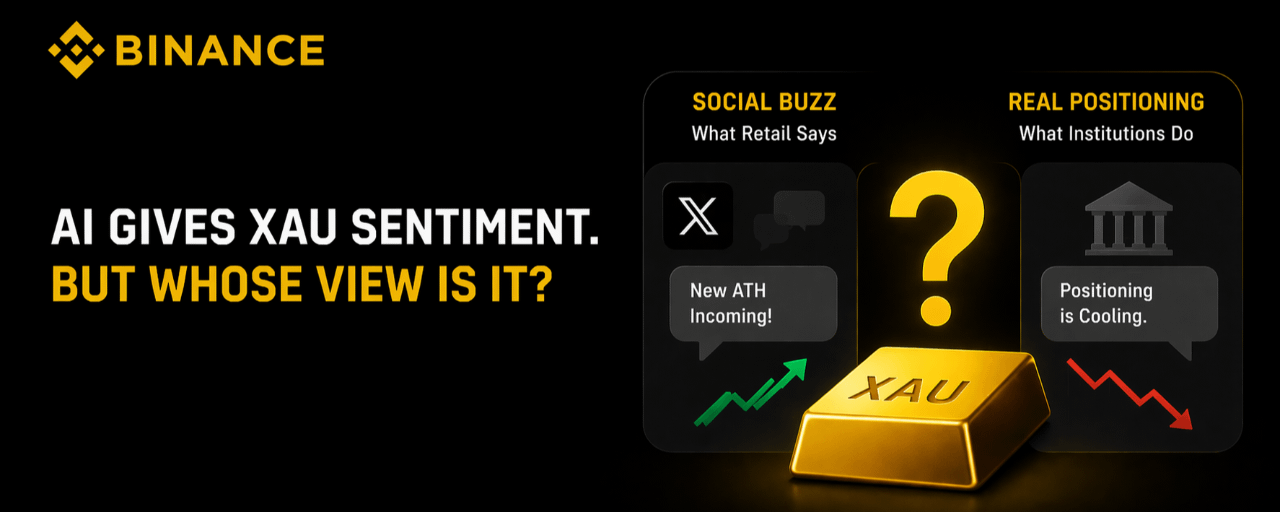
I started to pay attention to this in a rather strange situation.
A sunny afternoon in Hanoi, Binance AI Pro issued a signal to hold positions in gold. Meanwhile, on social media, almost everything leans towards a bullish scenario. The geopolitical news is dense, with many large accounts discussing the potential for a new peak, and the volume of discussions has increased significantly.
If you only look at Twitter, it is very hard not to get swept away.
But I still lean towards AI. The problem is that I don't really know why I should trust it more.
And the question starts from there.
In trading, sentiment is not a single thing. There are at least two completely different understandings.
On one side is market sentiment expressed through social media. This type reacts quickly, updates continuously, is easy to observe but also very prone to noise. Just a few large accounts or a strong news flow can significantly skew the overall viewpoint.
The other side is how large institutions are truly betting. Data such as position reports in the futures market, inflows into gold ETFs, or changes in physical demand. These things are not noisy, do not appear frequently, but reflect the behavior of large capital flows.
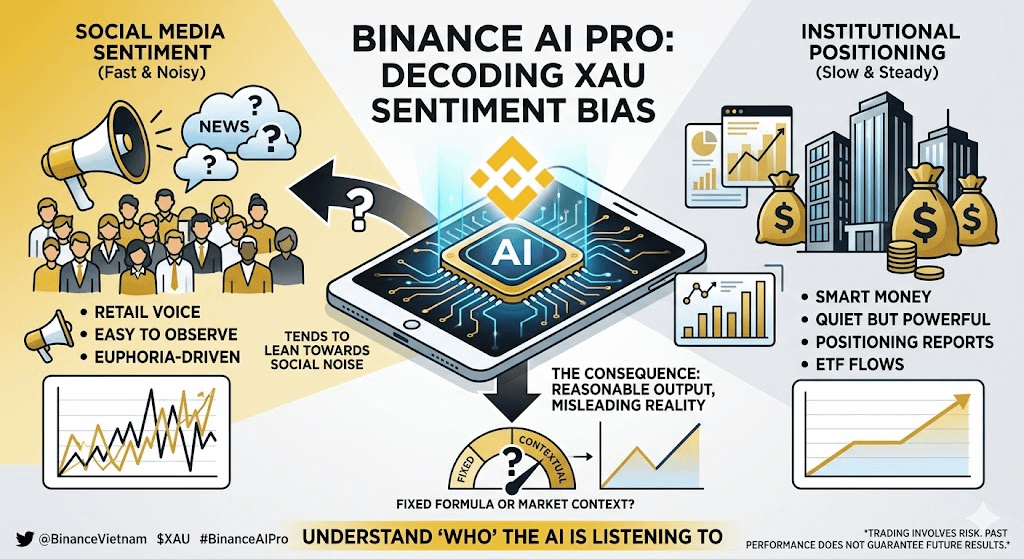
It is noteworthy that these two types often do not go together.
There are times when the market looks very bullish on the surface, but large capital is reducing positions. At that time, emotions and actions no longer match.
I have tried to observe this for a short period. Every time AI Pro mentions sentiment with $XAU , I cross-reference it with positioning data and what is happening on social media.
There are times when these two sources clearly go against each other.
And what makes me think is that AI often leans more towards reflecting from social media.
There is not enough data to draw a definite conclusion. But if that is the case, the issue does not lie in AI analyzing incorrectly, but rather in the input data.
If sentiment is primarily built from the voices of retail while the market is being led by large capital, then the results may still be 'logical' but do not accurately reflect the actual price movements.
This is a type of bias that is hard to detect because the output still looks convincing.
I do not think this is a reason to overlook AI Pro. On the contrary, it helps me synthesize information much faster than doing it myself.
But for markets like gold, where institutional money plays a significant role, understanding who AI is listening to is just as important as reading the signals it provides.
Ultimately, what I am unclear about is whether the system can distinguish market context. When to prioritize fast but noisy data, and when to rely on slower but more accurate data.
Or everything is still processed according to a fixed formula, regardless of the market's state.
Trading always carries risks. The proposals generated by AI are not financial advice. Past performance does not reflect future results. Please check the availability of the product in your area.