
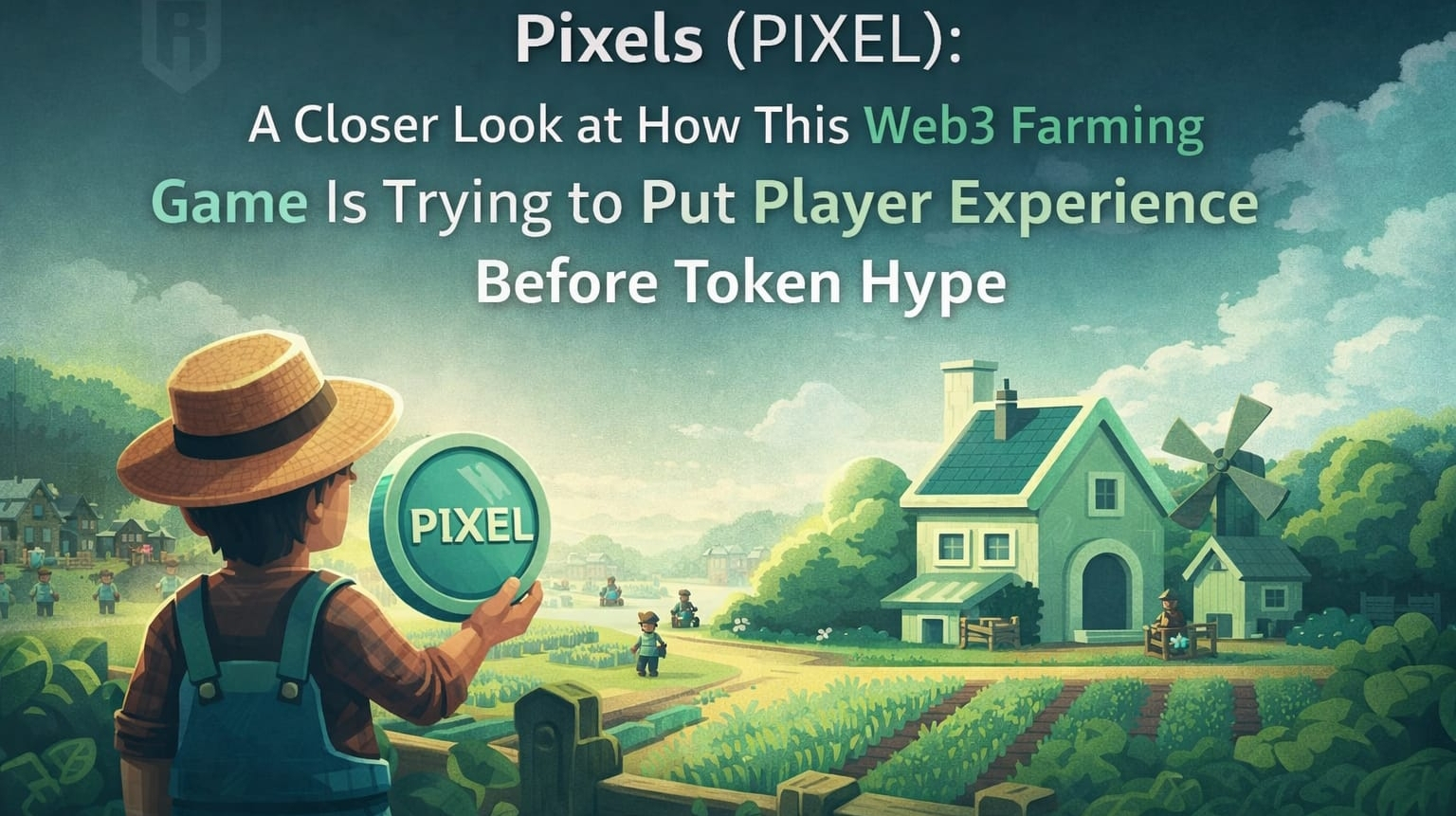
When I first started looking into Pixels, my first impression was that it was just a simple farming game with a Web3 label on it. It looked colorful, social, and easy to understand. A player can grow crops, collect items, move around the world, and spend time with other players. But the more I looked at it, the more I felt that Pixels is trying to do more than just offer a casual game. From what I understand, it is trying to solve one of the biggest problems in blockchain gaming: how to use Web3 in a way that supports the player experience instead of making the whole game feel like a money system.
This is the first thing that made me take Pixels seriously. In many Web3 games I have seen before, the reward model became bigger than the game itself. The focus slowly moved away from fun and moved toward earning. When that happens, the world stops feeling like a game and starts feeling like a system people use for extraction. In my opinion, Pixels seems to be trying to avoid that mistake. What I notice here is that the game experience comes first, while the blockchain side feels more like a layer in the background.
From my own observation, Pixels is built on familiar ideas, and I think that is a smart decision. Farming, exploration, collecting, crafting, and social interaction are things that many players already understand. Because of this, the game feels more approachable. A player does not need deep crypto knowledge to start playing. They can simply enter the world, do tasks, gather resources, improve slowly, and understand the rhythm of the game through normal play. To me, this matters a lot, because one of the biggest weaknesses in Web3 gaming has been making people learn the economy before they can enjoy the world.
What stands out to me most is that Pixels does not seem to treat blockchain as the main attraction. I personally think this is one of its better qualities. In many blockchain projects, the technology is presented as the most important thing, and the actual experience becomes secondary. But in Pixels, I get the feeling that blockchain is being used more as a tool than as an identity. Ownership, digital assets, and token mechanics are there, but they do not completely take over the purpose of the game. That makes the project feel more thoughtful to me.
When I look at the PIXEL token, I do not see it as something that should be judged only by price or market excitement. From my point of view, the more important question is how it fits into the game and the wider ecosystem. A token only becomes meaningful when it has a clear role. Otherwise, it becomes just another asset people trade without caring about the actual product behind it. What I understand from Pixels is that the token is meant to have a practical place inside the ecosystem, especially in premium actions and broader participation. That makes more sense to me than a model where one token is forced to carry the entire game economy on its back.
I also think the project is trying to show a more careful attitude toward sustainability. This is something I respect. In crypto-related gaming, it is very easy to create short-term attention by promising rewards, but it is much harder to build something that remains healthy over time. From what I can see, Pixels appears to be moving away from the older idea that players should stay mainly because of token payouts. Instead, it seems to be leaning more toward the idea that players should stay because the world itself feels rewarding, active, and enjoyable to return to.
Another thing I noticed is that Pixels does not feel limited to being only one farming game. The more I look at it, the more it seems like the team wants to build something wider than a single title. I get the impression that Pixels is also thinking about ecosystem growth, connected experiences, and a broader network where digital identity, player activity, and assets can have value beyond one isolated game loop. In my opinion, this is one of the more ambitious sides of the project, because it shows that the team may be thinking beyond short-term engagement.
At the same time, I do not want to describe it in a one-sided way. I think Pixels has strengths, but it also has real challenges. The biggest challenge, in my view, is execution. It is not easy to build a game that feels fun, social, stable, and economically balanced at the same time. When blockchain is added into that mix, the difficulty becomes even greater. A project can have a good idea and still struggle in practice. So for me, the real test is not the concept itself. The real test is whether Pixels can keep the experience healthy over time without letting the economy damage the game.
I also think it is important to be realistic about token-based ecosystems in general. Even when a project has good design, it still lives inside a market environment that can affect user behavior. If the market becomes weak, confidence can drop. If speculation becomes too strong, the game can lose balance in another way. This is why I do not think Pixels should be judged only by hype, attention, or token price. I believe it should be judged by deeper things like player retention, design consistency, economic stability, and whether people actually enjoy spending time in the world.
What I personally appreciate is that Pixels seems to show some learning from earlier Web3 gaming mistakes. It does not give me the impression that it is trying to rely only on noise or exaggerated promises. Instead, it feels like it is trying to build a world that people can understand and return to naturally. To me, that is a much healthier direction. The strongest online games are usually not the ones that only reward people. They are the ones that create a sense of place, routine, and connection.
In the end, my honest view is that Pixels becomes more interesting the more carefully I look at it. At first, it can seem like just another casual blockchain game, but after studying it more closely, I feel it represents a more mature idea. It seems to understand that players do not stay in a virtual world only because there is value to extract. They stay because the experience feels comfortable, meaningful, and worth returning to. That is why I think Pixels deserves attention. Not because it is the loudest project, but because it appears to be trying to build something in a calmer and more thoughtful way.
If I had to describe Pixels in a simple way based on my own understanding, I would say this: it feels like a project that is trying to make Web3 gaming feel more human. And in my opinion, that may be one of the most important things a blockchain game can try to do.