
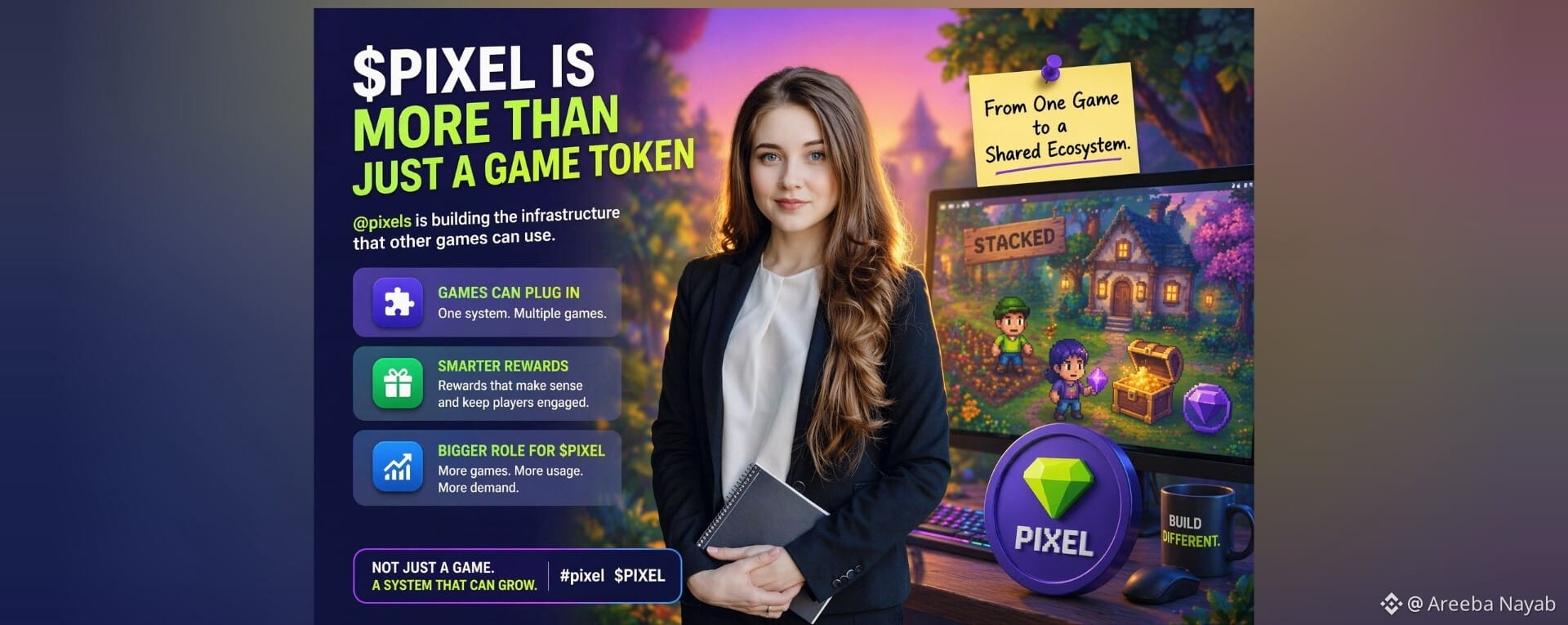
A lot of people still look at @undefined like it’s just another Web3 game.
But the direction they’re taking with Stacked suggests something different.
Instead of building only for one game, they’re building a system that other games can actually use.
And that changes how you look at $PIXEL.
Right now, most game tokens depend on the success of a single title.
If the game slows down, the token usually follows.
But if a token starts getting used across multiple games, the situation shifts.
It’s no longer tied to just one player base.
It starts getting exposure from different ecosystems at the same time.
That’s where Stacked becomes important.
It’s not just about rewards, it’s about creating a system where:
1. games can plug in
2. rewards can be distributed smarter
3. and player activity actually means something
If this expands, then $PIXEL naturally becomes part of that flow.
More games using the system → more reward distribution → more visibility for the token.
Also, from a business side, it makes sense.
Studios already spend a lot on acquiring users.
If Stacked helps them redirect that spending into player rewards instead,
it becomes easier to track what’s actually working.
That kind of setup is more practical than just running ads and hoping for retention.
Of course, it’s still early.
But compared to most projects that stay limited to one idea,
this feels like it’s opening up into something broader.
That’s why I don’t just see @Pixels as a game anymore.
It’s starting to look like a system other games might rely on.
And if that happens, $PIXEL won’t stay small.
