
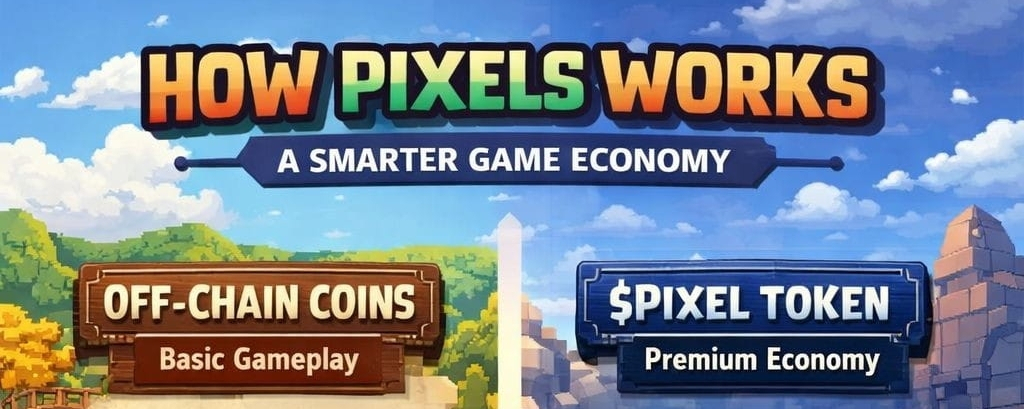
When I look at Pixels, I don’t see a game trying to compete with high-end graphics or fast-paced action, I see a system quietly asking what happens to the effort people put into digital worlds. Every day, people spend hours building, collecting, and progressing inside games, yet most of that effort disappears the moment they leave. Pixels takes a different direction, not by making things louder or more complex, but by trying to make that effort stay in some form, even outside the game itself.
The experience begins in a simple way. You farm, you explore, you gather resources, and you slowly build something that feels like your own space. There is no rush, no constant pressure to keep up. This slower rhythm is not accidental, it creates room for players to engage naturally instead of chasing short-term rewards. Underneath this calm surface, there is a system designed to connect actions with lasting outcomes. Because it runs on the Ronin Network, these actions can be recorded and settled without making the experience feel heavy or expensive. The technology supports the system quietly instead of dominating it.
What makes this approach interesting is how it blends familiarity with a new kind of structure. The gameplay itself is easy to understand, but the meaning behind it shifts slightly. When you plant a crop or collect an item, it is not just part of a closed loop controlled entirely by developers. Some parts of that loop extend outward, where assets and tokens exist beyond a single server. This does not suddenly solve the problem of ownership, but it changes the direction. It introduces persistence into places where there was none before.
In real-world systems, value depends on coordination. People agree on what something is worth, and that shared belief creates a functioning economy. Pixels reflects a smaller version of this idea. Players interact with each other, trade resources, and make decisions about how to use what they earn. These actions form a basic economic layer, not because the game forces it, but because the structure allows it to emerge. The PIXEL token plays a role here, not as the main attraction, but as a tool that connects effort with possibility. It creates small moments where players decide how to spend, save, or use what they have, and these decisions shape the system over time.
The challenge with any token-based system is maintaining balance. If rewards come too easily, players focus on extracting value instead of contributing to the world. If rewards feel too distant, engagement drops. Pixels tries to sit somewhere in the middle by linking rewards to activity and participation. The idea is to keep players inside the loop, where effort leads to resources, and resources lead back into meaningful choices. This is not a fixed solution, it is something that needs constant adjustment as player behavior evolves.
Another layer that quietly shapes the experience is the sense of presence. In many games, players exist in parallel without truly affecting each other. Here, there is an effort to make the world feel shared. Visiting another player’s land, seeing how they build, interacting with their environment, these small moments create a feeling that the world is active rather than static. This matters because economies are not just about numbers, they are about participation. Without visible activity, value feels disconnected from reality.
The connection to the Ronin ecosystem adds another dimension. Pixels is not isolated, it sits within a network that includes wallets, marketplaces, and other projects. This creates pathways for value and identity to move beyond a single game. Instead of being locked into one environment, players become part of a broader system. At the same time, this connection introduces dependency. The strength of the surrounding network influences how stable and useful the game can be over time.
From a deeper perspective, Pixels operates between two layers, interaction and settlement. Interaction happens inside the game, where players make choices, build, and engage with others. Settlement happens on the blockchain, where ownership and transactions are recorded in a persistent way. The strength of the system depends on how smoothly these layers connect. If settlement becomes too visible, it disrupts the experience. If it is too hidden, it loses its purpose. The balance between these layers is what determines whether the system feels natural or forced.
Looking ahead, the direction of the project depends on how well it can expand without losing its core simplicity. Adding new features is not enough, those features need to connect back to the main loop in a meaningful way. If the system becomes too complex, it risks pushing away new players. If it stays too basic, it may not hold long-term interest. Finding that middle ground is one of the hardest parts of building a system like this.
There are also risks that cannot be ignored. One of the biggest is the nature of incentives. If too many players join only for short-term gains, the system becomes unstable when those gains slow down. This has been a common pattern in many Web3 projects. Pixels tries to reduce this risk by focusing on a playable and enjoyable experience, but the presence of tokens always introduces a layer of expectation that needs to be managed carefully.
Another challenge is fairness over time. Early participants often have advantages, and if those advantages grow too large, new players may feel excluded. This creates a form of imbalance that can weaken the system from within. Designing a system where both early and new participants can find value is not just a technical issue, it is a question of long-term sustainability.
Durability is another important factor. What happens when growth slows, or when the broader market faces pressure? Systems that rely only on constant expansion tend to struggle in these conditions. For Pixels to remain relevant, it needs to function even when fewer players are joining. This means the internal loops of effort, reward, and participation must hold together without depending on external momentum.
In the end, Pixels is not just experimenting with a game, it is experimenting with how digital effort can carry weight. It is exploring whether small actions inside a virtual world can create something that persists, something that feels meaningful beyond the moment. Under ideal conditions, this idea feels promising. Under stress, it reveals the limits of design, incentives, and coordination. That is why it matters. It is not about proving that everything works perfectly, but about understanding what holds up when conditions are no longer easy.