
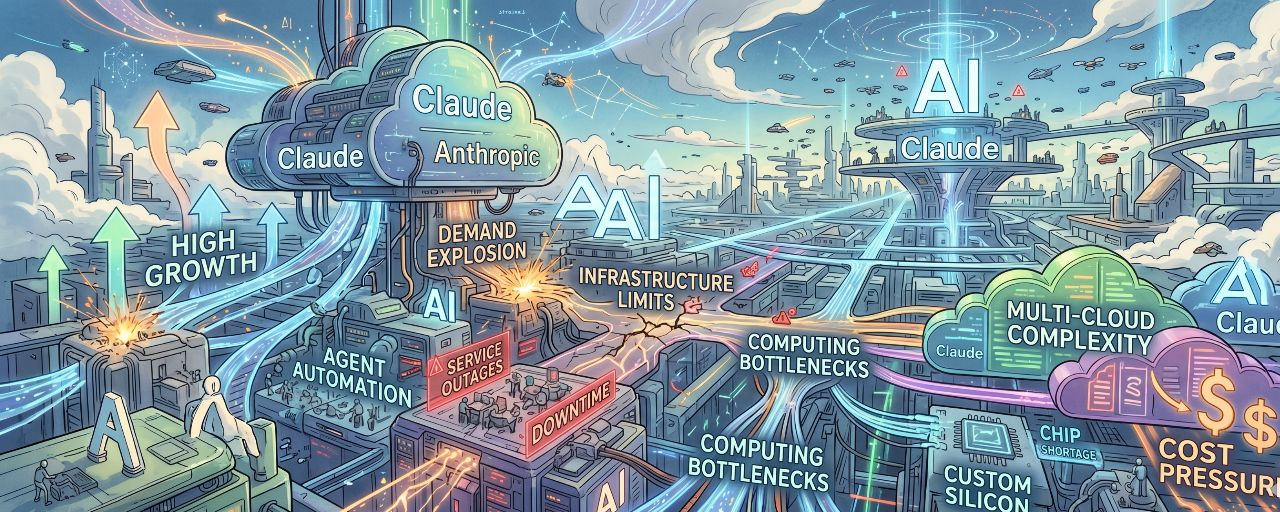

In the spring of 2026, a service interruption lasting several hours put Anthropic back in the public spotlight.
For many users who rely on Claude for programming, writing, and automation tasks, this is not just an ordinary failure, but more like an abrupt 'productivity halt.' However, if one focuses solely on the 'downtime' itself, they will miss a more significant signal—behind this fluctuation lies a hidden conflict of computing power that the AI industry is fully experiencing.
And what’s more noteworthy is:
Anthropic is not 'falling behind'; rather, it has hit the limits of its infrastructure while experiencing rapid growth.
Downtime is just the surface; the explosive demand is the essence.
Similar system failures are not unique to Anthropic.
Whether it’s OpenAI or Google, both have experienced varying degrees of service instability during the launch of large models or spikes in users. Such issues often stem from complex distributed systems:
· Traffic surges
· Reasoning load imbalance
· Scheduling system bottlenecks
· Multi-cloud architecture switching
Therefore, simplifying downtime as 'insufficient computing power' is an oversimplification.
But the problem is:
Why are such failures becoming more frequent and severe?
The answer is: The way AI is used is undergoing structural changes.
From 'dialogue tools' to 'computing power black holes'.
Early AI products were lightweight:
· Inquiries
· Responses
· End
But now, the new generation of AI systems represented by Claude Code has transformed into:
· Continuously executing complex tasks (for hours)
· Multi-round reasoning and decision-making
· Automated toolchain invocation
This brings about a fundamental change:
AI is no longer 'instant calls', but a 'continuous process occupying computing power'.
The result is:
· Single user consumption skyrockets
· Enterprise customers become the core consumers of computing power.
· System load shifts from linear growth to exponential amplification.
This is the true context of 'frequent downtimes'.
Explosive growth: The true competitive advantage of Anthropic.
If only looking at failures, it’s easy to misjudge Anthropic's status. But once revenue data is introduced, the conclusion changes drastically.
According to public information:
· By the end of 2025: annual revenue around $9 billion
· By 2026: over $30 billion
What does this mean?
Grew over 3x in a year
More importantly, this growth is not 'hollow heat', but comes from high-value scenarios:
· Code generation
· Agent automation
· Enterprise-grade AI services
In comparison:
· OpenAI is more consumer-scale oriented.
· Anthropic is more focused on enterprise and developer markets.
This brings an important difference:
Anthropic may not have the most users, but 'each user is worth more'.
Why does success lead to more serious problems?
This is precisely the most counterintuitive aspect of the AI industry:
The stronger the demand, the more likely the company is to encounter bottlenecks.
The reason lies in the triple pressure.
1) Computing power supply is 'choked'.
Current AI computing power is highly dependent on:
· NVIDIA GPU
· Google TPU
· Amazon Trainium
This means:
· Uncontrollable costs
· Supply constraints
· Multi-cloud architecture switching
Essentially, AI companies are 'leasing others' computing power'.
2) Cost structure is consuming growth
AI business models have a core contradiction:
Revenue growth ≠ profit growth
Especially in the Agent era:
· Continuous task execution
· Token consumption is huge
· Long-term accumulation of reasoning costs
The result is:
The more users there are and the more intensely they use, the faster costs grow.
3) Subscription model logic fails
Traditional SaaS assumptions:
Users are dissatisfied with limits.
But the reality of AI is:
Heavy users will 'squeeze the system dry'.
Thus, Anthropic begins:
· From subscription → pay-per-use
· Limit high-intensity usage
· Strengthen account control
Essentially, it’s about doing one thing:
Charge extreme power consumers separately.
In-house chip development: not firefighting, but competing for the future.
In this context, Anthropic begins exploring in-house chip development.
But it must be clarified:
This is not to avoid downtimes.
The reality is:
· Projects are still in very early stages.
· Design plan not yet determined
· Cycle lasts at least 3–5 years
· Costs start from around $500 million
This indicates:
In-house chip development is a long-term strategy, not a short-term fix.
Why are AI giants all doing the same thing?
Not just Anthropic:
· Meta
· OpenAI
All are pushing for custom chips or ASICs.
There are only two reasons:
1) Cost advantages
· Total costs reduced by 30%–50%
· Significant improvements in power consumption performance per unit
2) Control
More crucially:
Whoever controls the chips, controls the limits of AI.
If relying on external resources long-term:
· Expansion is constrained
· Uncontrollable costs
· Strategic passivity
Multi-cloud, multi-chip: the 'transitional solution' in reality.
Before in-house chips are implemented, Anthropic adopts:
Multi-vendor parallel strategy
Current deployments include:
· NVIDIA GPU
· Google TPU
· Amazon chips
Advantages:
· Diversify risks
· Increase resilience
· Optimize costs
But the cost is:
· System complexity skyrockets
· Increased scheduling difficulty
· Stability challenges are greater
To some extent, this is one of the technical backgrounds for frequent failures.
The real change happening in the industry
Piecing together all the clues, one can see that AI competition is undergoing a transformation:
Phase one (past)
· Competing on model scale
· Competing on parameter count
Phase two (now)
· Competing on reasoning efficiency
· Competing on cost control
Phase three (future)
· Competing on chips
· Competing on data centers
· Competing on energy and infrastructure
Conclusion:
AI competition is shifting from 'algorithm issues' to 'industrial system competition'.
Conclusion: The symbiosis of growth and bottlenecks.
Claude's downtime is not an isolated event.
It reveals a deeper reality:
· Model capabilities have matured
· Business demand is starting to explode
· Computing power becomes the core bottleneck
Anthropic's situation precisely illustrates its competitiveness:
It’s not that problems arise from poor execution, but because of being too successful.
Annual revenue jumped from $9 billion to $30 billion, indicating that it has crossed the most challenging threshold for AI companies—transitioning from technological validation to scalable commercialization.
But the upcoming issues are even more brutal:
How to transform explosive demand into sustainable delivery capacity?
Before this issue is resolved:
· Downtimes
· Price increase
· Usage limitations
None will disappear.
Because the real contradiction has never been:
"Is the system ready?"
Rather, it is:
Humanity is facing a technical system where demand growth outpaces computing supply for the first time.