
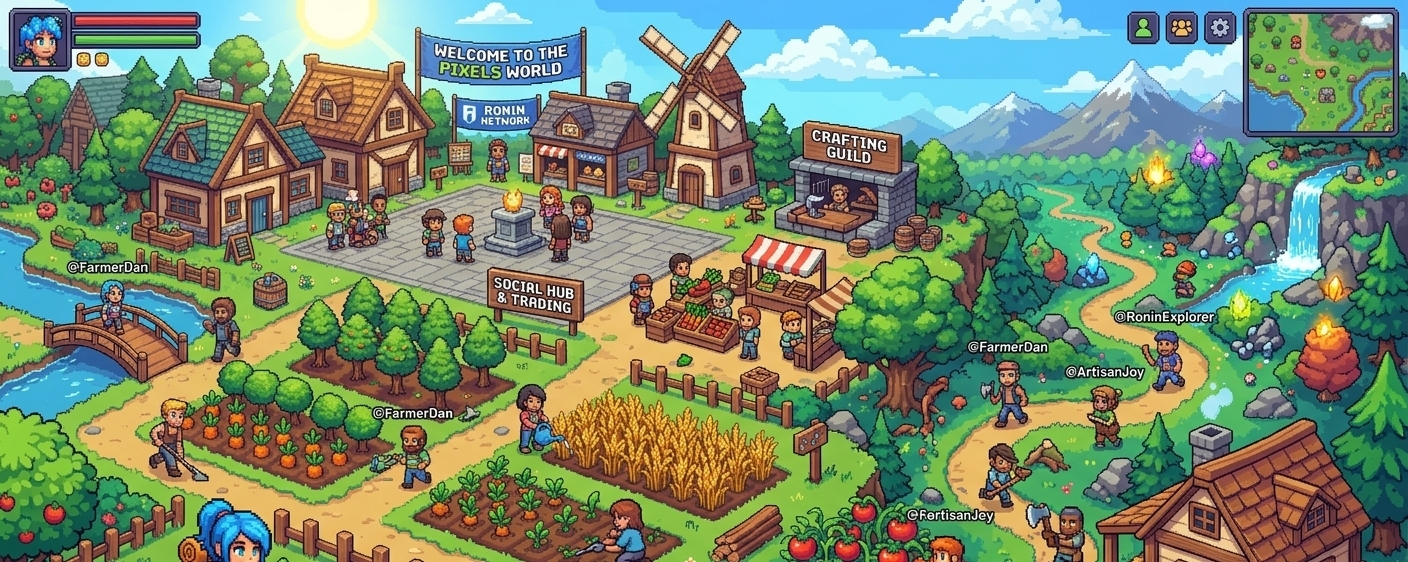

I didn’t open Pixels with a grand expectation. It looked simple, almost nostalgic, the kind of game you drift into when you want to slow down for a while. But something felt off within the first hour, and not in a bad way—more like a quiet tension I couldn’t explain. Why did my small actions feel like they mattered more than they should?
At first, I tried to ignore it. I planted crops, moved around, explored a bit. But the question kept returning: if this is just a game, why does it feel like I’m making decisions instead of just playing? That’s when I started paying closer attention, not to the surface, but to what was happening underneath. The fact that it runs on Ronin Network didn’t seem important in the beginning, but the more I played, the more it started to explain the feeling I couldn’t shake. The things I earned weren’t trapped inside the game. They existed in a way that felt… portable, almost independent of the world I was in.
That realization pulled me deeper. If what I’m earning can exist outside the game, then what exactly am I doing inside it? That’s where PIXEL started to make sense to me—not as a flashy feature, but as a quiet mechanism shaping everything. It wasn’t just something I collected; it was something that connected my actions to everyone else’s. Suddenly, farming wasn’t just farming. It was part of a shared flow, where what I produced could affect someone else’s decisions.
I started noticing my own behavior changing. I wasn’t just playing casually anymore. I began to think ahead, to plan, to wonder if I should plant this instead of that, or wait before selling something. It didn’t feel forced. It just happened naturally, as if the system was nudging me to care a little more than I intended to. And I couldn’t tell if that was the point, or just a side effect of how everything was designed.
Then another thought crept in. If I’m starting to optimize my actions, other players must be doing the same. And if everyone is trying to be more efficient, what happens over time? It doesn’t take long before more resources start appearing, more items circulate, and what once felt valuable begins to feel… common. That’s when the system starts asking a different kind of question, not to me directly, but through the experience itself. What keeps things meaningful when everything becomes easier to produce?
I realized then that the game isn’t just about what I do, but about how everyone behaves together. It’s not static. It shifts as players learn, adapt, and push the system in different directions. And somewhere in that movement, design decisions start to feel less like features and more like quiet forms of control. Reward rates, item scarcity, new updates—these aren’t just changes. They’re responses to behavior, and at the same time, they shape future behavior.
But not everyone seems to fit into this rhythm. I can imagine someone opening the game just to relax, only to feel overwhelmed by the invisible pressure to optimize. Because once you notice that your time could translate into something measurable, it becomes harder to ignore it. For some, that’s exciting. For others, it might take something away from the simplicity they were looking for.
What I still can’t fully figure out is where the value really comes from. Is it being created because people genuinely want what’s inside this world, or is it sustained because everyone believes it has value? And what happens if that belief weakens, even slightly? I don’t have a clear answer yet, and maybe that’s the part that keeps me watching more closely.
So now, instead of asking whether this is a good system or a flawed one, I find myself asking different questions. What kind of player does this world quietly favor? What happens when growth slows down? Do people stay because they enjoy being here, or because leaving feels like giving something up? And if the incentives were stripped away, what would still remain?
I’m still inside it, still observing, still unsure. It feels like a game sometimes, and other times it feels like I’ve stepped into something that’s still figuring itself out while I’m part of it. And maybe the only way to understand it is to keep asking these questions and see which ones stop making sense over time.
