
Last night, I was helping a neighbor fix that old game console downstairs in the community, the screen was full of pixel snowflakes. As I wiped off the dust, I thought, this broken thing is just like real life; it looks simple and cute on the surface, but underneath it’s layered with countless pits. Suddenly, my phone pinged with a group message saying Pixels is doing a Chapter 2 update. I was stunned for a moment, thinking, how is this pixel farm still alive? When I was a kid, I played those block games just for fun, farming and chopping trees, but now it’s wrapped up in blockchain with PIXEL tokens. It still has that friendly appearance, but I always feel like it’s covered in a layer of real-world rust. Everyone talks about playing games, but their eyes are calculating wallets. I shook my head and continued fiddling with the game console, but my mind flashed back to the ridiculous days of chasing various on-chain projects, laughing at my own foolishness while wondering, will this time be a bit different? Or is it just another reality mirror dressed in pixel skin?
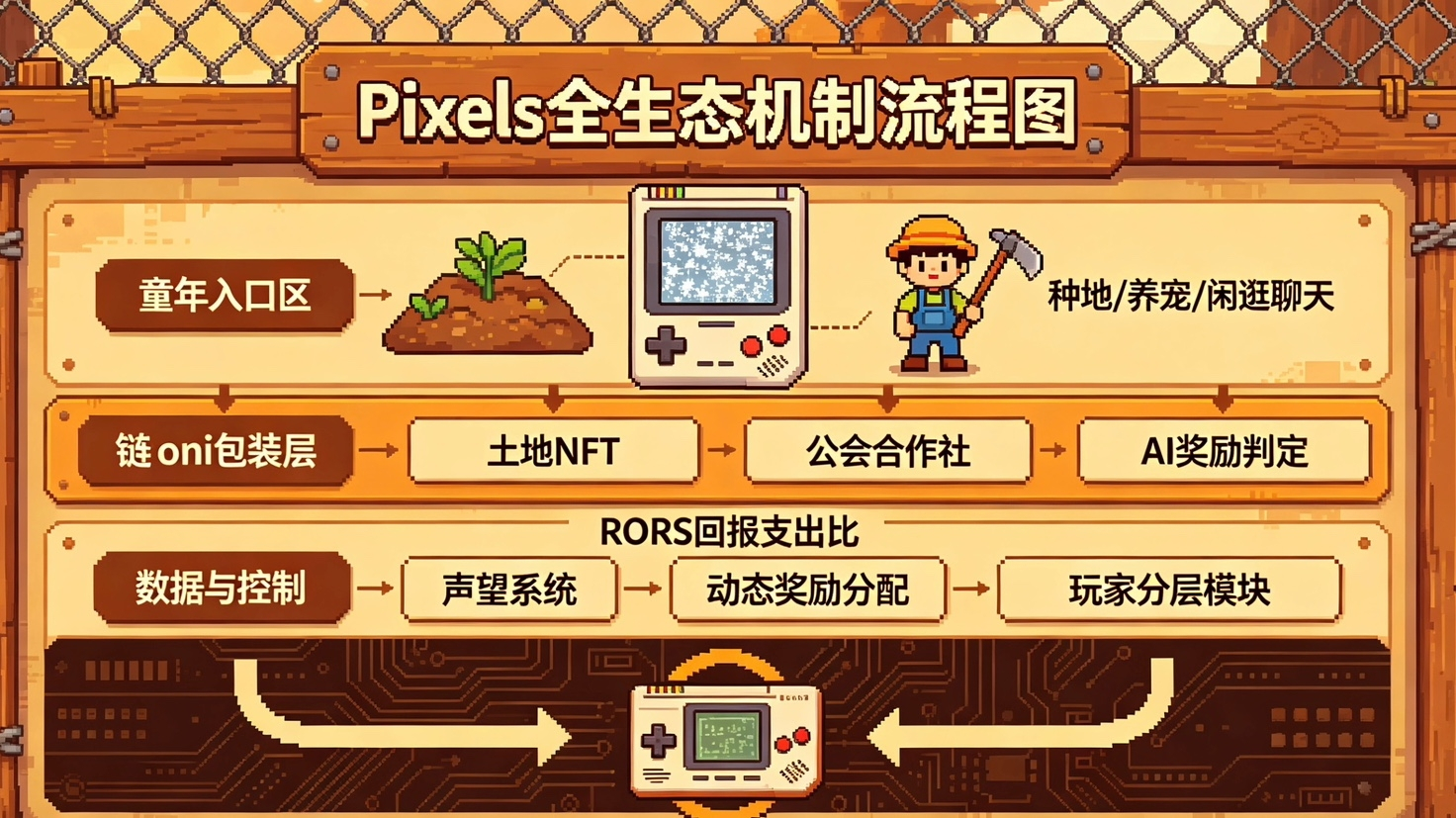
I played for two days, wanting to dismantle its underlying logic from the surface. On the surface, Pixels appears to be an open-world farming game with a pixel style; you enter as a little block person, farming, raising animals, completing tasks, wandering around chatting—simple like a childhood plot in the village, meant for daily leisure. But as you peel back the layers, the game is not just a simple single-player experience; it throws everything onto the dedicated Ronin path, where your land becomes an NFT—not just a decoration, but a real source of buffs, equivalent to having a few more irrigated fertile fields in reality that can provide you with more energy and special outputs. The guild system, when further examined, resembles a cooperative where everyone pools resources to unlock hidden benefits and can invite others to grind reputation together. The team has created a data-driven reward layer, reportedly using AI to differentiate between who is genuinely playing and who is just here to slack off. I began to critique this logic as I played; it claims to prioritize fun, but as the data runs, rewards get funneled to 'high-contribution' players. What about ordinary folks? Don’t they still have to rely on time and luck to accumulate slowly? Flashing back to my childhood helping my family plant rice, exhausted but only earning a bowl of rice in return, this farm on-chain, no matter how fancy the mechanics are, can't escape that bit of human calculation. I wonder if I've once again been fooled by something packaged to look like 'decentralization'—#pixel .
As we dig deeper, the underlying logic reveals a more realistic side. The team's ambition is not just to create a farming game, but to build a multi-platform. They treat player behavior data as a gold mine, using AI to precisely deliver rewards, emphasizing RORS, the return on reward spending ratio. To put it bluntly, they aim to ensure that every token distributed can lead to real retention, rather than just a rush to harvest and leave. This system sounds clever, like how a village chief uses big data to allocate land in reality, but as I play, I can't help but chuckle; fundamentally, it still uses backend algorithms to manage everyone's greed. The reputation system adds another layer, recording whether you are genuinely social or just grinding, which reportedly will affect costs and additional benefits—diligent players get more, while lazy ones get less. It appears fair on the surface but effectively divides players into various ranks. The entire flywheel logic is as follows: first, attract people with enjoyable pixel life, accumulate data, then use the data to deliver rewards accurately, reduce new user acquisition costs, and attract more good games. With more games, the data becomes richer, and the cycle snowballs. However, I must admit, I still don't fully understand some details of how AI determines 'real players.' It brings back memories of fixing game consoles, surrounded by invisible circuit boards, and now facing Pixels' backend logic, I feel just as confused, laughing at my own lack of intelligence. Realistically speaking, isn't this just encoding human laziness and calculation into code?
The PIXEL$PIXEL token is the most central screw in this layered logic. On the surface, it resembles high-end tobacco and alcohol, requiring effort to obtain, unlike everyday currency which can be used casually. In the core gameplay, you can gradually farm and upgrade without it, but to accelerate construction, unlock VIP, mint new NFTs, buy skins, or join high-level guilds, you have to invest PIXEL. The supply is tightly controlled, with only 100,000 minted daily, distributed to truly active and contributing players, not some game that prints unlimited money. Previously, BERRY managed daily trivialities; now it has become the 'hard currency' of the entire ecosystem, which can also be staked in different game pools, earning rewards while helping determine how many resources new projects should get. Staking is like voting for the village chief, directing resources towards your favorite 'village-run enterprises,' forming that publishing flywheel. I feel this design has unique aspects; it attempts to rectify the past issue of chain games where players 'earn and run.' It encourages everyone to fall in love with the pixelated life first and then naturally invest tokens. But critically speaking, doesn’t this still divide players into those with money to accelerate and those without who grind slowly? The reward-sharing layer appears communal, but in reality, it dangles scarcity to entice players. I recall my days of slacking off at work and scrolling on my phone; in reality, isn't that how we live? Seemingly free, but gradually ensnared by various 'premium services.' There are some governance details I don’t understand; how do they precisely know who should receive more? I only know that no matter how optimized this token is, it won't escape the human impulse of 'getting rich quick.'
So I maintain a neutral but slightly cautious optimism. Pixels is no longer just a farming game; after Chapter 2 launched, it introduced more exploration, pets, and player-built worlds, and the ecosystem is rolling towards a platform direction like a snowball, with a pretty active community. If it can genuinely prioritize fun, using data to deliver rewards accurately, allowing players to fall in love with this pixel world first and then naturally invest tokens, it might carve out a path in this muddy Web3 space. But critically, the chain game industry has never lacked excitement; it heats up quickly and cools down just as fast. If a new feature flops and players feel it's repetitive and boring, retention drops, and the flywheel gets stuck. While playing, I couldn't help but recall those defunct projects, seemingly thriving on the surface, but all empty shells beneath. Will Pixels also become the next 'pixelated bubble'? I tease myself, perhaps, but at least it is currently making an effort to pull 'play' in a sustainable direction, rather than relying solely on empty promises to attract people.$BTC
I need to say this upfront, or else it would be just empty talk. Game projects are inherently prone to being shattered by the hammer of reality; once players feel it's repetitive and their enthusiasm wanes, the economic cycle breaks. No matter how smart the PIXEL rewards are, they still rely on real contributions to sustain them. If everyone only rushes for short-term excitement, data gets chaotic, and rewards become meaningless. Not to mention the entire environment; regulations, technological iterations, competitors can kick in at any moment, making projects struggle to breathe. Halfway through playing, I suddenly questioned, isn't this just a reflection of real life? We go to work, farm, scroll on our phones every day, living in the cracks of various mechanisms and tokens—seemingly free but actually pulled by data and scarcity? I admit there are too many aspects I don't understand, recalling the gibberish when fixing game consoles, and now facing Pixels' backend logic, I'm just as puzzled. But it's precisely because of this that I find it real—not a savior, nor a scam, just a pixel world still rolling in the mud, carrying the greed, doubts, and a bit of silly joy of ordinary people like us. If you want to play, jump in and try; don’t expect it to change your life, but it might help you reclaim a bit of childhood joy amidst the critique of reality. Anyway, I’ll keep fixing my game console; what about you? Measure it out for yourselves.