
If you’ve been around Web3 games long enough, you already know how the cycle usually plays out. A new game launches, rewards look attractive, users rush in, and for a short period everything feels alive. Then slowly, the cracks start showing. Rewards lose meaning, systems feel repetitive, and the “game” starts looking more like a temporary extraction layer.
That’s exactly why @Pixels caught my attention in a different way.
At first glance, it doesn’t try too hard to impress you. It’s simple. You farm, craft, explore, and interact with other players. But once you spend time inside the system, you start noticing something deeper. The game isn’t built around quick rewards. It’s being shaped around behavior, access, and long-term positioning.
And that difference matters more than most people think.
What’s happening right now with $PIXEL is not just another update cycle. It’s a structural shift in how the game operates.
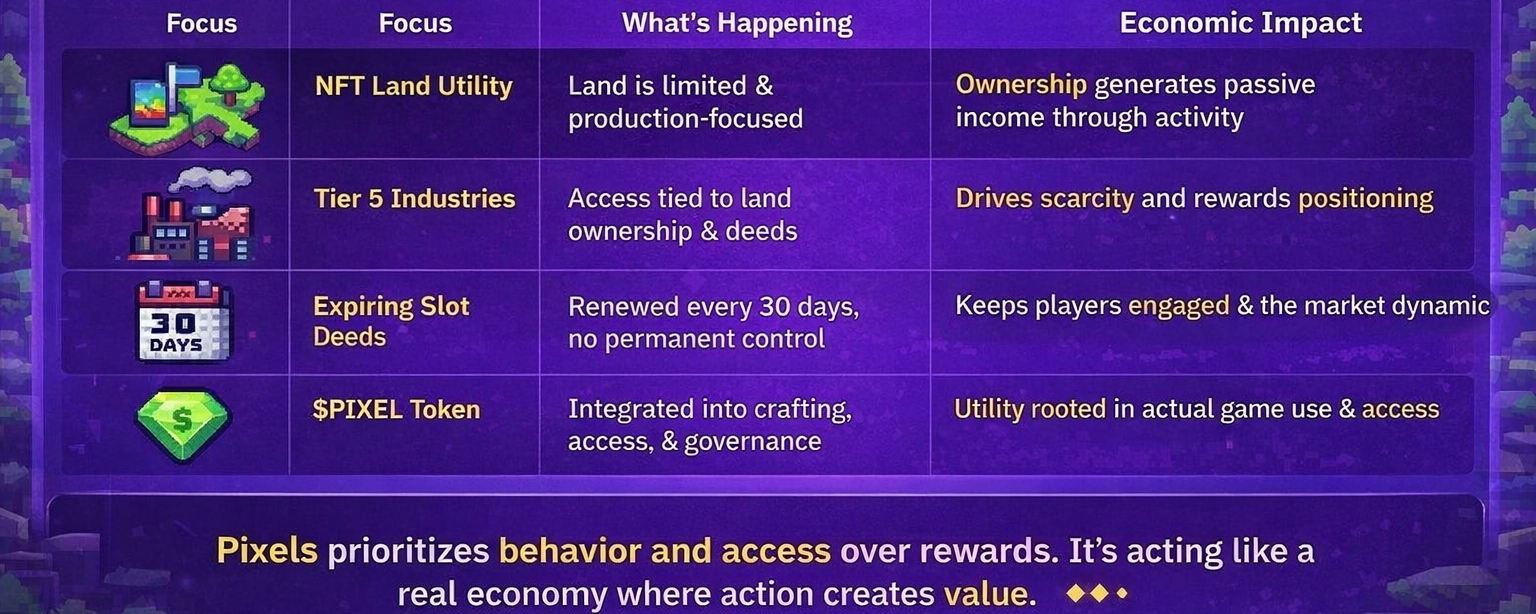
The introduction of Tier 5 industries is a big part of that shift. On paper, it looks like a normal expansion. More industries, more recipes, more progression layers. But the real change is in how access is controlled. Tier 5 isn’t something you unlock just by grinding. It’s tied directly to land ownership and slot availability.
That immediately changes the dynamic.
Now you’re not just asking “how much can I farm today?” You’re asking “do I even have access to produce at this level?” And if not, how do you position yourself to get that access?
This is where the land system starts to matter in a serious way.
There are only a limited number of NFT land plots, and they are not just cosmetic assets. They function as production hubs. If you own land, other players can use it, and you benefit from that activity. You don’t need to be constantly active to extract value. Ownership itself becomes a strategic position.
This creates a natural split between players.
Some players will focus on grinding and staying active daily. Others will focus on acquiring assets and positioning themselves in a way that allows them to earn from the overall activity of the ecosystem. Neither approach is wrong. But together, they create something that looks much closer to a real economy than a simple game loop.
Then comes one of the most underrated mechanics in the recent updates: expiring slot deeds.
At first, it might seem like a small design decision. Tier 5 slots expire after around 30 days and need to be renewed. But this single change prevents one of the biggest problems in Web3 systems, permanent control.
Without expiration, early players or asset holders could dominate the system indefinitely. With expiration, access becomes dynamic. You need to stay engaged. You need to keep making decisions. You can’t just lock in your advantage and disappear.
This keeps the system alive.
It forces participation without making it feel forced.
It also introduces something that most GameFi projects struggle with: balance between fairness and opportunity. New players still have a path to enter. Existing players still have an advantage, but it’s not absolute.
That balance is where sustainability starts.
Another subtle shift is how Pixels handles the player experience itself.
Unlike many Web3 games, it doesn’t constantly push the token narrative in your face. You’re not reminded every second about rewards or token prices. You’re just playing. Farming, crafting, exploring, interacting. Over time, you realize that these simple actions are connected to a much larger system.
That design choice reduces friction.
It makes the experience feel natural instead of transactional.
And ironically, that’s what makes the underlying economy stronger. Because when players stay longer, interact more, and engage naturally, the system gains real activity instead of temporary spikes.
The role of $PIXEL inside this ecosystem is also evolving.
It’s not just a reward token. It’s becoming part of the infrastructure that connects gameplay, ownership, and progression. Whether it’s tied to crafting, upgrades, access, or future governance layers, its value is increasingly linked to how active and healthy the ecosystem is.
That’s a key difference.
Instead of value being driven purely by speculation, it starts getting anchored in usage.
And usage is what builds long-term narratives.
What stands out to me the most is that Pixels doesn’t try to rush this process. There’s no aggressive over-promising. No constant hype cycles. It feels more like a system being carefully adjusted over time, where each update adds a new layer instead of replacing the old one.
Tier 5 didn’t reset the game. It built on top of it.
Land didn’t replace gameplay. It gave it structure.
Expiring slots didn’t remove advantages. They made them dynamic.
This kind of layered design is what most Web3 games miss. They build features in isolation instead of thinking about how everything connects.
Pixels is starting to connect those layers.
And when that happens, something interesting begins to form.
You stop looking at it as just a game.
You start looking at it as a system where time, access, and decisions interact with each other.
Where players don’t just participate, they position themselves.
Where ownership is not just about holding assets, but about understanding how the system moves.
That’s when it starts to feel like a real economy.
We’re still early in that transition, but the direction is becoming clearer with every update.
If Pixels continues building like this, focusing on behavior instead of hype, and systems instead of shortcuts, it could end up doing something most GameFi projects failed to achieve.
Not just attracting users, but retaining them.
Not just creating activity, but sustaining it.
Not just launching a game, but building an ecosystem that actually works over time.
And that’s why @Pixels is worth paying attention to right now.
Because what looks simple on the surface is slowly turning into something much deeper underneath.