
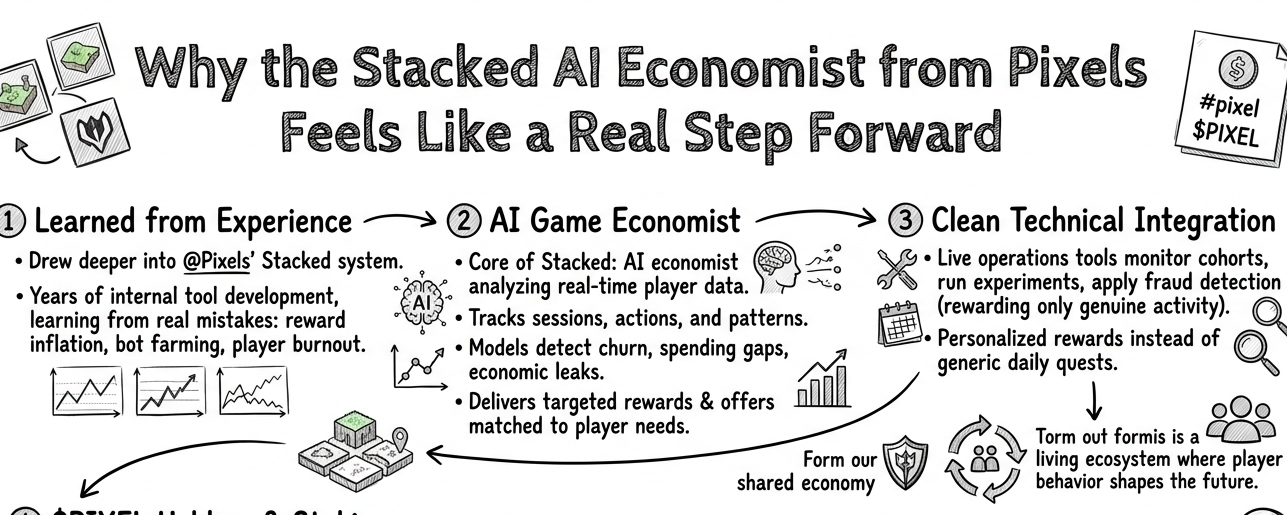
I've been thinking a lot lately about how most blockchain games struggle to keep players around for the long haul, and that's what drew me deeper into what the team at @Pixels has quietly built with their Stacked system. It started years ago as an internal tool they used while running Pixels day in and day out, learning from real mistakes like reward inflation, bot farming, and players burning out after a few weeks. Now Stacked has grown into a full AI-powered layer that sits underneath the games, handling rewards and engagement in a way that actually feels thoughtful and sustainable.
At its heart is this AI game economist that doesn't just throw points around hoping something sticks. Instead, it watches how real people play in real time. It tracks every session, every action, and every pattern across connected titles. Then it uses smart data models to understand things like which players are starting to drift away, which groups aren't spending as much as they could, or where the economy might be leaking value. From there, the AI suggests targeted offers and rewards that match what that specific player actually needs right now. It's like having a dedicated economist on the team who knows the game inside out, but one that can process millions of data points instantly and never gets tired.
What stands out to me on the technical side is how cleanly it all fits together without feeling forced. Stacked brings in live operations tools that let the team monitor player cohorts, run quick experiments, and apply strong fraud detection so only genuine activity gets rewarded. No more generic daily quests that everyone farms the same way. Rewards become personal — maybe a boost for someone who's been consistent but quiet, or a gentle nudge for a new player who's close to their first big milestone. Early tests inside the Pixels world showed real results, like big jumps in spending conversion and solid returns on the reward budget, which tells me the system isn't just clever on paper.
For holders, this changes staking from something passive into real participation. When you stake your tokens, you're helping decide which games or features get more support from the ecosystem pool. The capped monthly emissions keep things from flooding the market, while your stake earns calibrated returns that feel tied to actual growth. And because Stacked already connects Pixels with other experiences like Pixel Dungeons and upcoming titles, your progress and earnings can flow more smoothly across different worlds. Your land NFTs, playtime, and contributions all feed into one shared economy instead of sitting isolated in separate silos.
I like how this setup turns ownership into something practical and lasting. It's not about chasing quick farms that collapse when the hype fades. It's built on years of real player data and feedback from running a game that reached millions of daily users and generated meaningful revenue. The AI helps studios spot underserved segments, fix churn points in the onboarding flow, or create offers that improve retention without wasting budget. For everyday players, it means missions and rewards that actually match how you like to play, making the whole thing feel more fair and engaging over time.
Watching how other projects' reward systems usually fall apart after the initial rush, I find the Stacked approach from @Pixels refreshing in its calm honesty. It focuses on actions that matter — coming back regularly, making progress, contributing to a healthy loop — rather than spraying incentives everywhere. By moving routine rewards toward stable options like USDC or points while keeping tied to staking, governance, and premium features, it reduces selling pressure and builds a foundation that could support the community for years. Your land, your guild involvement, and your staked tokens all start to feel like part of something bigger, a living ecosystem where player behavior shapes the future.
In the end, Stacked isn't trying to reinvent play-to-earn with flashy promises. It's the result of learning hard lessons the old-fashioned way and then wrapping that knowledge in smart technology. If you've ever felt tired of games that boom fast and then go quiet, this quieter, data-driven path might be worth watching closely. It gives me hope that web3 gaming can move past the short cycles and create spaces where people actually want to stay and build together. The team at @Pixels has put in the work, and the results so far suggest it's paying off in ways that matter most. #pixel $PIXEL @Pixels
#USDCFreezeDebate #CryptoMarketRebounds
#SECEasesBrokerRulesforCertainDeFiInterfaces