
A unique finding suggests that the ancient Maya could perform complex healing procedures, not just decorate teeth.
Archaeologists have discovered the first confirmed case of using a precious stone as a filling in the molar of a representative of the Maya civilization, reports Arkeonews. The discovery challenges the established belief that dental interventions by the Maya were solely decorative in nature.
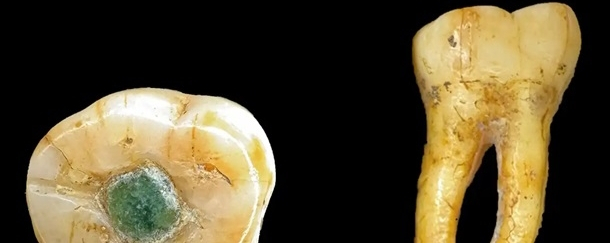
It concerns a lower molar, which is preserved in the Popol Vuh museum at Francisco Marroquín University. In the center of the chewing surface of the tooth, a neatly inserted green stone, presumably jadeite - a material that held high value in Mayan culture, was discovered.
Unlike previously known examples where decorations were placed on the front teeth and were easily visible, this case concerns a molar, which is a tooth not seen during conversation or smiling. This immediately excludes purely aesthetic purposes.
Detailed analysis showed that the stone fits perfectly into the cavity, cut at the junction of the main cusps of the tooth, and did not interfere with chewing. This indicates a high level of craftsmanship and knowledge of anatomy.
To determine whether the procedure was performed during the person's lifetime, researchers applied cone-beam computed tomography. The results showed the presence of calcifications in the tooth pulp - a reaction of living tissue to intervention, confirming that the operation was performed during the patient's life.
Scientists suggest that the insertion could have functioned as a kind of seal. It is likely that the affected carious tissues were initially removed, after which the cavity was filled with stone, securing it with natural resins with antibacterial properties.
Despite this, the ultimate purpose of the procedure remains unknown. Researchers do not rule out symbolic or ritual significance, as precious materials often held special meaning in Mayan culture.
The find is unique not only for Mesoamerica but also on a global scale. It demonstrates that ancient civilizations could experiment with complex dental practices that went far beyond aesthetics. Scientists hope that further research will help determine whether this case was an isolated incident or part of a broader, previously unknown medical practice.