
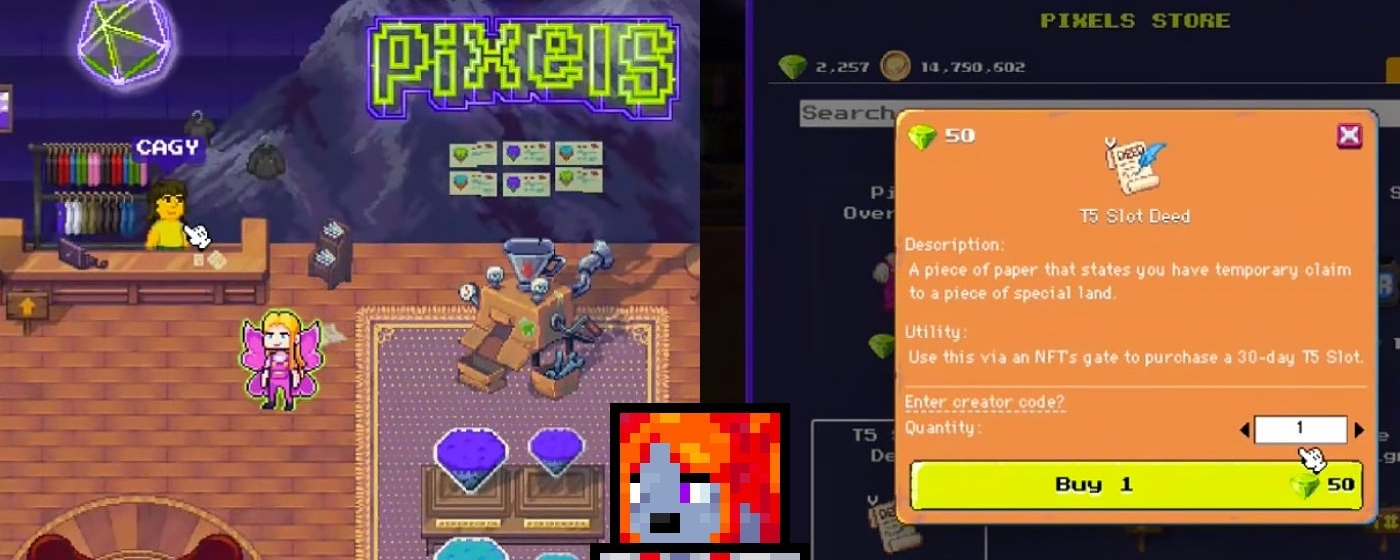
What if the problem with play-to-earn was never the rewards but when those rewards show up?
That’s the angle I started seeing after spending time in Pixels.
Because on the surface, it feels like every other game. You log in, run your loops, farm, complete tasks, stack Coins. Everything flows. No friction, no limits, just constant activity.
But after a while, something feels off.
Not in a broken way… just inconsistent.
You can run the same loop twice, same effort, same actions but the outcome feels different. One feels like it’s leading somewhere, the other just circulates.
And that’s when it clicks:
Maybe not every loop is supposed to pay you.
Coins start to feel less like rewards and more like circulation. They keep the system moving, keep players engaged, but they don’t represent real extraction. They’re there so the game never has to say “stop.”
But $PIXEL doesn’t behave like that.
It shows up selectively. Not based purely on effort, but on something less visible - timing, behavior, maybe even the state of the system itself.
Which makes the whole thing feel less like a reward system and more like a controlled release mechanism.
Instead of:
play → earn → withdraw
It starts to look like:
play → stay active → qualify → then maybe earn
And that “maybe” is important.
Because it suggests the system isn’t just tracking what you do in a single session. It’s looking at patterns, how you play over time, how you interact with the ecosystem, whether you’re contributing or just extracting.
That’s where something like Return on Reward Spend starts to make sense.
Not as a visible metric, but as a hidden limiter.
The system can’t just emit rewards endlessly like older GameFi models. It has to match what it gives out with what it can sustain. So instead of cutting players off, it quietly controls when value becomes available.
And the task board?
It stops feeling like a static list and starts feeling like a filter.
Not everyone sees the same opportunities. Not every action is equally rewarded. The system is constantly deciding what to surface and what to hold back.
Which leads to a strange realization:
You’re not just playing the game.
You’re interacting with an economy that decides when your gameplay is allowed to convert into value.
And that changes behavior.
Because now it’s not just about grinding harder. It’s about staying in the system long enough, consistently enough, to be in sync with it.
Some sessions might just be there to keep the economy stable. Others might be the ones where value actually flows.
And you don’t really know which is which while you’re playing.
That uncertainty is uncomfortable but also interesting.
Because it’s probably why systems like this don’t collapse as quickly as older play-to-earn models. They don’t let everyone extract at the same time. They regulate it, quietly, in the background.
So the real question becomes:
If rewards are no longer guaranteed, and access to value is controlled
Is this still a game you play?
Or a system you have to align with?