
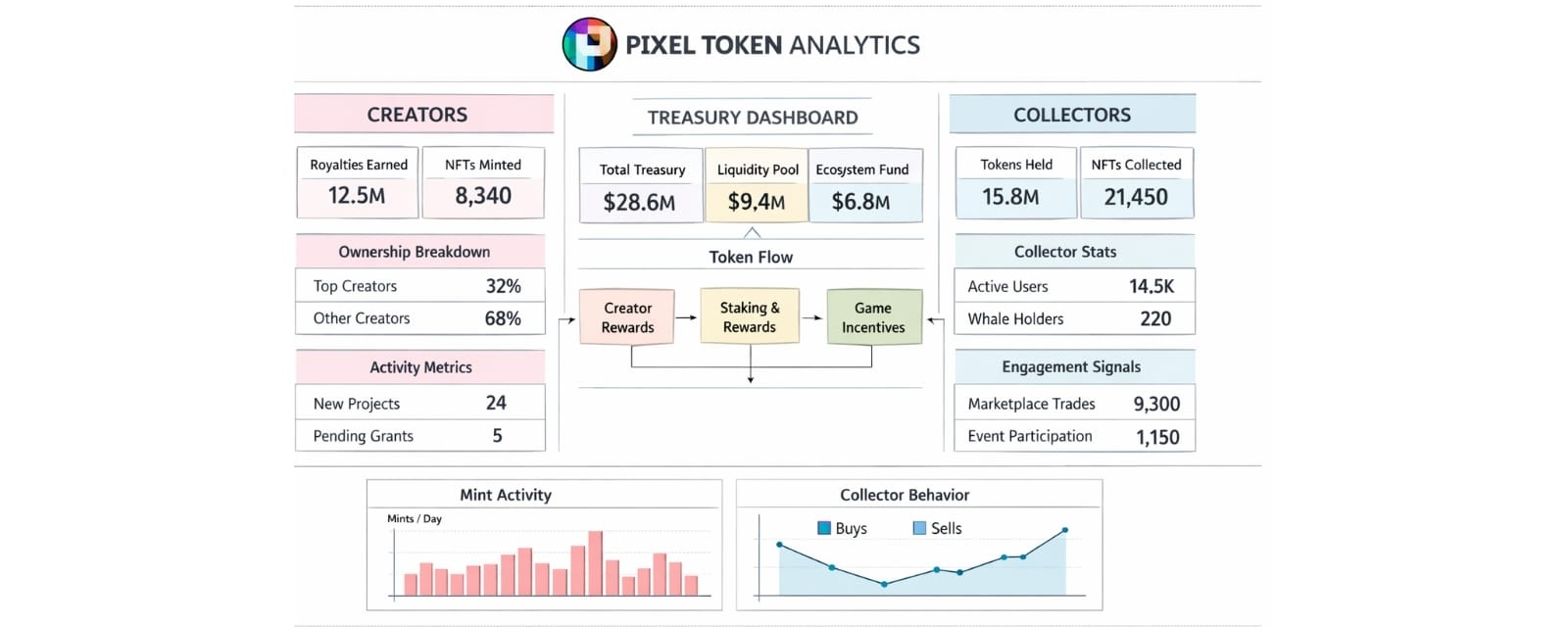
@Pixels I kept noticing that with pixel token DAO treasuries. The screen would show the usual things—stablecoin reserves, token balances, grant wallets, market-making allocations, creator payouts maybe queued for later—and it all looked almost responsible. Too responsible, actually. Clean categories. Smooth charts. A treasury that seems to know exactly what it is doing. Then a contributor payment lands late, or a reward pool gets topped up right before community questions start, and the dashboard suddenly feels less like transparency and more like stage lighting.
That is probably the part people miss. The problem is not whether the wallet is visible. Most of the time it is. The harder problem is whether visibility tells you what pressure the treasury is under when it moves.
With pixel token systems, that pressure is usually live. Not theoretical. Treasury decisions are tied to player retention, creator incentives, event rewards, ecosystem grants, liquidity support, sometimes just the need to stop sentiment from sliding for another week. So when you open a dashboard, you are not looking at a passive balance sheet. You are looking at a surface where governance, game economy management, and public trust all leave fingerprints at different times. Sometimes hours apart. Sometimes badly.
And that makes the neatness of the dashboard a little suspicious.
I do not mean suspicious in the dramatic sense. More in the operational sense. You start asking odd questions. Why was this transfer split into three smaller ones. Why did the community update arrive after the wallet move instead of before it. Why does the reward treasury shrink exactly when messaging becomes more optimistic. Maybe there are good reasons. Usually there are some. But the dashboard itself does not carry reasons. It carries traces.
That is where these tools start changing behavior. Once the treasury knows it is being watched in near real time, spending is no longer just spending. It becomes something closer to pre-defended spending. Wallet hygiene gets better, maybe. Timing gets cleaner. Categories get renamed. A messy intervention can be made to look procedural if it lands inside the right label. “Ecosystem support” can hide a lot of different moods.
I used to think that was still an improvement, and maybe it is. I am less sure now. A transparent dashboard can reduce blind trust, yes, but it also teaches everyone to read treasury motion like body language. People stop asking only whether funds are safe. They start trying to infer intent from pacing, clustering, silence, delays. In a pixel token DAO, where treasury choices can feed directly back into player rewards and community morale, that interpretive layer gets heavy fast.
So the dashboard helps. I think it does. But it also turns treasury management into a more public performance than some teams are ready for, and sometimes the most revealing part is not the balance drop. It is the around it.$PIXEL #PIXEL