
Why Pixels turns games into validators, and what that could mean for decentralized publishing
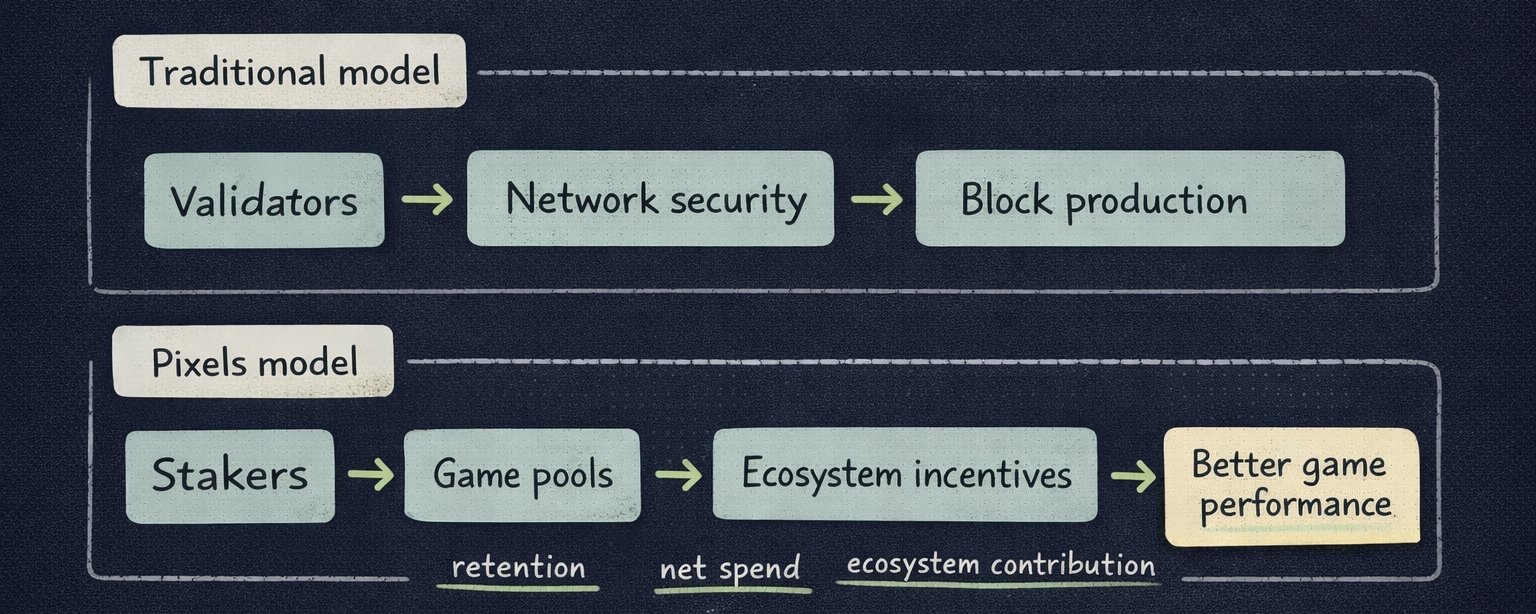
Most people still read Pixels through the usual game-token framework. A game launches, a token powers rewards, players earn, emissions flow, and the main question becomes whether the economy can survive the extraction cycle. But the more interesting shift in the new PIXEL design is that Pixels is trying to change who acts like a validator in the first place. In the staking section of the whitepaper, the project says, “One token. Many ‘validators.’ The validator is the game,” then explains that games themselves replace traditional validators while stakers help determine which games receive resources and incentives from the Pixels ecosystem.
That changes the meaning of staking. In a normal validator model, stake helps secure block production and network operation. In the Pixels model, staking becomes a capital-allocation layer for games. Users allocate PIXEL into individual game pools, effectively signaling which games deserve more support. The whitepaper says the amount staked into each game influences that game’s future share of emissions and incentives, creating direct competition between games for ecosystem capital.
This is where the publishing angle becomes important. Traditional publishing is usually top-down: a publisher decides where budgets go, which products get promoted, and which titles deserve more visibility. Pixels is attempting something different. Its decentralized publishing model says games compete to attract stakers by demonstrating strong player retention, high net in-game spending, and effective use of ecosystem tools. Staking allocations then act as a community signal about game quality and ecosystem contribution.
That is why I do not think “games as validators” is just a catchy metaphor. It is really a proposal for how publishing decisions could be decentralized. Instead of asking only, “Which game should the team push next?”, the system starts asking, “Which game can attract stake by proving better economics and better player outcomes?” My reading is that Pixels is trying to turn publishing into a market, where support is earned through performance rather than assigned only through hierarchy. That interpretation follows directly from the way the whitepaper connects game pools, emissions, and community-driven capital allocation.
The flywheel makes that thesis even more ambitious. Pixels describes the ecosystem as a closed loop where PIXEL staking becomes UA credits, those credits fund targeted in-game rewards, player spend creates revenue share, stakers receive rewards, and the resulting activity generates richer data and smarter future targeting. The whitepaper also says studios can use these on-chain UA budgets instead of relying on outside ad channels like Facebook or TikTok. That means the model is not just about rewarding players. It is trying to build a measurable growth engine for games.
That is also why the publishing model potentially extends beyond one title. In its revised-vision section, Pixels says it wants to move beyond optimizing a single game and instead build a decentralized growth platform for both Web3 and Web2 games, even comparing that direction to a decentralized AppsFlyer or AppLovin. The same section says the project pivoted after facing token inflation, sell pressure, and mis-targeted rewards in 2024, pushing it toward data-backed incentives, liquidity fees, and a new publishing model.
So when I look at Pixels, I do not think the biggest question is whether PIXEL is a good game token. I think the better question is whether Pixels can turn staking into a publishing market, where games compete for capital the way apps compete for distribution, and where ecosystem support is allocated through measurable performance instead of only top-down control. If Pixels can make that model work, “the validator is the game” may end up being the most important line in the whole design.