
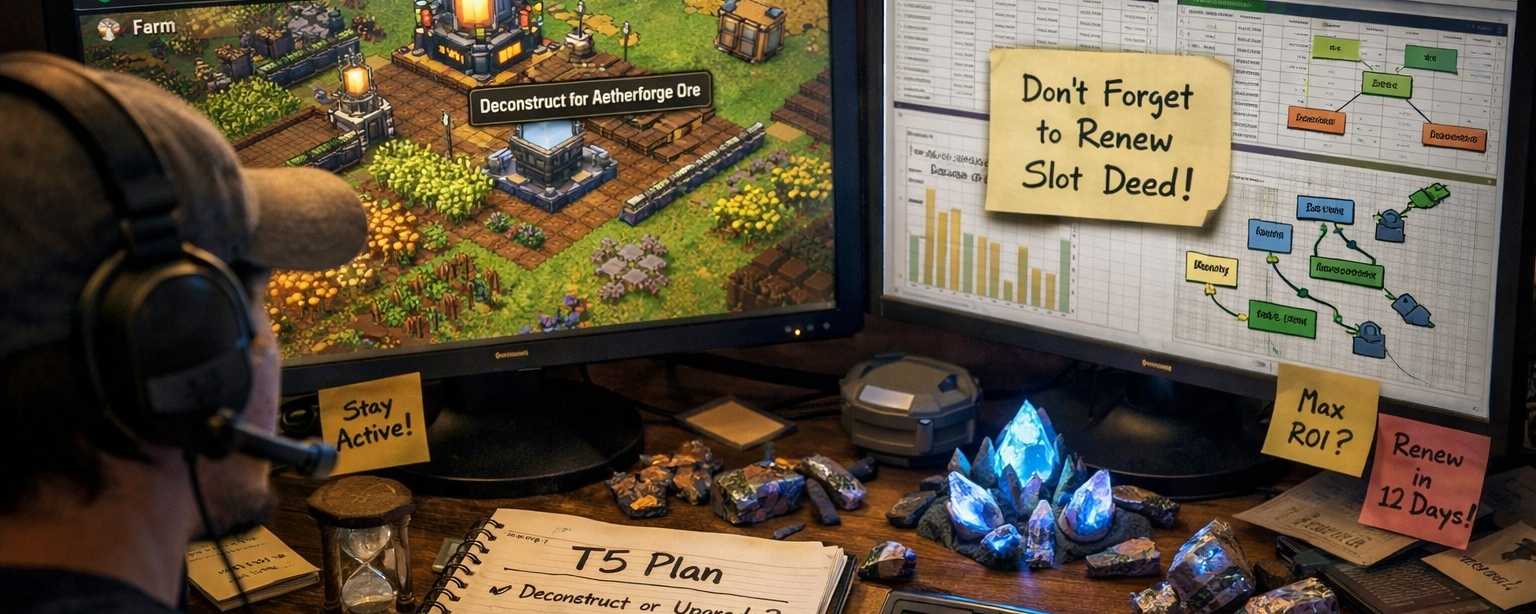
That question keeps looping in my head.When a game keeps stacking new systems, new mechanics, and new economic layers — is it actually becoming deeper?
Or is it slowly starting to carry too much weight?My first reaction to the
Tier 5 update was honestly mixed.On the surface, it felt familiar: new tier, new resources, new recipes. Classic stuff.But the more I sat with it, the more I realized — this isn’t just “more content.”
It’s quietly adding a whole new behavioral layer to the entire game.And that changes things.Look at T5 industries. They only exist on NFT land.
That single decision instantly splits the player base. Not everyone is playing on the same field anymore.Then you add slot deeds on top — not only do you need them, they expire every 30 days.That part hit me differently.It’s not loud pressure. The game isn’t yelling at you.
But the system is softly whispering: “Stay active… or fall behind.”Now commitment itself is part of progression.And then there’s the deconstruction system — probably the most interesting (and risky) part of the whole update.Before, the loop was straightforward: build, upgrade, stack.Now it’s saying: break it down, extract value, rebuild better.Creation and destruction are both on the table.Economically, it’s clever. New materials like Aether Twig and Aetherforge Ore only come from deconstructing — that means the supply is driven by circulation, not forced scarcity. Smart long-term thinking.But emotionally?If the best move is often tearing apart what you built, does it still feel good to build in the first place?
Does ownership start to fade… and optimization take its place?That tension is real.The fishing update gave me the same vibe.Five tiers. Durability curves. Tool-gated access.
Everything is logical. Everything is structured. Everything makes sense.But maybe… a little too clean.Less chaos. Less surprise. Less “I wonder what happens if…”
More planning, more spreadsheets, more optimization.Even the forestry XP buff (500 XP per log in T5) is a perfect example.
It’s a massive jump that aggressively pushes everyone upward.Which makes strategic sense.But it also makes me wonder: what happens to lower-tier gameplay?
Does it still feel meaningful for new or casual players?
Or does the whole game turn into a staircase everyone just sprints through?And those expiring slot deeds again…
Yes, they’re a healthy sink. They remove value from the economy.But they also add a quiet timer to your playtime.Are you logging in because you genuinely want to?
Or because the system clock is gently reminding you not to fall behind?Small difference on paper. Big difference in how the game feels over months.What I do respect is this:
The
@Pixels
team clearly isn’t just throwing features at the wall.
They’re deliberately shaping player behavior — resource flows, item lifecycles, commitment levels, economic circulation.That level of intentional design is rare in play-to-earn. Respect.Still… there’s a risk.The more optimized and calculated everything becomes, the easier it is to lose the actual “game” feel.When your main thoughts shift to:
What’s the ROI on this build?
Should I deconstruct now or later?
What do I lose if I don’t renew my slots?
…then the line between playing and managing starts to blur.And not everyone shows up to a game to run a business.Some people just want to explore.
Some want to chill in the world.
Some want to build something and feel attached to it — not constantly calculate whether they should tear it down for better efficiency.So for me, Tier 5 is directionally strong.
System-wise: impressive.
Economically: thoughtful.
Player experience: still an open question.I’ll be watching closely how this actually feels in practice.Time will tell if the weight makes the game stronger… or just heavier.What do you think? Are you excited about T5, or feeling the same mixed energy?