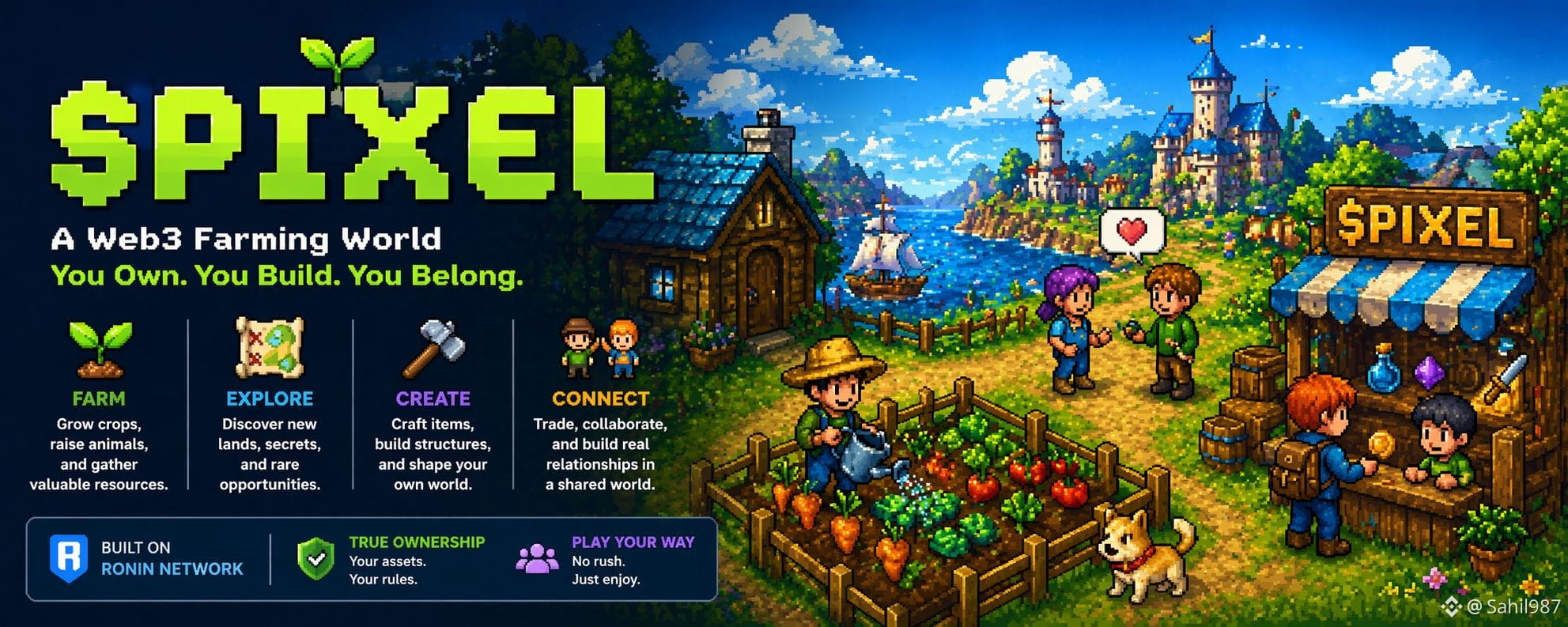

@Pixels After a while in Web3, you start noticing patterns.
If something needs constant incentives to keep people around, it usually won’t last. If every action is tied to a reward, the moment those rewards slow down, so does everything else.
That cycle has played out too many times.
Pixels doesn’t feel like it’s built around that cycle.
You log in, and nothing is pushing you. No pressure to optimize, no feeling that you’re falling behind, no urgency to squeeze value out of every minute. You just do small things farm, walk around, interact and then log off when you’re done.
It sounds simple, but it’s not common.
Because most systems are designed to drive behavior. Pixels feels like it just allows behavior.
And that difference shows up in how people stay.
From a trader mindset, this is one of those signals you don’t ignore.
If users need to be pushed, engagement is fragile. If users stay without pressure, it’s usually because the base experience is strong enough on its own.
Pixels leans into that.
You’re not thinking about efficiency every second. You’re not calculating outcomes constantly. You’re just spending time inside the game, and it feels natural.
That’s where real retention starts.
Built on the Ronin Network, it still gives you ownership. Your progress matters, your assets exist, but they stay in the background. They don’t interrupt the flow.
And that’s important.
Because once the financial layer becomes too visible, the experience breaks. It stops feeling like a game and starts feeling like something you need to manage.
Pixels avoids that by keeping things simple.
Another thing that stands out is how easy it is to return.
You don’t need to catch up. You don’t feel behind. You don’t feel like you missed something important. You just log back in and continue.
That lowers friction a lot.
And lower friction usually means people don’t leave as quickly.
The social layer adds quietly to this.
You see other players, small interactions happen, and the world feels active without being overwhelming. It’s not competitive by default. It’s just there.
And that’s enough to keep the loop going.
Of course, long-term success still depends on how everything evolves.
But if you’re looking at behavior instead of hype, this is one of the clearer signals.
Users staying without incentives being pushed constantly.
Time spent without pressure.
Engagement that feels easy.
$PIXEL isn’t trying to control how you play.
It just gives you a space where playing feels natural.
And in this space, that’s usually what lasts.