
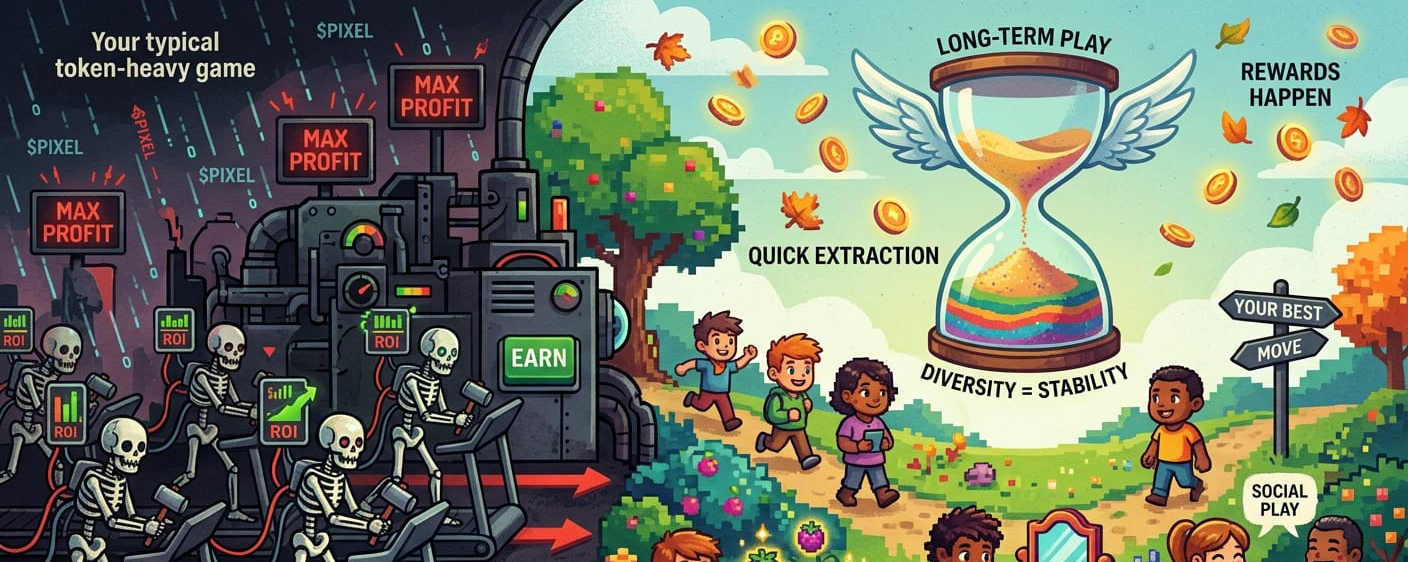
Pixels can be understood more clearly if you stop viewing it as just a farming game and instead see it as a small, living system where people, resources, and incentives interact over time. The farming, crafting, and exploration are only the visible layer, something familiar enough to invite players in. Beneath that surface, Pixels is trying to explore a deeper idea, which is whether a digital world can function like a real economy where participants are not just users, but holders of value and influence within the system.
Inside Pixels, players plant crops, gather materials, produce goods, and trade with others. These actions are simple on purpose, because simplicity allows scale and participation. What changes the nature of this activity is that parts of the game are anchored to a blockchain through the Ronin Network. This means that certain assets are not just temporary items inside a server. They exist as independent records that players can hold, transfer, or trade. The game becomes more like an interface to a shared ledger, rather than a closed environment controlled entirely by developers.
This shift matters because most digital environments today are fragile in terms of ownership. People invest time and sometimes money, but they do not control the outcome. If a company changes its rules or shuts down a service, everything disappears from the user’s perspective. Pixels introduces a different structure where ownership is more persistent. It does not eliminate risk, but it redistributes it. Players gain more direct control over their assets, while also taking on more responsibility for understanding the system they are part of.
The mechanics of Pixels can be seen as a coordination loop. A player performs actions like farming or crafting, which produces outputs such as items or tokens. These outputs are then recorded on the blockchain, which acts as the settlement layer. The Ronin Network ensures that ownership and transactions are consistent, even as thousands of players interact at the same time. Instead of relying on a central authority to maintain balance, the system relies on shared infrastructure and agreed rules.
The PIXEL token plays a central role in shaping behavior within this loop. It is both a reward for participation and a requirement for progression. Players can earn tokens through activity, but they must also spend them to upgrade land, access features, or produce higher value goods. This creates a cycle where effort leads to rewards, and rewards must be reinvested to maintain progress. The goal is to keep value moving rather than accumulating in a static way.
What matters here is not just the existence of a token, but how it flows. If tokens enter the system faster than they leave it, the economy becomes inflated and unstable. If they are too difficult to obtain or use, participation slows down. Pixels tries to manage this balance by connecting token usage directly to gameplay. Progress is tied to spending, and spending supports the overall system. It is less about speculation and more about maintaining circulation.
The broader ecosystem around Pixels adds another layer to this structure. Because assets exist on a shared network, they are not confined to a single application. Players can interact with wallets, marketplaces, and potentially other experiences within the same environment. This creates a form of continuity where identity and ownership extend beyond one game. In theory, this reduces fragmentation and allows digital value to move more freely across contexts.
At the same time, Pixels depends heavily on social behavior. It is not designed as a purely competitive system. Cooperation, trading, and repeated interaction are central to its function. This is important because no economy works on transactions alone. Trust, habits, and community norms play a major role in stabilizing any system. In a Web3 environment, where formal control is reduced, these social elements become even more critical.
The direction of Pixels suggests a gradual move toward deeper systems rather than rapid expansion. This likely involves making land more meaningful, crafting more complex, and interactions more layered. It also involves reducing friction for new users who may not be familiar with blockchain tools. The challenge is to keep the system open and accessible without removing the ownership structures that define it.
There are clear risks in this design. One of the most important is sustainability. If the system depends too heavily on new users entering and bringing value, it can weaken when growth slows. This has been a common pattern in earlier Web3 projects. For Pixels to remain stable, it needs internal demand for its economy, meaning players continue to find value in participating even when external conditions are not favorable.
Another risk lies in the meaning of assets. If items and tokens are too easy to generate, they lose significance. If they are too scarce, participation becomes limited to a small group. Maintaining the right balance requires constant adjustment and careful observation of player behavior. It is not a fixed solution, but an ongoing process.
There is also the issue of technical reliance. Because Pixels is built on a blockchain network, its performance depends on that network’s stability and security. Any disruption at the infrastructure level can affect the entire experience. This introduces a layer of dependency that traditional games do not face in the same way. At the same time, it also provides resilience by distributing control across a wider system.
In the wider context of Web3, Pixels represents a quieter kind of experiment. It does not rely on complex mechanics or high barriers to entry. Instead, it uses a familiar format to test whether ownership, incentives, and coordination can be integrated into everyday digital activity. It shows that the real challenge is not building systems that work in theory, but building ones that people continue to use when conditions are less ideal.
What ultimately defines Pixels is how it handles pressure. When rewards decrease, when markets slow down, or when player interest shifts, the system is tested. Do players remain because the experience itself has value, or do they leave when incentives weaken. This is where the difference between a temporary system and a durable one becomes clear.
Pixels matters because it is not just trying to entertain, it is trying to sustain. It sits at the intersection of play and economics, where enjoyment, ownership, and incentives must align over time. Under real world stress, only systems that can maintain balance between these forces tend to last. Pixels is one attempt to find that balance, and its outcome will say more about the future of digital economies than any short term success ever could.