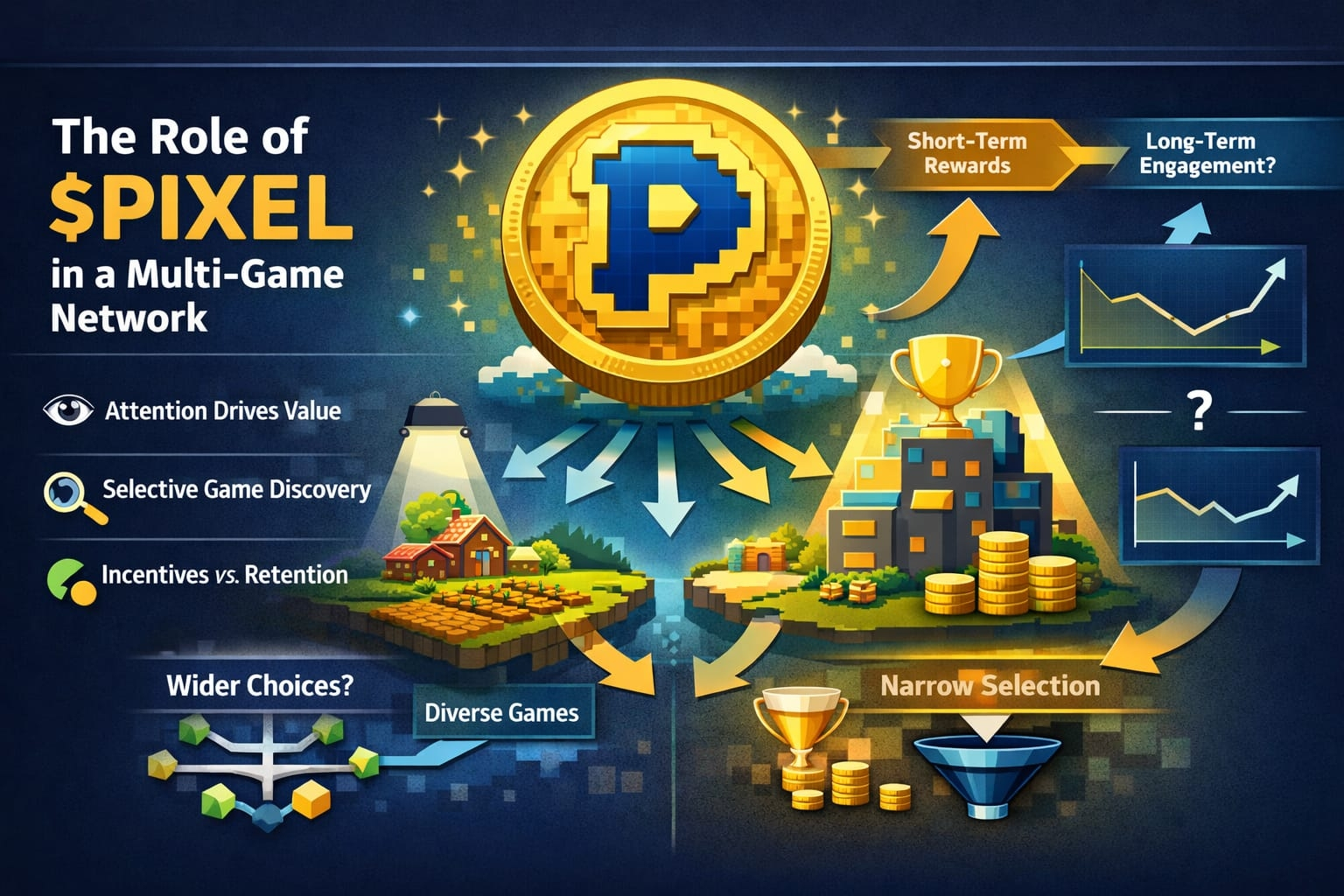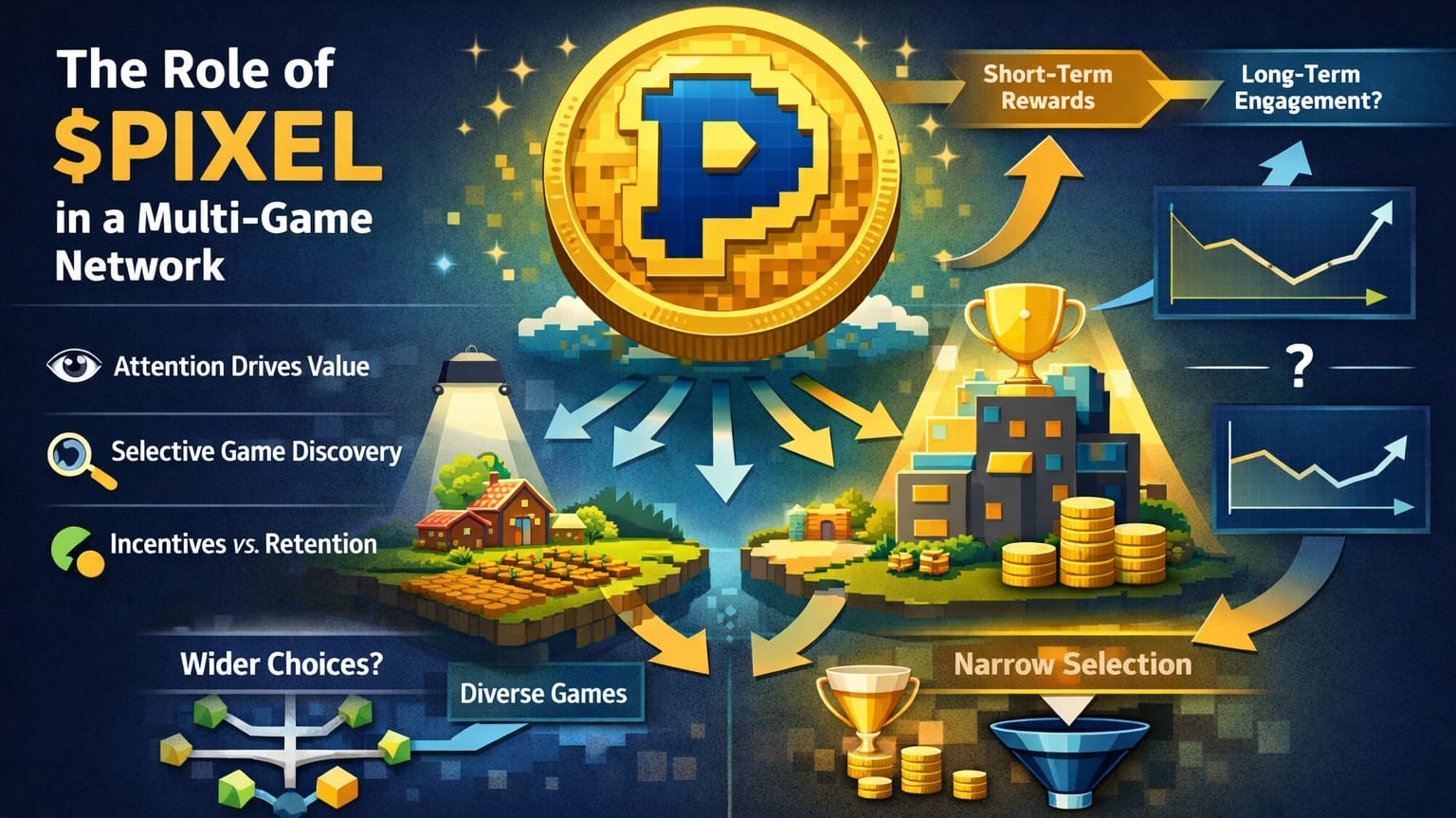
I keep thinking about how quickly people learn where to look first inside any crowded system. It happens almost automatically. In a new app, in a marketplace, even in a supermarket aisle, attention doesn’t spread evenly just because options exist. A few things become easier to notice, easier to trust, easier to repeat. The rest stay technically available but somehow peripheral. I’ve been coming back to that feeling while thinking about Pixels expanding into something bigger than a single game, because once a network starts holding multiple games, discovery stops being a side feature. It becomes part of the economy.
At first glance, that sounds simple enough. More games should mean more surface area, more players, more use cases for $PIXEL. But I’m not sure that is the right way to look at it. Expansion by itself only increases supply of experiences. It does not guarantee attention will distribute fairly across them, and it definitely does not guarantee durable demand for the token. If anything, a multi-game setup makes allocation more important. Not just capital allocation in the usual market sense, but attention allocation, player time allocation, social visibility allocation. And that is where the token starts to look less like a generic in-game asset and more like a sorting mechanism.
That shift matters. In a single game, a token can mostly live off direct utility claims: upgrades, purchases, speed, access. In a network of games, it may start doing something more structural. It may influence which game feels economically worth entering, which one feels worth staying in, and which one gets treated as background noise no matter how available it is. I don’t mean that pixel has to explicitly rank games on a public board for this to happen. Systems rarely need to announce their filters for users to feel them. If players notice that certain games offer better progression, better rewards, better liquidity, or simply more visible outcomes when $PIXEL is involved, attention starts clustering there.
And once attention clusters, the network stops behaving like a neutral collection of games. It starts behaving like a selective economy. That is the part I find more interesting than the usual “ecosystem growth” framing. Because if Pixel becomes the practical bridge between participation and visibility, then the token is not just supporting activity. It is helping determine which activity becomes legible enough to matter.
Legibility matters more than people admit. In crypto systems, the thing that often wins is not the thing with the most raw activity, but the thing whose activity is easiest to recognize, compare, and reward. A game can have players, sessions, items moving around, all of that. Still, if those actions do not convert into signals the wider network can read and respond to, they remain local. $PIXEL may be turning some forms of gameplay into a network-readable signal. Not proof in the formal attestation sense maybe, but close enough in economic behavior: a structured marker that this player engaged here, progressed here, spent here, returned here. That kind of record matters because systems stop restarting from zero once they can reuse past behavior.
I think that is where the multi-game story gets more complicated. The optimistic version says one token unifies the ecosystem. Fine. But unified for what? For simple payments, or for behavioral routing? Those are different things. A token used everywhere sounds broad, but breadth is not the same as depth. If Pixel is lightly used across many games without creating repeat dependency, that is usage, not necessarily real demand. Real demand shows up when players feel friction without it, or when developers realize that games tied more closely into the token’s logic gain more attention, more retention, or better conversion than those that do not.
That can create a strange incentive loop. Developers may start building not just for fun or gameplay differentiation, but for token compatibility in the attention economy. In other words, games might begin optimizing for how well they plug into the network’s reward and discovery logic, because that may be what determines whether players notice them at all. I do not think this is inherently bad. Every platform has ranking logic somewhere, even if it hides behind design language. But it does mean that pixel may quietly shape editorial power inside the ecosystem. Not through content moderation or formal approval. Through incentives, which usually end up deciding faster than policy does.
There is also a softer risk here. Attention gained through incentives can look healthy before it proves anything. A game can attract traffic because rewards are favorable, because token-linked loops are efficient, because users are chasing the best short-term route. That still leaves the harder question open: do players return when the relative incentive weakens? Retention matters more than event spikes. Repeated behavior under lower stimulation tells you much more about real product pull than a burst of token-sensitive activity. I think crypto gaming still struggles with this distinction. It often measures participation at the exact moment incentives are doing the heaviest lifting, then mistakes that for stable demand.
In a multi-game network, this problem gets sharper because comparison becomes constant. Players are not only deciding whether to play. They are deciding where to direct effort inside a menu of token-connected options. So PIXEL may end up pricing relative attractiveness more than gameplay itself. Not “is this game good,” but “is this game worth my time compared to the others, given how the network rewards attention?” That is a more market-like function than most people probably expect from a gaming token, and honestly it feels closer to portfolio behavior than entertainment spending.
The thing I cannot fully settle is whether this makes the ecosystem stronger or just more efficient at concentrating attention. Those are not the same outcome. A strong network helps good games compound. An overly optimized network may simply make already visible games even easier to choose, while smaller or stranger ones never get enough oxygen to prove themselves. And if that happens, then expansion into multiple games does not necessarily create diversity. It may just create more lanes through which the same token logic keeps selecting winners.
Maybe that is what $PIXEL is gradually becoming: not the center of gameplay, but the layer that decides which gameplay becomes economically visible enough to survive. I can see why that would be powerful. I can also see why it might narrow the ecosystem in ways that are hard to notice early. The network looks bigger from the outside. Inside it, attention may still be moving through a much smaller gate.