


I'm officially chatting$PIXEL Before that, I want to mention something in the gaming industry. Without understanding this matter, one cannot truly grasp what Stacked is doing, nor can one understand why I believe it to be more important than most people realize. There is a term in the gaming industry called LiveOps, which literally translates to 'real-time operation'. The actual meaning is: after a game goes live, it maintains player activity and willingness to pay through ongoing events, rewards, and limited-time content. This may sound ordinary, but behind it lies a core challenge faced by all gaming companies: how to trigger the right behaviors at the right time with different stimuli for different players? A heavy user who spends a lot of time in the game and a new user who has just registered for three days and hasn’t yet decided whether to stay or leave require completely different stimuli. Using the same set of reward rules for these two types of people either wastes the budget, triggers the wrong behavior, or both. The traditional way gaming companies handle this issue is by maintaining a data analysis team along with an operations planning team, holding regular meetings, and then manually adjusting event parameters. This process typically operates on a weekly cycle, and by the time their adjustments take effect, that group of churned users has long left. (Real Person Research · Prioritize Survival) This is not a problem of operational capability for a specific company; it is a structural efficiency defect of the entire industry.
What Stacked is doing, to put it simply, is replacing the slow cycle of 'data analysis + operational planning + manual adjustments' with a fast cycle of 'AI economists continuously analyzing + real-time adjustments of reward weights.' It enables game studios to ask AI: Why did this group of players collectively churn between D3 and D7? What specifically did the most loyal users do before day 30? What real correlations exist between certain in-game mechanisms and long-term retention? Then directly adjust the logic of reward distribution based on the answers within the same system, without needing cross-department meetings, and without waiting for the next activity cycle, compressing the time gap between insights and actions to the extreme. What does this mean for game companies? It means their LiveOps efficiency could change by orders of magnitude, not just a 10% improvement, but a complete reconstruction of the decision-making chain. And @Pixels has already validated this logic with its own game ecosystem—Pixels itself, as an open-world game focused on farming, exploration, and creation on the Ronin Network, is the first real stress test for this system, with 200 million reward distribution records and over $25M in real in-game revenue, which is the result of this fast cycle operating in a real environment.
I want to share a judgment that I have thought about for a long time, which may make some people uncomfortable: If Stacked really succeeds, its competitors are not other Web3 game reward systems, but the internal LiveOps teams of traditional game companies. This is a comparison of two completely different magnitudes—one competes for market share in the cryptocurrency space, while the other competes for the voice of operational efficiency in the entire gaming industry. The ceiling for the former is determined by the overall scale of Web3 games, while the ceiling for the latter is determined by the total LiveOps budget of the global gaming industry, and these two figures differ by more than one order of magnitude. Of course, this is the most optimistic scenario; there are countless obstacles to overcome on the path to realization: the acceptance level of traditional game companies for Web3 infrastructure, the uncertainty of the regulatory environment, and the acceptance of $PIXEL among non-crypto native users. However, if the direction is correct, these obstacles can be gradually solved issues, not fundamental logical flaws. Prioritizing survival, I will not give up on doubts just because the direction looks good, but I will believe that because the direction is right, its position on the observation list should carry much more weight than most people give it.
$PIXEL's role in this logic has thus become clearer and more important. It is not an in-game consumable, nor just a cross-game reward currency; it is the medium for value flow in the entire Stacked LiveOps ecosystem. The LiveOps budget of game companies is injected through Stacked and converted into $PIXEL rewards distributed to real participating players, who spend $PIXEL in the cross-game ecosystem, creating a continuous cycle of demand. The scale of this cycle depends on the quantity and quality of games connected to Stacked, rather than the popularity of any single game. This is why I believe there is a fundamental difference in demand structure between $PIXEL and other game tokens, which is not a difference at the narrative level but a difference in the source of economic circulation.
$PIXEL is currently at $0.00824, with a 24-hour decline of -2.60%. The highest in 24h reached $0.00875, the lowest $0.00808, with a trading volume of 377 million PIXEL and a transaction amount of 3.1489 million USDT. In terms of moving average structure, MA7 is at 0.00838, MA25 is at 0.00836, the two lines are very close and starting to flatten out, while MA99 has been consistently moving up at 0.00798, with a cumulative rebound of over 10% from the low of $0.00745. The narrowing of MA7 and MA25 is a structural signal I have been closely observing recently, and the node for directional choice is approaching. If MA7 effectively crosses below MA25, I will reassess the short-term structure. Currently, the continuous upward movement of MA99 indicates that the medium-term trend has not been broken. This time, the total reward for the @Pixels CreatorPad activity is 15 million PIXEL, with 7.5 million PIXEL exclusive to the Chinese-speaking region. As of April 28, there are currently 478 participants in the Chinese-speaking area. Prioritizing survival in real research, the changes in short-term structure do not alter my judgment on the fundamentals. Changing the judgment on fundamentals requires logical falsification, not fluctuations in the price level.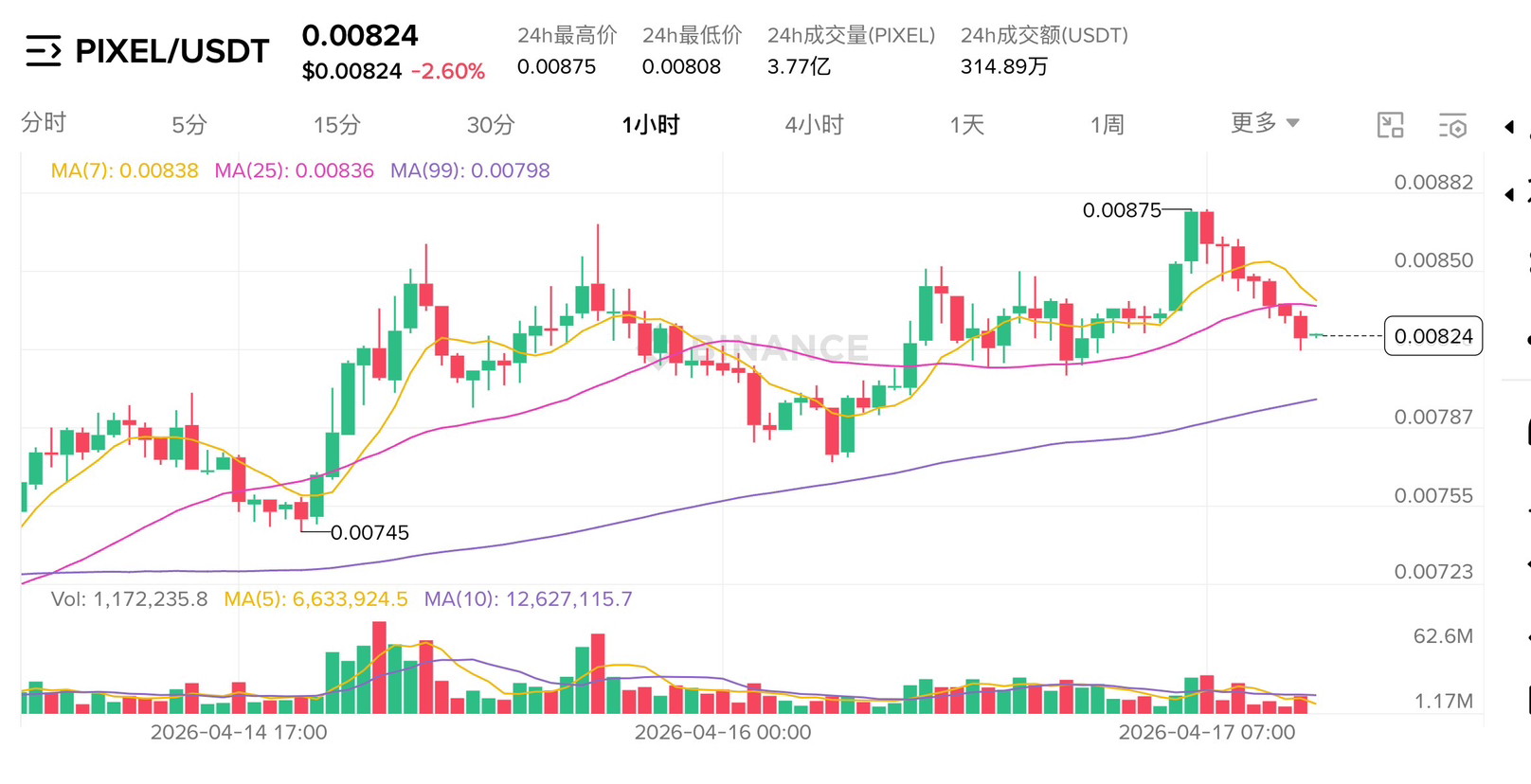
Finally, I want to say one thing: I have spent a considerable amount of time researching Stacked, not because its story is appealing, but because the problem it tries to solve is real and substantial. The gaming industry spends a lot of money on LiveOps every year, and the vast majority flows into inefficient manual adjustment processes, and this inefficiency has been accepted by the industry for so long that no one seriously questions whether 'there's a better way.' Stacked is questioning this issue and has provided a preliminary answer with real data. What it means for $PIXEL if this is successful, I have my own judgment, but I am not in a hurry to express it, because the first principle of prioritizing survival in real research is: logical coherence is the first step, continuous verification by data is the second step, and conclusions should only be drawn after both steps are completed.