
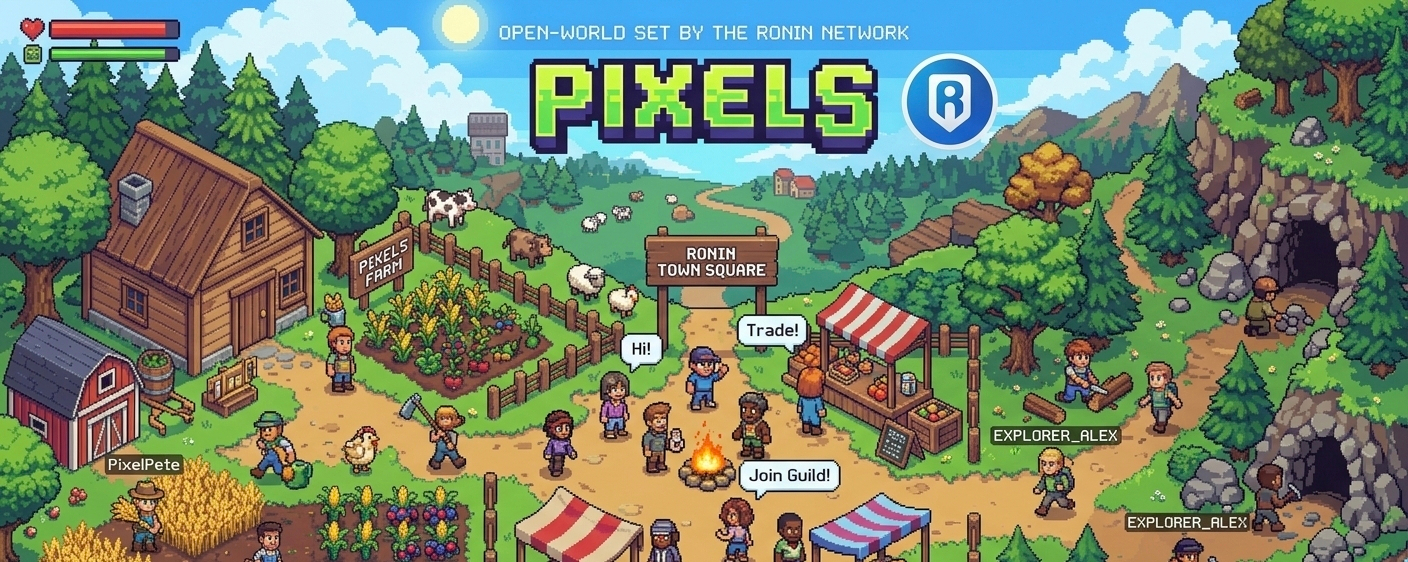

I didn’t set out to understand a farming game. I was trying to make sense of why people were treating one like it mattered. When I first came across Pixels, nothing about it looked unusual on the surface—soft colors, simple mechanics, the familiar loop of planting and harvesting. But then I noticed something that didn’t quite belong in that picture. People weren’t just spending time in it. They were making decisions the way they would in something with consequences.
That tension stayed with me. If I plant something in a game, why should it matter beyond the game? The answer didn’t come from the crops or the gameplay loop. It came from what sits underneath. Pixels runs on the Ronin Network, and that changes the nature of what a “thing” in the game actually is. The carrot I grow isn’t just a temporary object in a closed system—it can be turned into something that moves, something that exists outside the boundaries of the session. That realization didn’t make the system clearer immediately, but it did make it harder to dismiss as just a game.
Once I started looking at it that way, the idea of ownership stopped sounding like a buzzword and started behaving like a constraint. If something I earn can leave the game, then the game no longer fully controls its meaning. It becomes part of a wider environment where other people assign value to it, trade it, hold it, or ignore it. That changes how I would act inside the system. I wouldn’t just be playing for progression; I would be paying attention to what others are doing, what they want, what they’re willing to exchange. The field I’m farming in starts to feel less like a sandbox and more like a small, open economy.
That’s where the experience begins to split. It can still be a quiet, repetitive farming loop if I choose to treat it that way. But the structure doesn’t insist on that interpretation. It quietly allows another one to emerge, where every action has a potential economic shadow. Over time, it becomes difficult not to notice which crops are more valuable, which items move faster, which strategies seem to compound. The system doesn’t force optimization, but it rewards attention to it. And once enough people start paying attention, the atmosphere shifts.
I found myself less interested in whether this was “good” design and more interested in what it seemed to favor. The system appears to make it easy for assets to circulate, for new participants to enter without much friction, and for what you earn to persist beyond a single play session. But in doing so, it seems less concerned with maintaining a tightly controlled balance or ensuring that progression is purely about skill. The result is something that feels less like a carefully tuned game and more like a living environment where outcomes are harder to predict.
That unpredictability becomes more noticeable as more people arrive with different intentions. Some come to explore, some to relax, and some to extract value. Those motivations don’t stay separate for long. They start influencing each other. Prices shift, scarcity appears in places you wouldn’t expect, and the experience of a new player begins to depend on decisions made by players who arrived much earlier. What looked like a simple farming loop starts behaving like a system where participation itself changes the conditions of play.
The presence of the PIXEL adds another layer to this. It doesn’t just reward activity; it shapes it. It nudges attention toward certain behaviors and away from others. Over time, those nudges accumulate. They influence what feels worth doing, what feels wasteful, and what feels urgent. The system begins to guide its participants not through rules alone, but through incentives that are constantly being interpreted and reinterpreted by the people inside it.
As the system grows, the question of who steers it becomes harder to ignore. Decisions about supply, rewards, and changes to the game don’t stay abstract. They affect how people behave, what they expect, and whether they continue to participate. Governance, in that sense, stops being something in the background. It becomes something you experience indirectly through shifts in the environment. Sometimes those shifts feel smooth. Sometimes they don’t. It’s not always clear which outcomes are intentional and which are emergent.
I keep coming back to a quieter uncertainty. Systems like this seem to rely, at least in part, on continued engagement. As long as people keep arriving, trading, experimenting, the system has momentum. But it’s less obvious what happens when that momentum slows, or when expectations change faster than the system can adapt. It’s not a failure by default, but it’s not something that can be assumed away either.
So I don’t find myself trying to settle on a final judgment. It feels more useful to keep watching how behavior evolves inside it. Whether people stay because they enjoy the experience or because the incentives still feel worthwhile. Whether the economy can hold together without constant expansion. Whether decisions made at the top translate into stability or friction on the ground. And whether the idea of ownership continues to produce something tangible, or gradually leans more toward speculation.
What I’m left with isn’t a conclusion, but a way of looking. If the incentives shift—and they will—do the people inside the system shift with them in a way that keeps it coherent? Or do those shifts start to pull the system apart in ways that only become visible after the fact?
