
Brothers, today let’s speak some bone-deep truths and smash all those filters that casually claim to 'disrupt the Web3 landscape.'
Taking advantage of the current period from April 15 to 30, 2026, which is the peak of the Binance Square Creator event, both funds and traffic are leaning towards deep content. I simply use this opportunity to thoroughly expose the recent card revealed by @Pixels ——the Stacked engine.
The current GameFi circle is really hard to look at. The vast majority of projects are just a skinned funding scheme, equipped with a few utterly useless social check-in panels. Opening servers, boosting prices, a flood of studio scripts draining resources, economic collapse, and finally, the project party pulls the plug. This death spiral script is so familiar even to the new recruits. But in this Darwinian hell where machine dogs outnumber humans, can Pixels' Stacked B2B underlying infrastructure truly rewrite fate, or is it just another way to harvest the inexperienced? Let’s look at the evidence.
1. Abandon ToC big talks and turn into a 'cold-hearted foreman.'
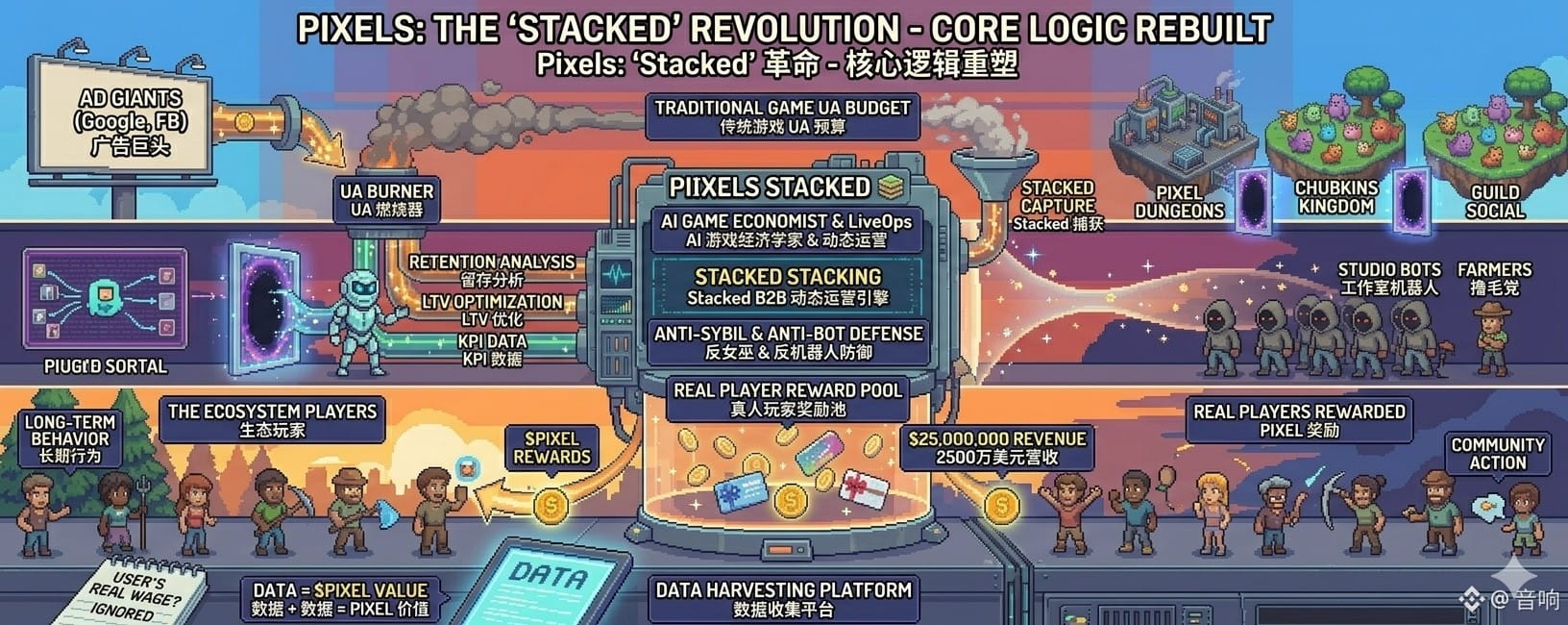
The Pixels team has definitely rolled and bled in the previous economic quagmire, so their positioning this time is extremely cunning. Stacked is no longer about drawing big pies with retail investors, but has directly transformed into an infrastructure aimed at game developers (B2B).
Do you remember the core logic we talked about before? 'One reward is a perfectly attributed advertisement.'
The task platforms that issue air points on the market are extremely weak. The core ulterior motive of Stacked is to intercept the exorbitant user acquisition budgets (UA) fed to traditional gaming giants by advertising giants and turn them into real money (tokens or gift cards) distributed to real players. Sounds great, right? But don't forget, it's not doing charity; it is precisely acquiring your behavioral data. It does not reward mindless idling; it only rewards actions that can genuinely enhance game retention and LTV (lifetime value). This business closed loop is perfect on paper, but the crux lies in: Can Pixels' underlying anti-witchcraft and anti-automation codes withstand the bombardment of global black markets?
2. AI game economist: Eliminate the million-dollar data team.
Flipping through the underlying architecture of Stacked, what makes me most alert and interested is that 'AI game economist.' In the current market situation, even a local dog project wants to leverage AI, but if Pixels can actually run this system combined with LiveOps (dynamic online operations), it will definitely be a dimensionality reduction strike against existing task platforms.
Game developers who connect to this engine essentially get a top-notch data analysis team for free. This AI can directly analyze queues and tell you why heavy spenders always run away on the 3rd to 7th day after registration; or accurately distill which feature loyal players of 30 days are obsessed with. If budget leaks are discovered, game operators can directly adjust reward strategies in the same backend, instantly completing ROI optimization. You think you are playing a game, but in fact, you are the continuous testing fuel in this ROI optimization machine. Of course, the premise is that the data fed to the AI in the early stages must be absolutely clean; otherwise, the calculations will yield a heap of garbage instructions that accelerate collapse.
3. The $25 million moat: Reject PPT car manufacturing.
When discussing investment logic, we ultimately need to look at blood generation ability. In this stage of stock game where VCs are immune to PPT narratives, Pixels has revealed its bottom line: a solid $25 million historical revenue proof.
This means that Stacked is not just some programmers pulling an all-nighter to come up with a brainchild, but a mature product that has survived billions of real interactions and anti-fraud tests. This creates a very high competitive barrier – underlying architecture, anti-robot algorithm models; this is absolutely not something a temporary outsourcing team can replicate at a pixel level in two months. This is also why I am willing to dig deep despite the huge market noise, because the threshold for the entire blockchain gaming infrastructure track has quietly been raised to a terrifying level.
4. From game currency to settlement currency: the logic of cross-ecosystem water sellers.
Finally, we need to look at the token capture logic of $PIXEL , which is its core differentiator from ordinary SaaS software.
In the past, everyone thought it was just a shovel for farming games, with its lifecycle entirely tied to growing vegetables. But now, once the Stacked engine is fully deployed, $PIXEL 's identity has qualitatively changed into the underlying settlement currency for the entire cross-game ecosystem. External games that want to gain real traffic must connect to this system and consume tokens to distribute rewards. This move is extremely ruthless; Pixels has directly switched its ecological position from 'gold rushers' to 'water-selling oligarchs.' As long as there are people continuing to make games on this land, there will be a continuous flow of real consumption scenarios. This cross-border narrative tension is extremely in line with the long-term aesthetics of big funds.
Summary: See through the bottom line, ensure survival and enjoy the benefits.
However, it is crucial to avoid getting carried away in transactions. This model of converting advertising costs into on-chain rewards is indeed the only way to break through in Web3 gaming. But the biggest resistance lies in: Are those low-quality game developers, who are used to a one-time profit scheme, really willing and able to integrate into this stringent, refined operational engine?
We need to closely monitor Stacked's external access list and real on-chain activity data in the coming months. Don't just listen to what the project party boasts, and don't be swept away by market sentiment. In this Darwinian survival of the fittest, speaking with data and calculating your own 'real hourly wage' is the ultimate rule for us retail investors to survive and thrive.