
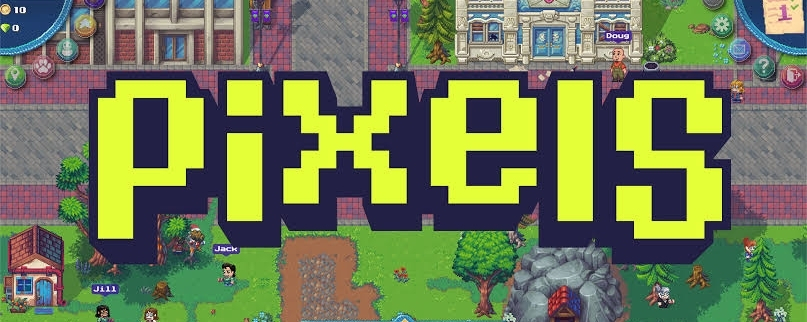
i used to think i was just playing a game on Pixels.
log in, move around, farm a bit, hit the Task Board, repeat. simple loop. everything felt responsive, like what i did mattered directly… like the system was reacting to me in real time.
but the longer i stayed, the harder that became to believe.
because nothing actually behaves like it’s reacting.
it behaves like it’s executing.
and that difference is subtle at first.
you don’t notice it when everything is smooth… crops grow, actions complete, Coins stack endlessly like the system is designed to never push back. no friction, no limits, no resistance anywhere inside the loop.
but that’s the point.
that layer isn’t where decisions are made.
it’s where activity is generated.
because inside Pixels, most of what you do isn’t being valued.
it’s being collected.
every action… every loop… every session…
it all feeds into something that isn’t visible on the surface.
not the Task Board.
not the farm.
not even the token.
something behind it.
and once you start noticing that, the entire system feels different.
because the game you’re playing…
isn’t the system that’s deciding anything.
the real system sits one layer above it.
and that’s where Stacked starts to make sense.
at first, it sounds like just another rewards system.
but the more you look at how Pixels actually behaves… the less it feels like rewards are being “given” at all.
they’re being allocated.
not randomly.
not evenly.
not even based purely on effort.
strategically.
because what Stacked really does isn’t just distribute rewards.
it decides where rewards should exist in the first place.
that’s why the loop inside Pixels feels unlimited…
while rewards don’t.
you can farm forever.
craft endlessly.
repeat loops without restriction.
but $PIXEL doesn’t follow that same logic.
it appears selectively.
and that’s not a bug.
it’s the system working exactly as designed.
because most play-to-earn systems failed for one simple reason…
they rewarded everything.
and when everything gets rewarded…
nothing holds value.
so Pixels flipped the model.
instead of paying for activity…
it evaluates behavior first.
and only then decides what deserves to cross into real value.
that’s where the AI layer changes everything.
because now the system isn’t just tracking actions.
it’s analyzing patterns.
who stays after rewards slow down
who leaves when value drops
who adapts
who just repeats
and over time, that builds something more powerful than any quest system.
it builds predictability.
not for players.
for the system.
and once behavior becomes predictable…
rewards don’t need to be reactive anymore.
they can be pre-positioned.
that’s why the Task Board doesn’t feel like it’s responding.
because it isn’t.
it’s showing you outcomes that already passed through a filtering layer.
a layer deciding:
which actions matter
which players matter
and most importantly…
where reward budget actually goes
because at scale, this isn’t a game design problem anymore.
it’s an economic one.
reward distribution has to stay efficient.
spend has to stay below value generated.
and not every player can be paid equally without breaking the system.
so instead of trying to reward everyone…
Stacked optimizes who gets rewarded and when.
that’s the real shift.
because now rewards aren’t tied to actions directly.
they’re tied to outcomes that improve the system itself.
retention
engagement
long-term value
and suddenly, everything inside Pixels makes more sense.
why some loops never convert
why some players consistently see better rotations
why timing changes outcomes
it’s not randomness.
it’s allocation.
and that allocation isn’t happening locally.
it’s happening across the entire ecosystem.
because Pixels isn’t just one game anymore.
it’s infrastructure.
the same system that powers its economy…
is designed to expand beyond it.
which means $PIXEL itself stops behaving like a single-game reward token.
and starts behaving like something else entirely.
a routing layer for value.
moving rewards from where budget exists…
to where the system decides it should go.
and that decision isn’t static.
it updates continuously.
across players.
across sessions.
across the entire network.
which means the question changes.
it’s not:
“how do i earn more”
it’s:
“where is the system currently allocating value”
because once you understand that…
you stop treating the game like a fixed loop.
and start seeing it for what it actually is.
a live economy…
run by a system that isn’t playing alongside you.
it’s managing everything around you.
and maybe that’s the real reason it works.
not because it rewards players more.
not because it feels better.
but because it knows exactly when not to reward you.
and in a system where value has to survive…
that might be the most important decision of all.