
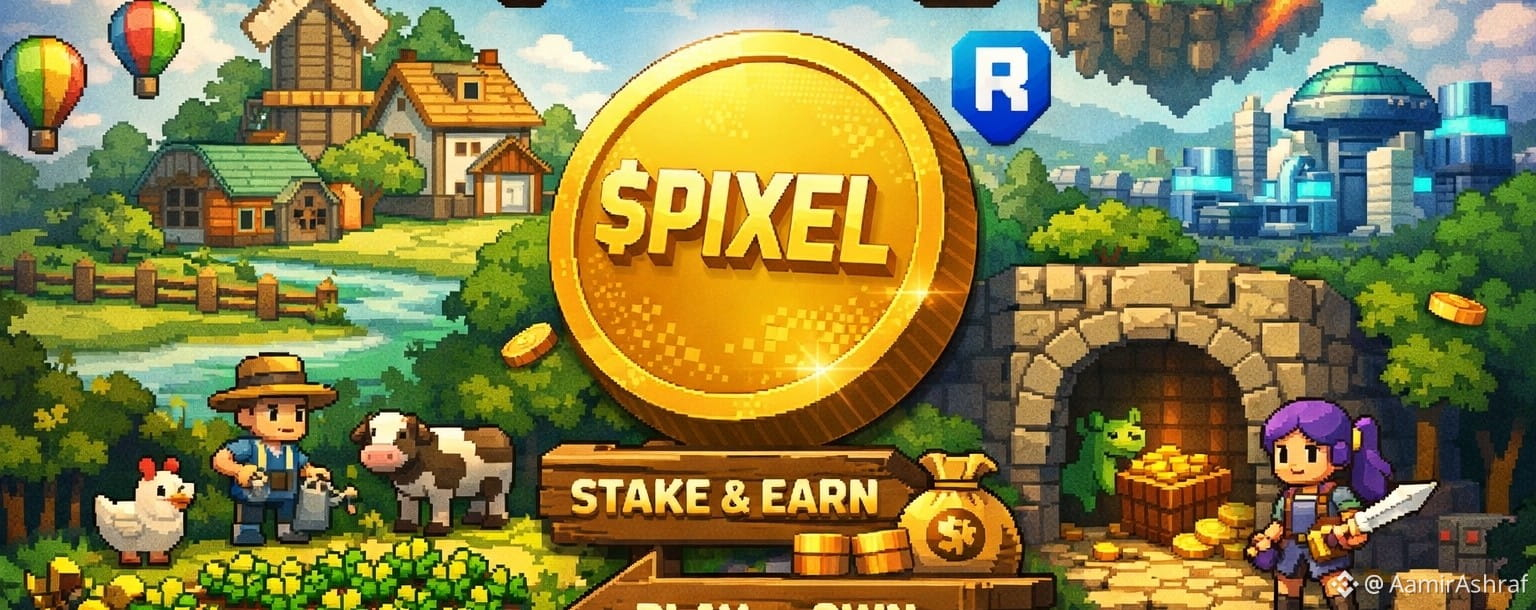
The world of blockchain gaming has rapidly evolved over the past few years, but few projects have managed to capture attention and scale like $PIXEL As a core component of the Pixels gaming universe, $PIXEL is not just another token—it represents a new direction in Web3 gaming, combining entertainment, ownership, and economic participation into one seamless ecosystem.
At its core, Pixels is a social, open-world farming and exploration game built on the Ronin blockchain. It blends casual gameplay—such as farming, crafting, and exploration—with blockchain-based ownership, allowing players to truly own their in-game assets. This means that land, items, and pets are not just virtual—they are NFTs that can hold real-world value, creating a bridge between gaming and decentralized finance.
One of the key strengths of $PIXEL lies in its utility. Unlike many GameFi tokens that rely heavily on speculation, $PIXEL is deeply integrated into gameplay. Players use it for in-game purchases, VIP features, NFT minting, and participation in guilds. This multi-purpose functionality ensures that the token remains relevant and valuable within the ecosystem, rather than being purely market-driven.
The Pixels ecosystem has also introduced an innovative “fun-first” approach. Earlier blockchain games often failed because they focused too much on earnings rather than gameplay. Pixels addresses this by prioritizing user experience while still offering earning opportunities. With over a million daily active users reported in 2026, the platform has proven that Web3 games can scale when they focus on engagement first.
A major innovation driving the futureis its expanding ecosystem, especially through staking and multi-game integration. The introduction of $PIXEL staking allows players to earn rewards while supporting different games within the ecosystem. This creates a decentralized economy where users actively shape the growth of the platform. Instead of a single-game economy, @Pixels is evolving into a multi-game publishing hub, where multiple titles share the same token and reward system.
Another breakthrough is the Stacked ecosystem, which redefines play-to-earn mechanics. Rather than simply rewarding repetitive gameplay, Stacked integrates Web2 and Web3 reward systems into one unified experience. This approach helps maintain economic balance and prevents inflation—one of the biggest issues in earlier GameFi projects. By carefully placing blockchain elements within gameplay, Pixels ensures that the economy remains sustainable and player-driven.
Additionally, Pixels uses a dual-currency model consisting of in-game Coins and the premiu. Coins help players progress within the game, while $PIXEL acts as the higher-value asset tied to blockchain functionality. This separation helps stabilize the economy and allows both casual and competitive players to participate without barriers.
Looking ahead, the future gaming appears promising. With continuous updates, ecosystem expansion, and new partnerships, Pixels is positioning itself as a leader in the Web3 gaming industry. Its transition from a single farming game to a full-scale gaming ecosystem highlights its long-term vision and adaptability.
In conclusion,.is more than just a gaming token—it is the backbone of a growing digital economy. By combining engaging gameplay, real asset ownership, and a sustainable reward system, Pixels is setting a new standard for blockchain gaming. As the industry matures, projects like Pixels and its Stacked ecosystem may define the next generation of gaming, where players are not just participants but true stakeholders in virtual worlds.#PİXEL