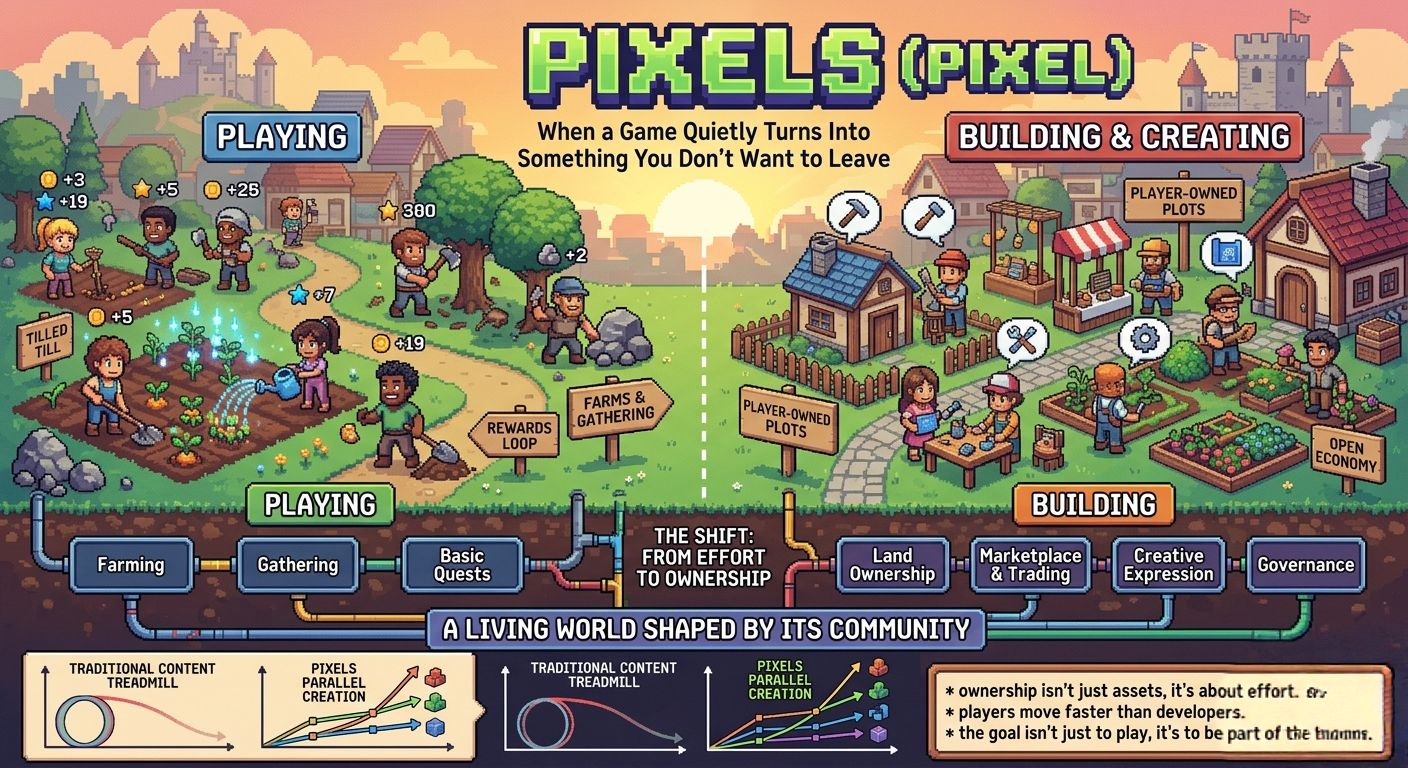
I’ll be honest… it doesn’t feel like a game after a while.
And no, not in some dramatic, “this changes everything” kind of way. It’s quieter than that. You log in, walk around, plant a few crops, maybe trade something… and then it hits you later, not during.
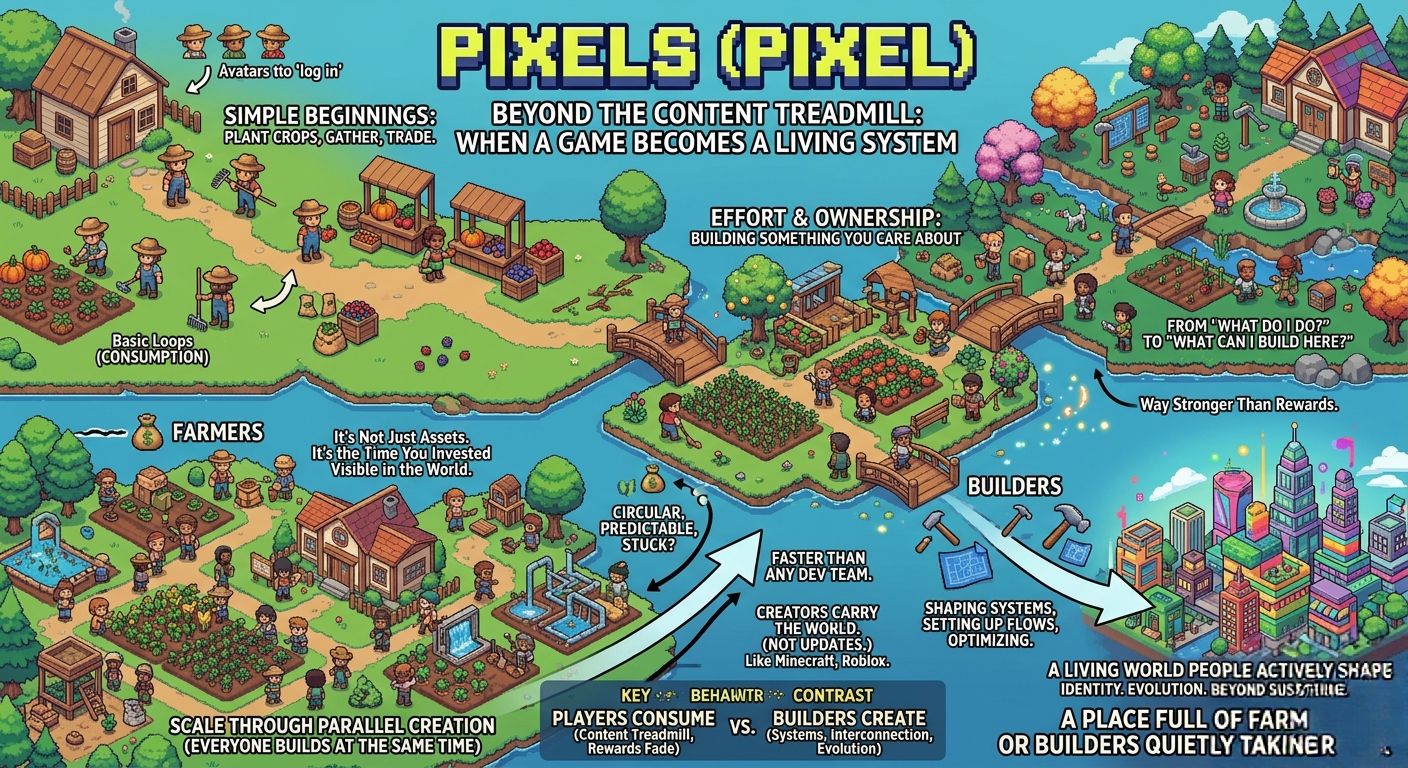
You’re not thinking, “what should I do next?”
You’re thinking, “what can I build here?”
That shift? That’s the whole story.
Look, I’ve seen this before.
Most games follow the same script. Developers build stuff, players run through it, updates drop, people come back, and then… it fades. Every time. It’s a content treadmill. And the problem is simple—players move faster than devs. Always have.
You can’t outbuild consumption. Doesn’t matter how big the team is.
And Web3 games? Yeah… they didn’t really fix this. They just threw tokens at the problem. Rewards, yields, incentives—whatever you want to call it. It works for a bit. People show up. Numbers look good.
Then rewards slow down.
And suddenly… nobody cares.
Because let’s be real—if the only reason someone’s playing is money, they’re already halfway out the door.
Here’s where Pixels does something different.
Not loudly. Not in-your-face. It just… shifts the structure.
You’re not just playing a game. You’re inside a system.
And yeah, at first it looks basic. Farming, gathering, trading. Nothing groundbreaking on the surface. But that’s where it gets interesting.
These aren’t just loops to keep you busy.
They actually connect.
Farming feeds into trading. Trading shapes how people interact. Land starts to matter. Decisions stack. Small stuff at first—but it builds.
And suddenly, the world doesn’t feel like a map anymore.
It feels like a place people are shaping.
That’s a big difference.
Here’s the thing people don’t talk about enough—ownership isn’t about assets.
It’s about effort.
Anyone can hold a token. That doesn’t mean anything by itself. But when you spend time building something—even something simple—you start caring about it. Not because it’s valuable on paper, but because you made it exist.
That’s where Pixels gets it right.
It lets your time show up in the world.
Not as a number. As something visible. Something you can tweak, expand, come back to.
And once that happens… you’re not just “playing” anymore.
You’re maintaining something.
That’s a different kind of hook. Way stronger than rewards.
Now let’s talk scale, because this is where things usually break.
Most games scale by adding content. More updates, more features, more stuff to do. But that model hits a wall. Eventually, players catch up. They always do.
Pixels doesn’t rely on that.
It leans into something else—parallel creation.
Basically, everyone builds at the same time.
Not in some big, coordinated way. Just through normal play. You farm here, someone trades there, another person optimizes their land… and all those small actions start stacking into something bigger.
No one’s controlling it fully.
But it grows anyway.
Faster than any dev team could manage alone.
That’s the edge.
And yeah, we’ve seen versions of this before.
Minecraft did it.
Roblox did it too.
Those games didn’t win because of constant updates. They won because players stuck around to create. Build stuff. Show off. Mess around. Come back.
Content didn’t carry those worlds.
People did.
Pixels is moving in that direction—but with an added layer where ownership and economies actually stick. Not perfectly, not fully matured yet… but the foundation is there.
And honestly, that’s what matters.
Now here’s where things get tricky.
There’s a clear split happening inside the game.
Most people are still playing. Just running the loops. Farming, earning, optimizing. Nothing wrong with that—it’s the entry point.
But a smaller group?
They’re building.
And I don’t mean building in some fancy, developer sense. I mean they’re thinking in systems. Setting up flows. Figuring out how to make things work better—not just for themselves, but in relation to others.
They’re shaping how the game actually functions.
That’s a completely different mindset.
And it changes everything.
Because playing consumes.
Building creates.
Simple as that.
So yeah, the big question isn’t about tokens or rewards or even player count.
It’s this:
How many people actually cross that line?
How many stop treating Pixels like a game… and start treating it like something they’re part of?
Because if most players stay in farming loops, the system stays… kind of stuck. Circular. Predictable.
But if enough people start building—
Then this thing evolves.
It stops being “a Web3 game.”
It turns into something closer to a living world people actively shape.
And at that point… it’s not really about sustainability anymore.
It’s about identity.
So what does Pixels become?
A place full of farmers running loops?
Or a place where builders quietly take over?
Yeah.
That’s the real question.