
I’ve been around long enough to know how these things usually go.
A new cycle starts forming, and suddenly everything is a world again. Open worlds, social worlds, digital economies that promise to feel alive. I’ve watched enough of them rise, trend for a while, and then quietly disappear into inactive wallets and abandoned Discord servers.
Pixels sits somewhere in the middle of that familiar pattern. It doesn’t feel careless. That’s the first thing I noticed. There’s a kind of restraint in how it presents itself. Farming, exploration, creation. Not trying too hard to reinvent human behavior, just trying to repackage it inside a tokenized environment.
And I respect that. Quietly.
But respect doesn’t mean belief.
Because I’ve also seen how often “simple” becomes “forgettable.” Especially in Web3, where attention is short and loyalty is even shorter. People don’t stay because something is well designed. They stay because they need it. And I’m not sure yet if anyone actually needs Pixels.
The Ronin ecosystem helps. It gives the project a kind of structural backbone that many others never had. Lower friction, smoother onboarding, an existing user base that understands what it means to interact with a blockchain game. That matters more than people admit.
Still, infrastructure alone doesn’t carry a world.
The core idea feels almost too safe. Farming loops, resource gathering, social interaction. These are mechanics that worked in Web2 because they were wrapped in habit, not ownership. People didn’t log into those games because they believed in digital land scarcity or token rewards. They logged in because it became part of their routine. Something quiet. Something consistent.
Web3 keeps trying to shortcut that process. It replaces habit with incentives. It assumes that if you attach value to actions, people will stay longer.
They don’t. Not really.
They extract, then they leave.
And that’s where Pixels starts to feel like a question rather than an answer. Can a game like this move beyond extraction? Can it create something that feels… necessary, even in a small way?
I look at it and I see care. The kind of care that suggests the team actually plays games, not just builds them for metrics. The world isn’t overloaded. It breathes a little. There’s space to exist without constant pressure to optimize every action.
But then the other thought creeps in. Is that enough?
Because good design often dies quietly when it meets real users. Friction shows up in unexpected places. Wallet setups, token volatility, unclear progression systems. Things that seem minor from the inside end up being the exact reasons people never come back.
And then there’s the larger issue no one really wants to sit with.
Most of these projects are built to be seen, not lived in.
They launch with momentum, partnerships, narratives. Everything is front-loaded for attention. But survival is slower. Messier. It requires something deeper than mechanics and tokenomics. It requires a reason to exist when nobody is watching.
I don’t know if Pixels has that yet.
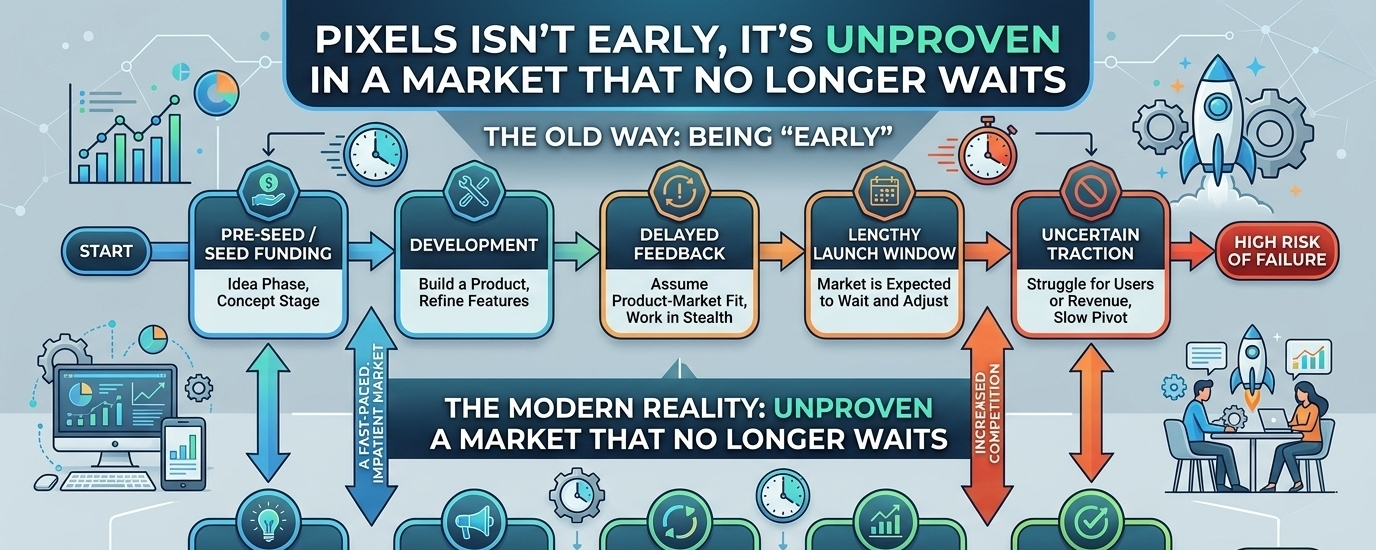
Maybe it’s still early. Maybe it’s not supposed to.
Or maybe it ends up like many others I’ve watched over the years. Thoughtful. Well put together. Quietly fading while louder, less careful projects take the spotlight for a while before meeting the same end.
I keep coming back to that tension. The difference between something that looks meaningful and something that becomes part of someone’s life.
Pixels feels like it’s trying to cross that gap.
I just can’t tell if it knows how far that gap actually is.
