

 To be fair, when@Pixels At the beginning of the year, it was suddenly announced that $BERRY would be completely abolished, forcibly transitioning to $PIXEL the single-token model. My first reaction was: this team is really bold, daring to land so hard. At that time, the community was in an uproar, feeling that the resources they had worked so hard to accumulate would greatly shrink. But after several months of continuous observation, I found that behind this 'surgical removal,' there was an extremely ruthless yet exceptionally clever logic of economic restructuring.
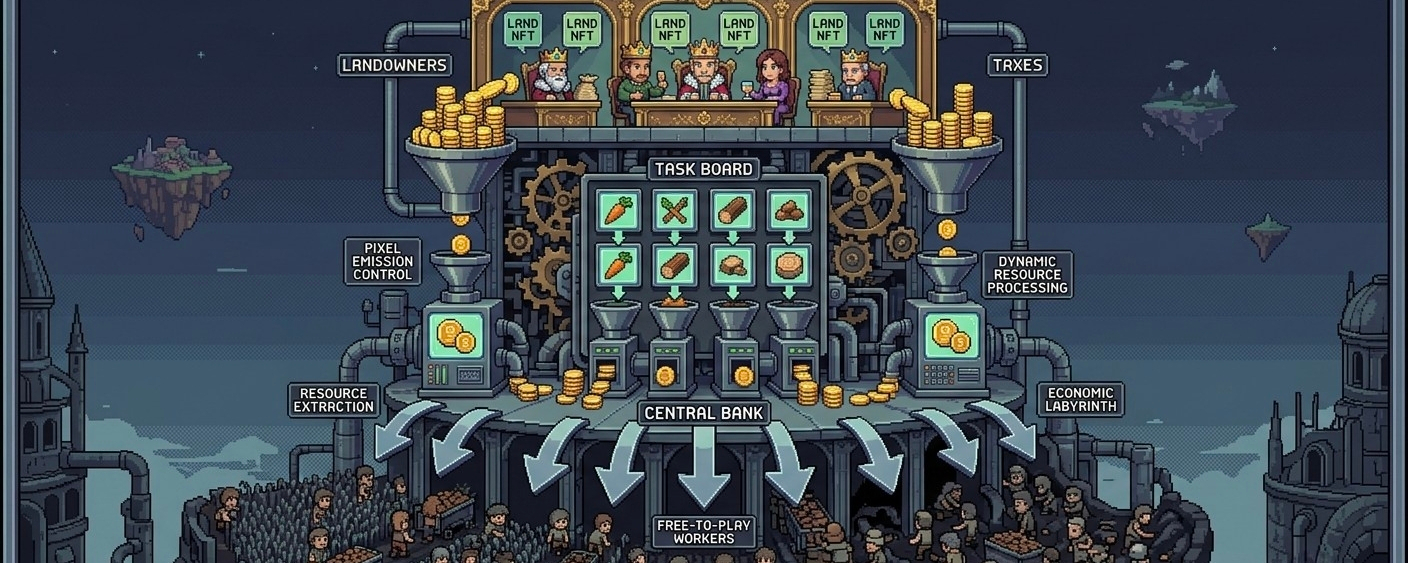
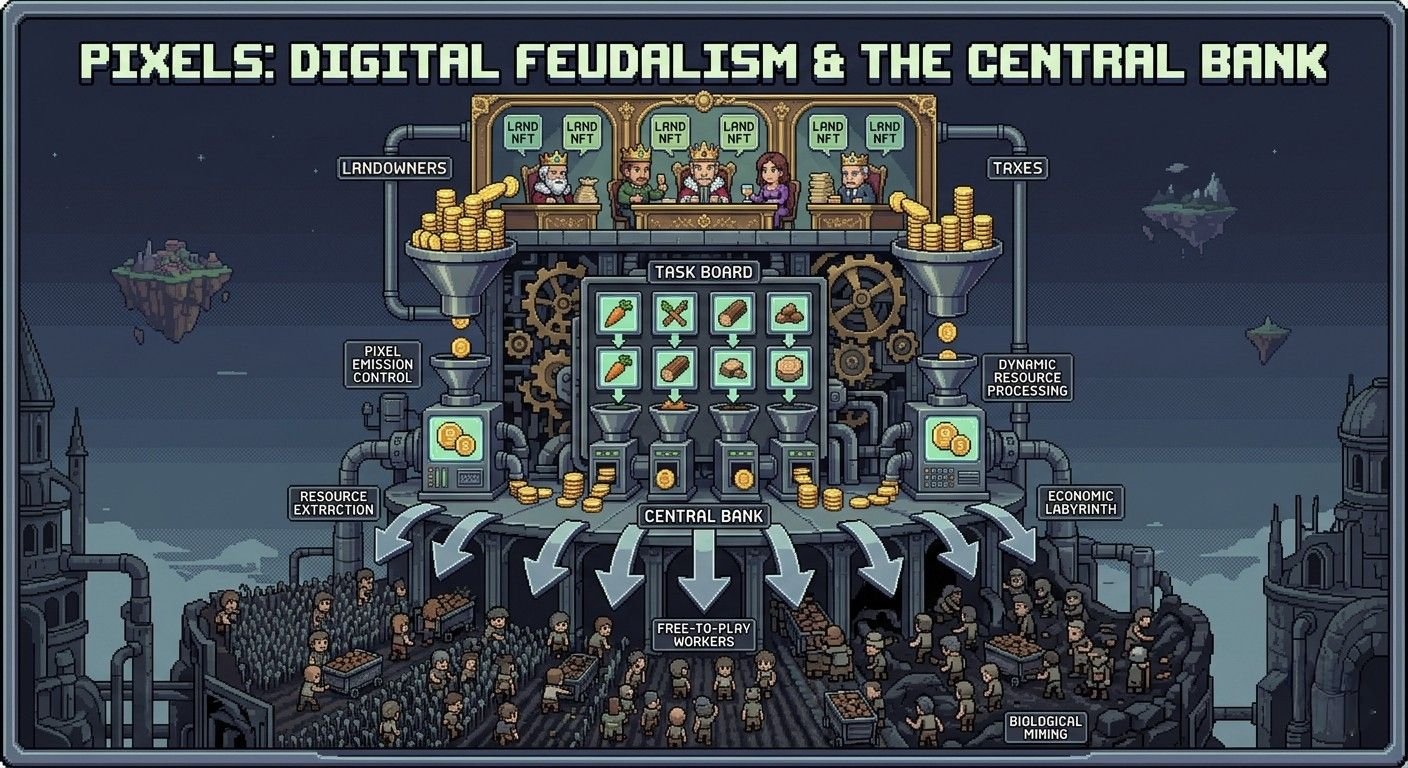
On the surface, the core gameplay now has turned into refreshing the 'Task Board.' Every day, watching what materials the NPCs need, farming, chopping wood, cooking, and then completing tasks to exchange for $PIXEL. This sounds like a completely ordinary daily task system in an RPG. However, if you analyze it from a macroeconomic perspective, this task board is not just a simple task list, but a 'central bank' with absolute control.
It does not have a fixed output formula. The system monitors the resource inventory, player behavior, and token pool across the entire network every day. Do you think you are randomly generating high-priced wine orders for a few $PIXEL ? No, that is the algorithm accurately delivering 'bait' after calculating the current inflation rate, token price, and number of active wallets in the background. This is actually a highly centralized dynamic token issuance (Emission) and recycling mechanism. When the market weakens or the token price continues to be weak, you will find that high-yield orders have almost disappeared out of thin air, which is equivalent to the project team manually pulling the plug in the background, forcibly reducing liquidity.
This design gives me a strong sense of class division. Early Web3 games often liked to boast about 'Play to Earn', as if everyone could share a piece of the pie in this utopia as long as they worked hard. However, Pixels has blatantly established a 'digital feudal society' through its land NFTs (Land) and asset thresholds. Players who own land are the true landlords; they don’t even need to farm themselves, they can simply set tax rates (Tax) to profit while lying down. Meanwhile, the vast majority of ordinary players attracted by the 'zero-cost' gimmick are actually cyber tenants working in this system.
What I must complain about is that this extremely fine macro control actually conceals a very fatal economic flaw: $PIXEL lacks real external consumption scenarios. The team has been emphasizing that VIP memberships, pet hatching, or buying special items require consuming tokens, but essentially this is still a 'left hand to right hand' game of existing stock. When the real market demand for tokens is insufficient, and the price inevitably seeks a support level downwards, the labor value of players is forcibly exploited. You grow the same amount of carrots, spend the same time cost, but your purchasing power in the real world continues to shrink.
Ultimately, Pixels has abandoned the illusion of the dual-token spiral ascent from the Axie era, choosing a more controllable yet harsher path. It is not making a casual farming game, but is running an extreme stress test model using real-world capital flows.
This makes me ponder a question: when we are crazily calculating the input-output ratio in this pixel world, staying up late to gather pumpkins to fulfill our orders, are we truly enjoying the fun of the game, or are we unconsciously and voluntarily becoming the cheapest biological mining machines in this vast and cold economic model? Perhaps the truth of Web3 games is just that, stripping away the decentralized facade, what is inside is still the most traditional form of capital alienation.#pixel