
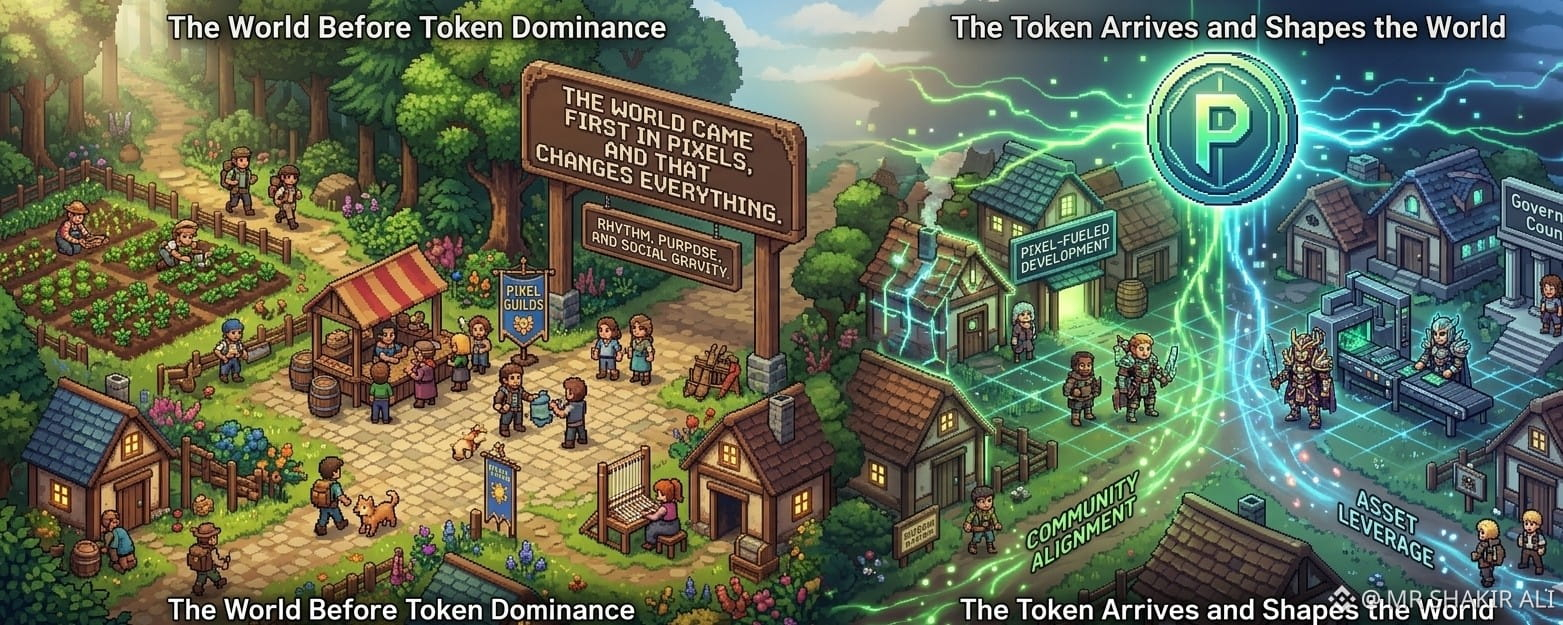

What keeps pulling me back to Pixels is a small design instinct that many Web3 games never really learn. It does not rush to make me think about the token first. It asks me to notice the world. I see farming, wandering, guilds, land, pets, production, routines, and a kind of digital village life before I am asked to think about economics. That sequence feels important. In most crypto-native games, the financial layer arrives too early and flattens everything beneath it. The world becomes a delivery system for incentives. Pixels seems to be trying, at least in structure, to reverse that order.
That is why I think the real Day 1 question is not whether PIXEL has utility. That is too easy. Almost every token can be given a function. The sharper question is this: if the world already has rhythm, purpose, and social gravity, what exactly is the token meant to strengthen without distorting what came before it?
I keep returning to that because Pixels presents itself less like a single mechanic and more like a lived environment. The farming matters, but so do identity, progression, collaboration, and space. The land matters, but so does the feeling of staying somewhere long enough for habits to form. When a project starts from that kind of world logic, the token cannot be allowed to act like the author of meaning. It arrives later. So its role is narrower, but also more dangerous. It does not create the world. It changes the pressure inside it.
And that change is where things become interesting.
A token, in a world like this, does not only reward activity. It selects what kind of activity deserves reinforcement. That is a very different power. It tells players, quietly, which forms of participation count more, which positions become more strategic over time, and which layers of the world can turn patience into leverage. In theory, that can be healthy. A world needs commitment from people who stay, build, coordinate, and contribute. Not every system should treat a passing visitor and a long-term participant exactly the same. But once a token begins amplifying commitment, I have to ask what form of commitment it recognizes best. Is it care? Is it consistency? Is it ownership? Or is it proximity to the parts of the system that compound faster than the rest?
That is the tension I feel in Pixels. The project seems to understand that fun cannot survive if every small action is turned into extraction. That restraint is meaningful. But restraint alone does not remove hierarchy. It just makes hierarchy more elegant. When value is attached more selectively, the game starts sorting people in subtler ways. Some players are simply playing. Others are positioned to turn structure into advantage. In that sense, the token may not dominate the world openly, but it can still begin to shape which lives inside that world become heavier than others.
I do not say that to dismiss Pixels. Actually, it is the opposite. I think Pixels becomes more worth taking seriously when I stop reading it as a cheerful farming game with crypto rails and start reading it as a governance question disguised as a world. What happens when a game tries to preserve atmosphere, social feeling, and daily habit, while also layering in an asset that rewards deeper alignment? Can the token remain a support beam? Or does it slowly become a filter that decides whose version of the world matters more?
For me, that is the real measure. A world should come before its currency. That part is easy to say. The hard part comes later, when the currency begins to speak. Then the test is whether it deepens the world’s meaning or quietly starts replacing it. Pixels is interesting because it seems aware of that line. I am just not sure awareness alone is enough to keep the line from moving.
