
Pixels didn’t start out looking like a project that would end up mattering beyond its own little corner of the internet.
It looked modest. A browser game. Crops, land, resource loops, pixel art, light social play. The kind of thing people might open in one tab while doing something else in another. That first impression wasn’t wrong, exactly. It was just incomplete. The farming layer was real, but it was also a disguise. Underneath the soft visuals and slow routines, Pixels was doing something far more ambitious: it was figuring out how to make people return, and not in the cheap, desperate way a lot of Web3 projects tried to do it.
That distinction is everything.
Most projects in this space spent years confusing attention with attachment. They thought if you dropped rewards into the system, users would stay. If you wrapped ownership around ordinary gameplay, users would care more. If you added enough financial incentive, maybe the experience itself could be thin and still survive. We’ve seen how that story usually ends. The economy gets loud, the world gets hollow, and eventually the user realizes they were never really playing so much as cycling through an extraction loop with better branding.
Pixels, to its credit, seemed to understand the trap early. Or at least earlier than most.
What it built first wasn’t a speculative machine. It built rhythm.
You log in. You plant. You gather. You craft. You move through the world. You check what changed. You make a small decision. Then another. Nothing in that loop sounds dramatic when written out. That’s almost the point. Good habit-forming systems rarely announce themselves with fireworks. They settle into your day quietly. They make themselves familiar. And once something becomes familiar, it gets harder to replace than people assume.
That’s why Pixels worked.
Not because farming is some revolutionary mechanic. It isn’t. Farming is old design language. It works because it creates recurring obligation without feeling punitive. A planted crop asks you to return later. A crafting chain nudges you to think one step ahead. A piece of land starts to feel like yours not because a smart contract says so, but because you’ve spent time shaping it. That’s the real trick. Ownership in games doesn’t start on-chain. It starts in the mind. If a player doesn’t feel attached before the asset matters financially, the rest is just paperwork.
Pixels leaned into that psychological layer better than many of its peers. It didn’t try to drag users into complexity before giving them a reason to care. It didn’t stand at the door explaining itself like an overprepared founder at a networking event. It let the world do the talking. That matters more than it sounds. In digital products, friction at the start is fatal. People leave faster than teams like to admit. So if you want scale, real scale, you have to make entry feel almost effortless.
Pixels understood that. It welcomed people in softly, then built the deeper logic underneath their feet.
And once it had enough people moving through the loop, the project changed shape.
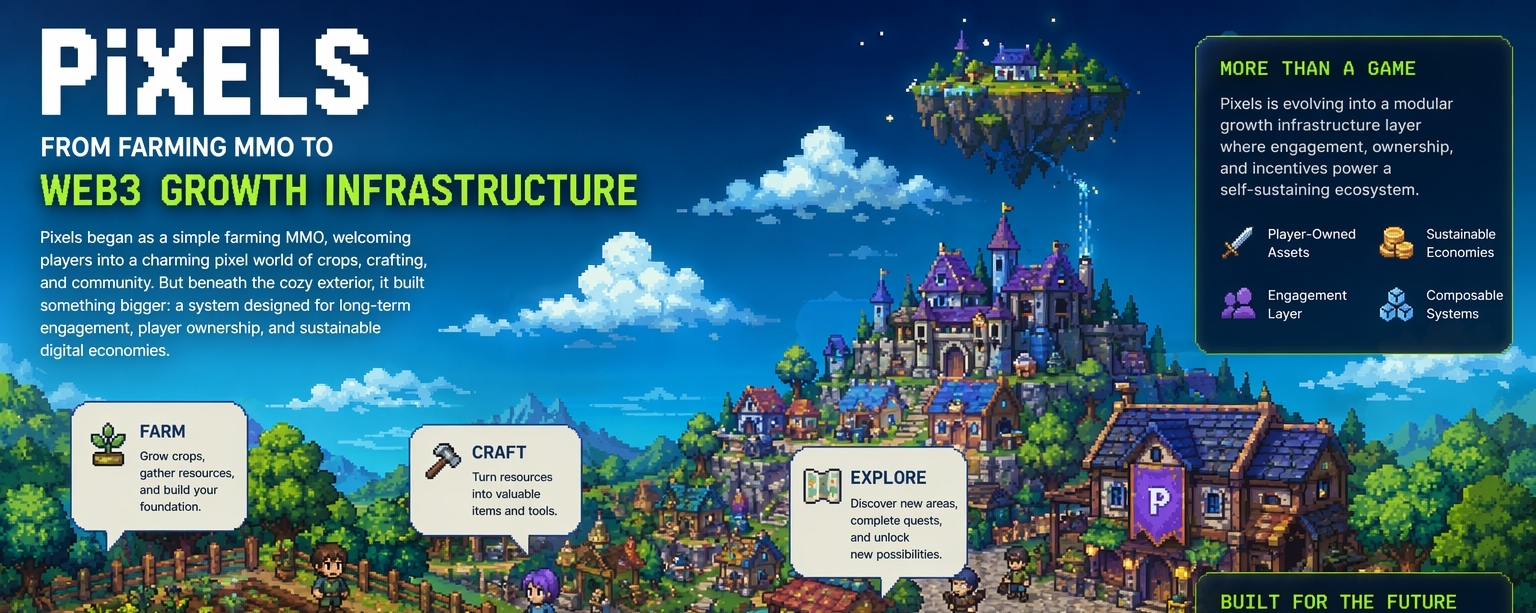
This is where a lot of surface-level takes on Pixels miss the plot. They keep describing it as a farming MMO, which is a bit like calling a city block a single storefront because that’s what you noticed first. The farming shell is still there, sure. But what Pixels has really been building is a system for retention, participation, and digital behavior. The game wasn’t just the product. It was the testing ground. A live environment where the team could watch how users respond to routine, scarcity, status, collaboration, and reward pacing.
That is much more valuable than a cute art style.
Because once you understand how to get users to come back consistently, you’ve moved beyond game design in the narrow sense. You’re operating in a different category now. You’re not just asking, “Is this fun?” You’re asking, “What keeps a person invested long after novelty wears off?” That second question is harder. It’s uglier, too. Less glamorous. But it’s where durable products are made.
And Web3, frankly, has been starved of durable products.
Too many projects built for the screenshot. Big launch, loud community, token event, optimistic thread, then the slow drift into irrelevance. You could almost set your watch by it. The problem was never only bad economics. The deeper problem was that most of those projects never built a world people actually wanted to inhabit when the incentives became less exciting. Once the sugar rush wore off, there wasn’t much left.
Pixels avoided some of that by building on routine instead of spectacle.
That doesn’t mean it escaped every familiar problem. It didn’t. Any project with a tokenized economy has to wrestle with the same structural tension: how do you keep rewards meaningful without letting rewards become the only reason anyone is there? That’s not a design footnote. Ignore it, and the world starts to feel like contract work in costume. Users may stay for a while, but their relationship with the project changes. They stop exploring. Stop identifying with the space. Stop caring beyond yield. At that point, the game is technically alive and spiritually dead.
Pixels has spent part of its evolution trying not to fall into that hole.
You can see it in the way the project has gradually shifted from being understood as “the place where you farm” to being something more layered: a space where progression, social coordination, and digital ownership interact as part of a broader system. That broader system is the real story. The visible gameplay is only the most legible part of it.
And here’s where it gets interesting.
Once a project learns how to shape user behavior inside one world, it doesn’t stay confined to that world for long. It starts asking bigger questions. How do you keep players active over time? How do you design rewards without draining the experience of its spontaneity? How do you turn casual users into repeat participants? How do you create systems that feel alive rather than managed? Those are not just game design questions anymore. Those are infrastructure questions disguised as creative ones.
That’s what Pixels has been edging toward.
It increasingly feels less like a single game project and more like a growth system built through gameplay. A place where engagement mechanics are not accidental byproducts, but the thing being refined, sharpened, and eventually generalized. The farming world becomes the wrapper. The deeper product is the machinery of return: how users progress, how they form attachment, how they coordinate, how they respond to incentives, how they accumulate meaning over time inside a digital environment.
That may sound abstract until you consider the alternative. If a project never develops that machinery, it remains fragile. Every content update has to overperform. Every campaign has to create fresh excitement. Every lull becomes a threat. But if a project has built a strong engine for recurrence, it can survive quieter periods because users don’t need to be seduced from scratch every time. They already belong.
Belonging is a stronger moat than hype. Always has been.
Pixels also benefited from something many technically ambitious projects still underestimate: it never felt like it was trying too hard to impress you. That lightness was strategic, even if it didn’t look like strategy. People are far more willing to enter a world that feels approachable than one that immediately demands ideological commitment. Nobody wants homework at the point of entry. They want a reason to care first. Pixels offered that reason through atmosphere and rhythm, not through lectures about the future of ownership.
Smart move.
Because once users cared, the project had permission to become more ambitious.
And ambition is clearly part of the story now. You can feel it in the way Pixels has stretched beyond its original identity. It no longer reads like a neat little farming title with a token bolted on. It reads like a project trying to understand how digital worlds can function as engines of sustained participation. Not one-off excitement. Not a speculative spike. Sustained participation. The difference between those two things is the difference between a pop-up stall and an actual town square.
One disappears when the event ends.
The other changes how people move.
Pixels has been inching toward that second category.
Of course, there’s risk in that evolution. There always is. The more systematized a project becomes, the easier it is to squeeze the warmth out of it. And warmth matters here. Maybe more than the charts crowd likes to admit. A world like Pixels works because it feels gentle enough to live in. Not grand. Not militarized. Not obsessed with proving its own sophistication every five minutes. If the deeper economic and behavioral systems become too visible, that softness could vanish. Then the whole thing starts to feel like a beautifully drawn spreadsheet.
That’s the danger.
Because once users sense that every path has been engineered primarily for optimization, they stop relaxing into the space. They become self-conscious. Transactional. They start seeing the rails beneath the ride. And when that happens, you don’t just lose charm. You lose trust. The world no longer feels like a place. It feels like a funnel.
Pixels still has to avoid that outcome.
It has to keep the human texture intact while building more serious structure underneath. That’s not easy. In fact, it’s one of the hardest balancing acts in digital product design. You need enough system to create durability, but not so much that the user feels processed. You need progression, but not suffocation. You need incentives, but not the kind that turn every action into labor. You need attachment that feels earned, not engineered.
Get that wrong, and the consequences show up fast. The user may not write an essay about it. They’ll just stop coming back.
That’s what makes Pixels worth watching. Not because it’s flawless, and not because it invented farming mechanics or online ownership or social progression. It didn’t. What makes it compelling is that it seems to grasp where the real battle is. Not at the level of slogans. At the level of behavior. It understands that digital worlds live or die on the quality of return. Whether people re-enter willingly. Whether the place still feels inhabited after the novelty has worn off. Whether a user’s relationship with the project deepens or flattens over time.
Those are adult questions. Serious ones. The kind teams usually confront only after the easy growth phase ends.
Pixels appears to have been building around them all along.
So yes, on the surface, it’s still a farming MMO. That part hasn’t vanished. The crops are still there. The land is still there. The approachable, almost disarming presentation is still part of its identity. But that description no longer carries the full weight of what the project has become. The farm is the visible metaphor. The real build sits underneath it: a model for how digital spaces can convert light engagement into habit, habit into attachment, and attachment into something much more durable than momentary attention.
That’s why reducing Pixels to its aesthetic misses the point.
The art style gets you in the door.
The real architecture is what keeps the lights on.
And maybe that’s the most telling thing about the whole project. It never needed to look intimidating to become structurally ambitious. It never needed to shout to become significant. It simply kept learning from the people inside it—how they moved, what they valued, why they returned—and then it kept rebuilding itself around those answers.
That’s not a small evolution.
That’s a project figuring out what it actually is.