

I’ll be honest with you guys.
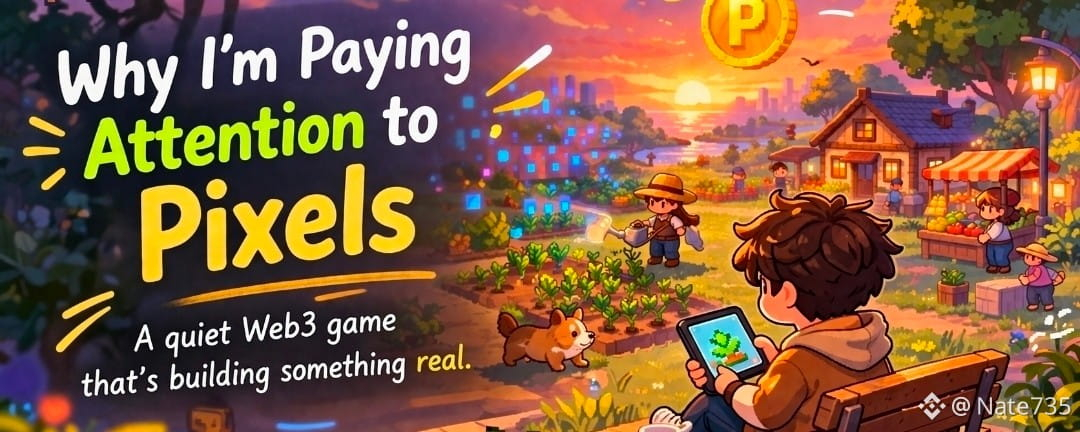
When I first stepped into Pixels, I wasn’t expecting much. It didn’t hit me with that usual “this is going to be massive” feeling that most Web3 games try to create right away. No flashy promises, no aggressive rewards popping up every second. It actually felt… quiet.
And strangely, that’s what made me stay.
The experience didn’t try to pull me in forcefully. It just let things unfold at its own pace. You start small, doing basic things like farming, gathering, moving around. Nothing revolutionary on paper. We’ve all seen these mechanics before in traditional games.
But the difference here is subtle.
It doesn’t constantly remind you that you’re earning. It doesn’t push the “on-chain” narrative in your face every minute. And because of that, you stop thinking like a farmer of rewards… and start behaving more like an actual player.
If you’ve been around Web3 gaming for a while, you already know the usual cycle. A game launches, incentives attract a wave of users, everyone rushes in for rewards, and then activity drops when those rewards slow down. It’s not always bad design, it’s just how most of these systems were built.
Pixels feels like it’s trying something different.
Instead of building around the token first, it feels like the focus is on the experience itself. The economy is still there, but it sits quietly in the background. And that small shift changes how you approach everything.
You don’t log in thinking “what can I extract today?” You log in thinking “what should I build next?”
That’s a big difference.
The pacing plays a huge role here too. At first, it might feel slow especially if you’re used to fast reward loops. But over time, that slower rhythm creates consistency. You’re not being rushed, and you’re not being pressured. It just becomes something you come back to naturally.
And honestly, that kind of retention is much harder to build than hype.
Another thing I noticed is how smoothly the blockchain side is integrated. Ownership exists, trading exists, but it doesn’t feel overwhelming. You’re not constantly dealing with wallets or thinking about fees every step of the way.
For most players, that matters more than we think.
Because people don’t stay in games for the tech. They stay because the experience feels good.
Now, let’s be real there are still challenges.
The economy is always the hardest part to balance. Rewards tied to activity sound great, but they need constant adjustment. Too much, and you get inflation. Too little, and people lose interest. That balance isn’t static it evolves, and Pixels will have to keep adapting.
There’s also the bigger question that I keep thinking about:
If you remove the earning part completely… does the game still hold up?
Right now, it feels like it’s somewhere in between. The simplicity is relaxing, but some players might eventually look for deeper systems. How the team expands from here without losing that simplicity will be key.
The social layer is another interesting piece. Interacting with others, visiting spaces, trading it adds life to what could otherwise feel repetitive. It’s not overly structured, which makes it feel more natural, but that also means it needs to grow carefully over time.
If I zoom out and look at the bigger picture, Pixels doesn’t feel like it’s chasing hype.
It feels like a quiet experiment.
An attempt to answer a simple but important question:
Can a Web3 game keep people coming back without constantly pushing rewards?
And honestly, that’s a much harder problem to solve than just attracting users.
There are risks, of course. Token behavior, market conditions, external factors all of that will always play a role. But beyond all of that, the real test is simple.
Will people still log in when the excitement fades?
Because if they do not for rewards, but because they actually enjoy being there then Pixels might be onto something that most projects in this space haven’t figured out yet.