
I have spent a lot of time looking at blockchain games, and honestly, most of them feel like ticking clocks. You see the exact same pattern play out constantly. A project launches, the token spikes on early hype, players rush to extract value, and the economy bleeds out because there is no sustainable sink. The play-to-earn death spiral is so predictable that I approach any new gaming token with immediate skepticism. If a game relies solely on continuous new user growth to pay old users, it is just a temporary transfer of wealth. For a long time, I assumed Pixels would face the exact same fate as just another farming game. But my perspective started shifting when I stopped looking at the game itself and started digging into the infrastructure they were building quietly in the background, specifically the Stacked ecosystem.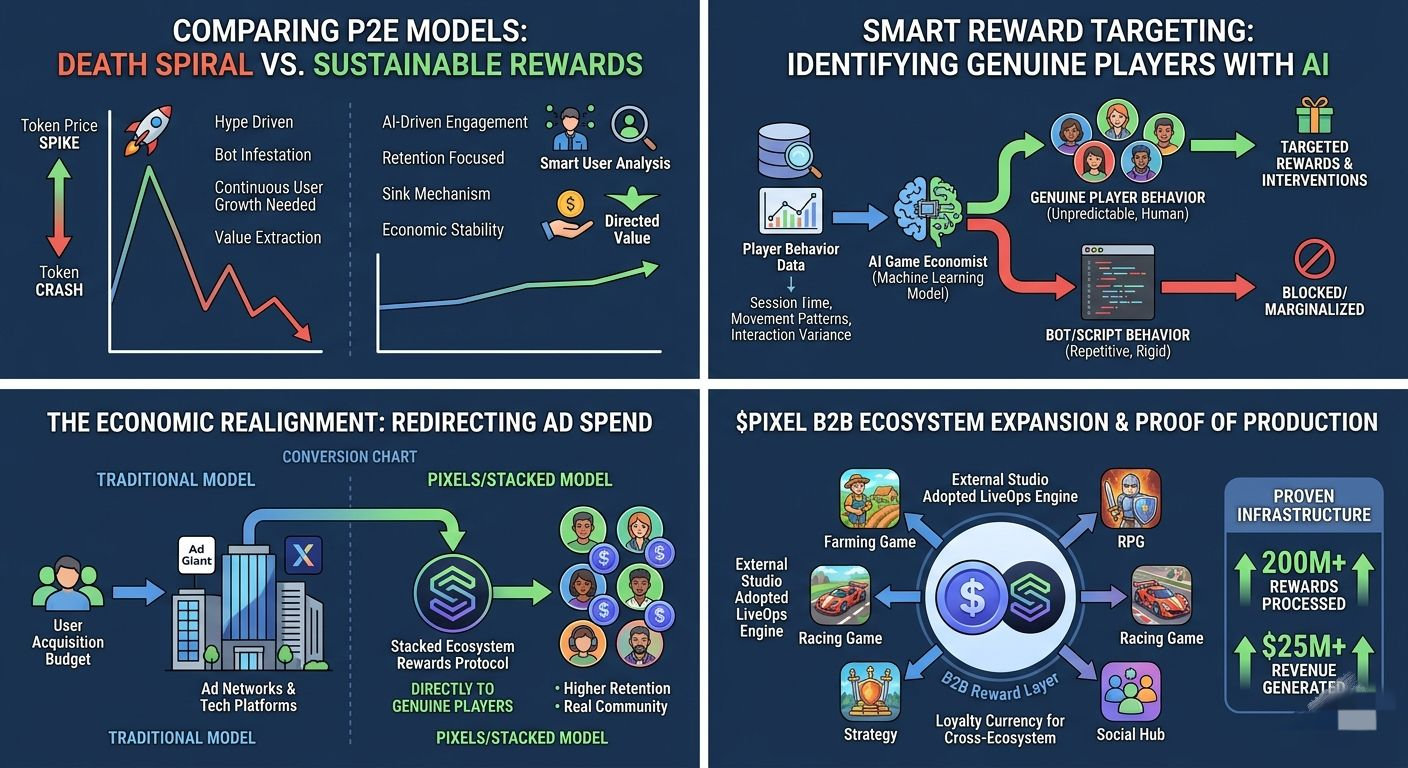
What caught my attention was the underlying mechanics of how they are trying to solve token inflation and user retention. If you have ever tried to manage a reward pool, you know the friction of rewarding the right player without attracting bots that drain your treasury. That is where the Stacked LiveOps engine attempts to answer a very difficult question regarding how smart reward targeting actually uses machine learning to identify genuine players. Instead of handing out tokens to anyone who clicks, the system uses an AI Game Economist to analyze player cohorts and behavioral patterns. It looks at how a player moves, the variance in session times, and interaction habits. Machine learning separates the rigid, repetitive actions of a script from the messy, unpredictable behavior of a real human. Once it isolates genuine players, it figures out exactly why people drop off. The AI finds the friction point where a player usually quits and suggests highly targeted interventions. It might trigger a specific reward just before that expected drop-off point. It is a concrete approach to giving real value for actual engagement, rather than subsidizing spam accounts.
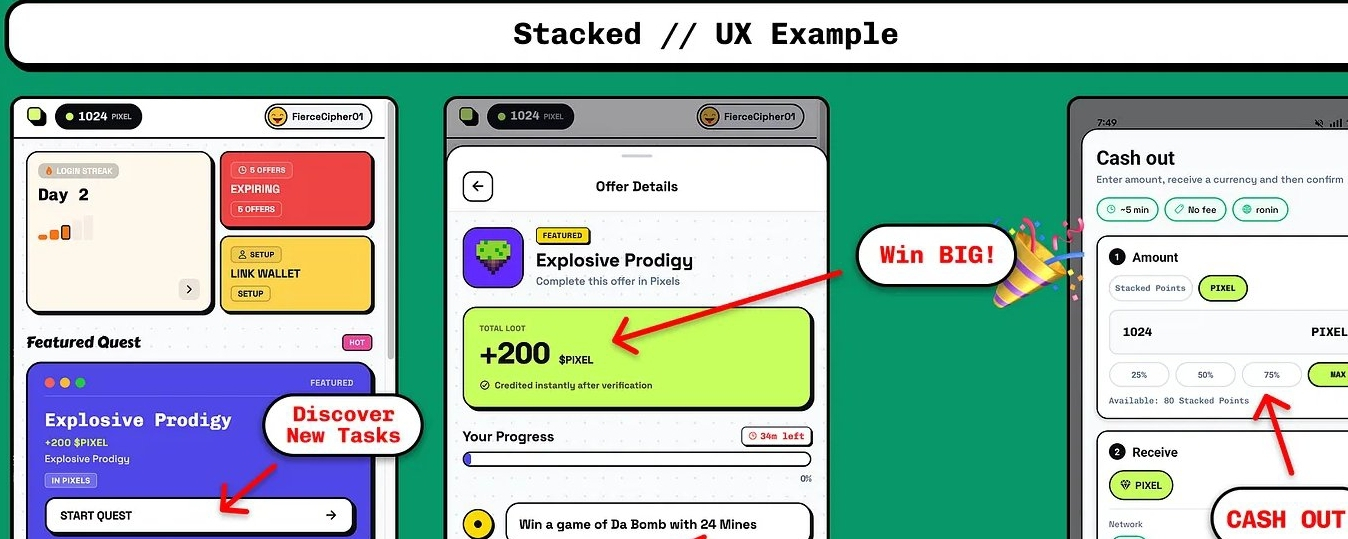
Seeing this operate made me rethink how user acquisition budgets are usually spent. In traditional mobile gaming, studios throw millions of dollars at ad networks every single month just to acquire users who might play for three days and leave. That money goes entirely to the tech platforms hosting the advertisements. What Stacked is trying to do is take that traditional ad spend and redirect it directly into the pockets of the players themselves. If you are a genuine player adding value to the ecosystem, the acquisition budget is paid out to you directly as a reward for your time. This is a fundamental shift in gaming economies, and economically, it makes a lot of sense. You are paying the people who actually populate your world, which inherently creates a stronger, more resilient community.
But I am realistic about the limitations here. This infrastructure is not a magic fix for bad game design. Balancing virtual economies is notoriously difficult, and automated reward targeting adds a whole new layer of complexity. If external game studios adopt these AI tools but configure them incorrectly, or misunderstand their own player lifecycles, their economies will still bleed out. An AI can suggest the optimal time to drop a reward, but if the game is fundamentally boring, players will simply take the reward and leave. The tools only amplify what is already there. If the core loop is deeply flawed, no amount of machine learning saves it.
Despite those reservations, the broader implications make this interesting right now. We are watching the asset transition from a single-game currency into a business-to-business cross-ecosystem loyalty layer. If Stacked becomes the go-to infrastructure for other Web3 games to manage their LiveOps, the survival of the currency is no longer tied strictly to the daily active user count of the original game. It becomes a utility token for a broader network of external studios. And unlike projects that sell promises on a whitepaper, this system is actually live. The fact that they have already processed over two hundred million rewards and generated upwards of twenty-five million dollars in revenue proves this is being built in production. That real-world friction provides data you cannot simulate in a lab.
My approach going forward is just to observe how this plays out over the medium term. The real test is not in the documentation, but whether external studios actually adopt this LiveOps engine and see a measurable, sustained improvement in their own player lifetime value over a multi-month period. I want to carefully watch if the anti-bot architecture holds up at scale when third-party games plug into the network and bring their own completely unique vulnerabilities.
Ultimately, the space is full of theories about fixing the broken play-to-earn model, but very few teams put live infrastructure into the hands of users to see what breaks. The transition to an AI-driven, rewarded ecosystem is complex and will undoubtedly face hurdles. But it is a much more thoughtful attempt at building a sustainable digital economy than simply hoping new players keep buying the bags of the old ones. It comes down to real usage and hard data. An economy built in production, responding to actual human behavior, is always more compelling to me than an idealized concept waiting to be built.